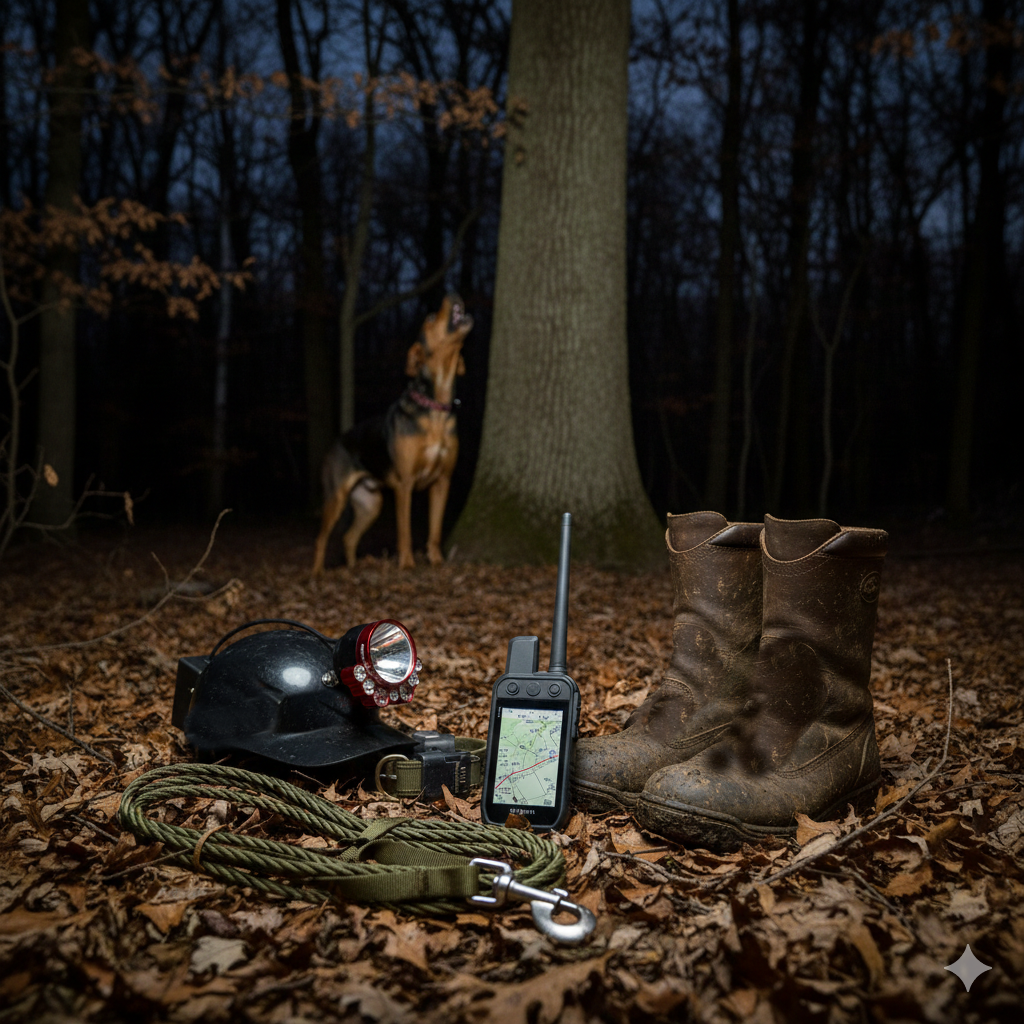
The Top 10 Essential Gear Items for Coon Hunting (What Actually Matters at
Night)
When it comes to night hunting with hounds, having the essential coon hunting gear isn’t optional, it’s the difference between a smooth hunt and a long, frustrating night. Look, I’ve been chasing coons for over three decades now, and I’ve learned one thing the hard way: when you’re hunting at night with hounds, your gear isn’t just nice to have. It’s the difference between a successful hunt and a disaster that ends with you stumbling through the dark, wondering where your dog went and why you ever thought this was a good idea.
There’s a massive gap between what sounds good in a catalog and what actually performs when you’re two miles into timber at midnight with the temperature dropping. I’ve watched plenty of hunters show up with all the wrong stuff, and I’ve made my own share of expensive mistakes. This isn’t about having the fanciest equipment or keeping up with every trend that pops up online. It’s about understanding what gear do I need for coon hunting at night, and more importantly, what happens when that gear fails.
This list isn’t sponsored hype or catalog copy. It’s based on what experienced hunters actually use, what they argue about in online groups and parking lots, and what they replace immediately when it breaks. I’ve pulled insights from years of watching what works, what gets complained about, and what shows up in every single successful night hunt. Whether you’re hunting for pleasure or running competition casts, some gear is just non-negotiable.
How This List Was Built
Before we get into the actual gear, I want to explain where this information comes from, because not all hunting advice is created equal. I’ve spent years watching what hunters use in the field, reading through hundreds of discussion threads where people share their failures and successes, and paying attention to what shows up in every single night hunt photo or video. You start to see patterns.
Competition hunters have different priorities than pleasure hunters. Someone running dogs solo has different needs than a guy who hunts with a group every weekend. Terrain matters too. What works in flat hardwoods might be completely wrong for swampy bottomland or steep hill country. I’ve tried to account for all of that here.
The hunting community is pretty vocal about what works and what doesn’t. When someone’s GPS collar dies three hunts in a row, they’re going to talk about it. When a headlamp fails halfway through a cast, you hear about it. When boots fall apart or a knife won’t hold an edge, that information spreads fast. I’ve been listening to those conversations for years, and I’ve had most of these failures happen to me personally.
This list focuses on night coon hunting gear that actually matters, the stuff that separates a good hunt from a frustrating one. Let’s get into it.
The Top 10 Essential Coon Hunting Gear Items
1. A Reliable Tracking System
This is number one for a reason. Without a dependable GPS tracking system, everything else on this list becomes optional because you’re not going to be hunting long. I don’t care how well you think you know your dogs or how good your hearing is. At night, in thick cover, you need to know where your hounds are.
The shift from old-style telemetry to GPS tracking changed coon hunting completely. Telemetry could tell you a direction and maybe a distance if you were lucky. GPS tells you exactly where your dog is, whether he’s moving or treed, and lets you navigate directly to him. The technology has gotten good enough that most serious hunters won’t even consider the old systems anymore.
Battery life is the complaint I hear most often in online discussions. You’re out there for hours, sometimes all night, and the last thing you need is your tracking system dying with a dog treed a mile away. Look for systems that give you at least 20 hours of runtime, and pay attention to how temperature affects battery performance. Cold kills batteries faster than anything.
Signal loss is the other big issue. Dense timber, deep hollows, and certain types of terrain can interfere with GPS signals. The better systems handle this more gracefully, maintaining the last known position and reconnecting quickly when the signal returns. Cheaper systems just lose the dog entirely until you get line of sight again.
When you’re shopping for GPS trackers for coon hunting dogs, think about how you hunt. If you run dogs that range wide, you need a system with serious reach. If your dogs work closer, you might get away with something more basic. Either way, this is not the place to cheap out. A quality tracking system from a reputable manufacturer is the foundation of everything else you do.
2. A High-Quality Coonlight for Night Hunting
Every single night hunt photo or video you’ve ever seen has one thing in common: a coonlight. It’s always there, strapped to someone’s head, lighting up the woods. There’s a reason for that. You need both hands free when you’re hunting with hounds, and you need light you can count on.
Here’s where most people get it wrong. They focus on lumens, thinking bigger numbers mean better light. What actually matters is beam pattern. A coonlight with 1000 lumens and a terrible beam pattern is worse than 500 lumens with a well-designed spot and flood combination. You need distance to see where you’re walking and where your dog might be, but you also need peripheral light so you don’t trip over every root and rock.
Some hunters swear by red or green lights for preserving night vision. The theory makes sense, and there are situations where it helps. Personally, I’ve found that once you need serious light to navigate or find a treed dog, you’re going to use white light anyway. But having the option doesn’t hurt, especially if you’re trying to stay low-key approaching a tree.
The mounting system matters more than people realize. Helmet-mounted lights stay put better if you’re moving through brush, but not everyone wants to wear a helmet. A good headband system works fine as long as it’s adjustable and doesn’t slip when you sweat or when you’re looking up at a tree. Some of the best coonlights for night hunting with hounds use a battery pack that sits on the back of your head, balancing the weight.
I can’t tell you how many times I’ve seen someone show up with a cheap coonlight that dies halfway through the hunt. Battery life matters just as much here as it does with your tracking system. Look for something that gives you at least 8 to 10 hours on a medium setting, and carry backup batteries. When your light dies at 2 a.m., and you’re half a mile from the truck, you’ll understand why this made the list.
3. A Dependable Lead and Tie-Out Setup
This is one of those things that doesn’t seem critical until you have a wreck, and then suddenly it becomes the most important piece of gear you own. A solid lead and tie-out setup keeps your dogs safe and under control, whether you’re loading at the truck or securing them at a tree.
The weak point in cheap leads is always the snap. I’ve seen snaps break, bend open, or just fail to close properly, and every single time it causes problems. When you’re trying to control an excited coonhound in the dark, you need hardware you can trust. Look for brass or stainless steel snaps with a positive locking mechanism, and check them regularly for wear.
Competition hunters are particularly obsessive about leads, and for good reason. When you’re handling multiple dogs in high-pressure situations, your equipment needs to be absolutely reliable. Even if you’re just hunting for pleasure, the same principle applies. A dog that breaks loose at the wrong time can ruin a hunt or worse.
Tie-out safety is something people don’t think about until it goes wrong. You need a system that keeps your dog secure at the tree but doesn’t create a tangling or choking hazard. The length matters, the attachment point matters, and the strength of every component matters. I’ve seen too many close calls from people using gear that wasn’t up to the task.
4. Tough Boots Built for Your Terrain
Your feet take an absolute beating during a coon hunt. You’re walking miles in the dark over terrain you can’t see clearly, through water, mud, briars, and whatever else the woods throw at you. The wrong boots will make you miserable, and I’ve seen plenty of hunters cut trips short because their feet were destroyed.
Snake protection is a consideration depending on where you hunt, though I’m keeping this broad since terrain varies so much. What matters everywhere is ankle support, because you’re going to step in holes, on uneven ground, and over obstacles you can’t see. A turned ankle ends your hunt immediately.
The waterproof versus breathable tradeoff is real. Fully waterproof boots keep your feet dry when you’re crossing creeks or walking through wet bottomland, but they don’t breathe well and your feet can get sweaty and uncomfortable. Breathable boots are more comfortable for long hunts in dry conditions, but the first time you step in water, you’re done. Think about where you hunt most often and choose accordingly.
What I can tell you for certain is that comfortable walking boots or general purpose hiking boots don’t cut it for serious coon hunting. You need something built for the specific demands of moving through rough terrain at night, often for hours at a time. The boots need to be tough enough to handle briars and brush, supportive enough to prevent injury, and durable enough to last more than one season.
Online forums are full of regret posts from hunters who tried to save money on boots and paid for it with foot injuries, blisters, or boots that fell apart after a few hunts. This is one area where the right recommendations for coon hunting boots make a huge difference in your experience.
5. A Well-Built Hunting Vest or Pack
At 2 a.m., when you need something specific, the last thing you want is to be digging through a poorly organized pack or wishing you’d brought better gear. A quality hunting vest or pack designed for night hunting makes everything easier.
Think about what you actually carry on a hunt. Shotgun shells if you’re carrying a gun. Hunting tags and licenses. Your GPS handheld unit. Water and snacks for a long night. Maybe a backup battery, a first aid kit, an extra collar, or any number of other items, depending on how you hunt. All of that needs to be organized and accessible in the dark.
Pocket placement and design separate good vests from bad ones. You want easy access to the things you need frequently, with secure storage for items that need to stay put when you’re moving through brush. Some hunters prefer a minimalist setup with just the essentials. Others like to carry more gear and be prepared for anything. Neither approach is wrong, but your vest or pack needs to match your style.
Durability matters because this gear takes abuse. It’s getting scraped against trees, snagged on briars, and generally subjected to rough treatment every time you hunt. Cheap materials and poor stitching will fail. Look for heavy-duty fabrics, reinforced stress points, and quality zippers or fasteners.
6. Quality GPS-Compatible Dog Collars
The collar on your dog is different from the handheld tracking unit, but it’s just as important. This is what actually goes on the dog, and it needs to survive everything your hound can throw at it.
Durability is the number one concern. Dogs hit fences at full speed. They go through water, briars, and brush that would shred lesser equipment. They roll, they dig, they do everything possible to test the limits of their collars. The housing needs to be waterproof and impact-resistant, and the strap needs to stay secure without being so tight it’s uncomfortable.
Battery anxiety during long hunts is real. You check the handheld and see your dog’s collar is at 20% battery with hours left to hunt. It’s a terrible feeling. Better collars give you longer runtime and more accurate battery indicators, so you’re not guessing. Some systems let you swap batteries in the field, which is a nice feature if you’re doing all-night hunts or running multiple casts.
The range expectations matter, and this ties back to your tracking system. Your collar and handheld need to communicate reliably at whatever distance your dogs typically run. This is where cheap systems fall apart. They might work fine when the dog is close, but lose signal when he ranges out. For serious hunting with hounds gear, you need components that work together reliably.
7. A Trustworthy Knife or Multi-Tool
I’m not going to dramatize this, but there are emergencies in coon hunting that require a good knife, and they’re emergencies you need to be ready for. Dogs get tangled in fences or caught on obstacles. Leads need to be cut quickly in certain situations. There are practical, real-world reasons to carry a quality blade.
One-handed access is critical. When you’re holding a dog or dealing with a situation that requires both hands, you need to be able to get to your knife quickly and open it safely. Fixed blades are reliable but can be awkward to carry. Folding knives with good one-handed opening mechanisms are popular for a reason.
Beyond emergencies, you use a knife for all sorts of small tasks during a hunt. A multi-tool adds usefulness with pliers, screwdrivers, and other implements that come in handy. Whatever you choose, it needs to hold an edge and be reliable. This isn’t the place for a cheap gas station knife that will break when you actually need it.
8. Weather-Appropriate Clothing
There’s often a disconnect between what looks good in photos online and what actually works in the woods. Clothing is a perfect example. The right layers matter more than brand names, and understanding how to dress for night hunting will keep you comfortable and effective.
Cotton fails in cold or wet conditions. It absorbs moisture, loses insulation value, and can actually make you colder once it’s wet. Base layers made from synthetic or merino wool materials wick moisture away and maintain warmth even when damp. This is basic outdoor knowledge, but you’d be surprised how many hunters still make this mistake.
Quiet fabrics versus noisy synthetics is another consideration. Some modern materials are fantastic for warmth and moisture management, but sound like a garbage bag when you move. If you’re trying to approach quietly or listen for your dogs, that matters. Look for clothing designed for hunting that balances performance with noise reduction.
Cold weather mistakes beginners make usually involve either wearing too much or too little. You’re going to be moving, often a lot, which generates heat. If you overdress, you’ll sweat and then get cold when you stop. The solution is layers you can add or remove as needed. A good base layer, an insulating mid-layer, and a wind and water-resistant outer layer give you flexibility.
For coon hunting tips and gear recommendations, this is one area where experience really teaches you what works for your body and your hunting style. Pay attention to how you regulate temperature during a hunt and adjust accordingly.
9. A Coon Squaller
A coon squaller is one of those tools that separates experienced hunters from beginners, and it’s something you’ll appreciate more the longer you hunt. This is a mouth-blown call that mimics the sound of a distressed animal, and its main purpose is getting a coon to move once you’ve got him treed.
Here’s the situation every coon hunter faces regularly: your dog has a coon treed, you get to the tree, and you’re shining your light up trying to locate him. Sometimes that coon just sits there, absolutely motionless, blending into the bark and branches. You can look for ten minutes and not see him, even though you know he’s up there somewhere. That’s where a squaller earns its place in your vest.
When you use a squaller at the tree, the sound makes the coon move. He might shift position, turn his head, or change his posture just enough that your light catches his eyes or you see movement. That’s all you need. Once he moves, you can locate him and finish the hunt instead of standing there frustrated, knowing he’s up there but unable to spot him.
The technique matters more than most people realize. Don’t blow a squaller in a steady rhythm or cadence. That sounds unnatural, and coons wise up to it quickly. You want erratic, irregular sounds that mimic actual distress. Vary the pitch, the length of the calls, and the spacing between them. Make it sound chaotic and real, not like a pattern.
This becomes especially important with educated coons. A coon that’s been treed a few times gets smart about staying still when lights hit the tree. He knows the routine, and he’s not going to give himself away by moving just because you’re shining a light around. These experienced coons will sit there like a knot on a log until you give them a reason to react. A good squaller call often provides that reason.
Mouth-blown squallers are simple, reliable, and don’t require batteries or electronics that can fail. They’re small enough to keep in your pocket or hang around your neck, and they work every single time you need them. There’s no learning curve with technology, just the technique of making realistic sounds.
Not every treed coon requires a squaller. Plenty of times, you’ll get to the tree and spot the coon right away. But when you need it, you really need it. Standing at a tree for twenty minutes, knowing there’s a coon up there but unable to locate him, is one of the most frustrating experiences in coon hunting. A squaller solves that problem more often than not, and for the small investment and minimal space it takes up, there’s no reason not to carry one.
10. A Reliable Compass
Even though modern GPS tracking systems have changed coon hunting completely, there’s one piece of old-school gear that still deserves a spot in your kit: a quality compass. Electronics fail, and when they do at 2 a.m. in unfamiliar timber, you need a backup that doesn’t depend on batteries or satellites.
I’ve seen it happen more times than I care to count. A GPS unit takes a hard hit and the screen cracks. Batteries die faster than expected in cold weather. You drop your handheld crossing a creek and it’s done. Software glitches, signal loss in deep hollows, or just plain equipment failure can leave you without the technology you’ve come to depend on. When that happens, a compass becomes the most important piece of gear you own.
The beauty of a compass is its simplicity. No batteries to die, no signals to lose, no screens to crack. It works the same way every single time, regardless of weather, temperature, or how rough you are on your gear. A quality compass is nearly indestructible and will outlast any electronic device you own.
Knowing how to use a compass is just as important as carrying one. If you’ve never navigated with a compass and map, take the time to learn before you need it in an emergency. The basics aren’t complicated, but they’re skills you need to practice. Understanding how to take a bearing, follow it, and navigate back to a known point could make the difference between walking out confidently and wandering around lost.
I prefer a compass that’s easy to read in low light conditions, with luminous markings that glow after being exposed to your coonlight. A baseplate compass works well because it’s designed for navigation and map work. Some hunters like a button compass they can keep on a zipper pull or attached to their vest, but I’ve never really cared for those. I find them to be unreliable at best.
The compass doesn’t need to be expensive or fancy. A basic, quality compass from a reputable manufacturer will do everything you need. What matters is having it with you and knowing how to use it. Keep it somewhere you won’t lose it, protected from impacts that might affect its accuracy.
Think of your compass as insurance against technology failure. You might hunt for years and never need it because your GPS works perfectly every time. But the one night your electronics fail, and you’re miles from the truck in country you don’t know well, that compass becomes priceless. It’s the kind of gear you carry hoping you never need, but you’re incredibly glad to have when the situation demands it.
This is old-school knowledge that still matters. The hunters who’ve been doing this long enough have all had experiences where technology let them down. They’ve learned to respect backup systems and traditional skills. A compass represents both of those things, and it takes up almost no space in your vest or pack.
Buying Advice by Hunt Style
The gear you need depends somewhat on how you hunt, so here’s some specific guidance based on different approaches.
For the Pleasure Hunter: Focus on reliability and comfort. You’re out there to enjoy the experience, so prioritize gear that works consistently and doesn’t create frustration. A good GPS tracking system, a reliable coonlight, and comfortable boots will serve you well. You can skip some of the competition-level features and focus on quality basics.
For the Competition Hunter: You need gear that performs under pressure and won’t let you down when it matters. Invest in top-tier tracking systems with the best range and reliability. Carry backups for critical items. Your leads and collars take more abuse in competition settings, so durability becomes even more important. Time matters in competition, so anything that makes you more efficient is worth considering.
For the New Hunter: Start with the essentials and buy quality where it matters most. Your tracking system and coonlight should be good ones from the start because cheap versions will frustrate you and cost more in the long run when you replace them. For other items, you can start with mid-range gear and upgrade as you learn what you actually need. Talk to experienced hunters in your area about what works in your specific terrain and conditions.
For the Veteran: You already know what you like and what works for you. At this point, you’re probably replacing worn-out gear with updated versions or trying new technology as it becomes available. Focus on incremental improvements and keeping your backup gear current. Your experience lets you make smart decisions about where to invest and where to save.
Final Thoughts
Here’s the honest truth about coon hunting gear: it won’t make a bad dog good. No amount of expensive equipment will fix a poorly trained hound or make up for a lack of experience. But bad gear can absolutely ruin a good hunt, and inadequate equipment can turn a successful night into a frustrating disaster.
The key is understanding what to bring on a coon hunt and investing where failure hurts most. Your tracking system and coonlight are non-negotiable. Good boots and appropriate clothing keep you comfortable and safe. Quality collars, leads, and backup gear prevent problems before they happen. Everything else on this list serves a real purpose based on decades of hunters learning what works through trial and error.
When you’re putting together your essential coon hunting supplies, think about the conditions you hunt in most often, how you hunt, and what failures would cause the biggest problems. Then build your kit around preventing those failures. It’s smarter to invest in quality gear upfront than to replace cheap equipment repeatedly.
This list represents what experienced hunters actually use and trust, not what looks good in a catalog or sounds impressive online. These are the items that show up consistently in successful hunts, that get recommended in online discussions, and that veterans replace immediately when they wear out.
Buy once, cry once, especially at night. Quality gear costs more upfront but saves money and frustration in the long run. When you’re deep in the woods at midnight with your dog treed and everything working the way it should, you’ll understand why the right equipment matters so much.
Get out there, invest in the gear that actually matters, and enjoy the hunt. There’s nothing quite like a successful night chasing coons with good dogs and equipment you can count on.
Starting a young coonhound? Get the free “First 30 Nights” guide before you make mistakes you can’t undo
Gear matters, but it won’t fix training mistakes.