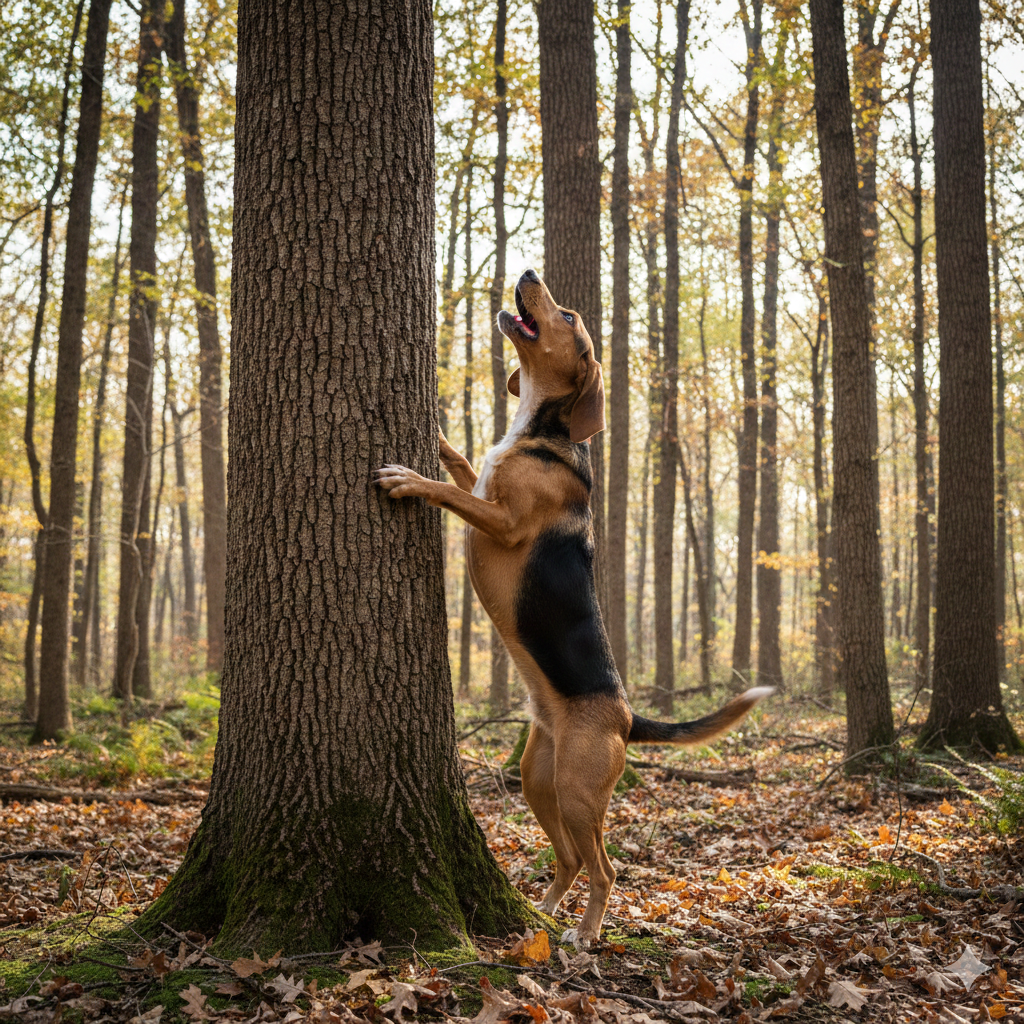
A young squirrel dog that trees a lot feels exciting.
He’s locating. He’s barking. He’s hitting trees fast. You barely get settled, and he’s already working another one.
At first, it looks like talent.
Then you start shining.
And you start noticing something.
There isn’t a squirrel there nearly as often as there should be.
If your young squirrel dog trees too much and isn’t accurate, you’re not looking at high drive. You’re looking at a dog learning to guess.
And guessing, once it becomes a habit, is hard to unwind.
What’s Actually Happening
When a young squirrel dog over-trees, one of two things is happening.
He is either:
- Treeing on old scent
- Treeing on expectation instead of confirmation
Young dogs love the act of treeing. It’s exciting. It brings you in. It creates interaction. It feels like success.
If treeing gets attention, and attention feels rewarding, the dog can start skipping steps.
Instead of finishing the track and confirming the end, he learns that “tree” ends the work.
That is not stubbornness. That is reinforcement.
And reinforcement builds patterns fast in young dogs.
Why It Happens
There are a few common reasons young squirrel dogs tree too much and lose accuracy.
- Treeing Has Been Rewarded More Than Tracking
If early hunts focused heavily on praising tree behavior, especially with cage work or easy setups, the dog may associate treeing itself with success. That works short-term. Long term, it can create a dog that values the act of treeing more than being right. Accuracy must be rewarded more than volume.
Some young dogs trail well but lack patience at the end. When scent thins out or shifts trees, instead of working through the problem, they commit to the first likely trunk. This is immaturity, not lack of ability. Track finishing is learned through repetition and exposure, not correction alone.
- He Is Hunting With Too Much Excitement
Young squirrel dogs fed off hype can start hunting with their head instead of their nose. They anticipate where the squirrel should be. They check obvious trees. They tree where squirrels were earlier. That looks like hustle. It is actually mental shortcutting.
- You Are Hunting Heavy Squirrel Areas
This one surprises people. In very thick squirrel woods, dogs can get sloppy because they are constantly around scent. Instead of isolating one track and finishing it clean, they bounce from tree to tree on residual odor. Without structure, accuracy suffers.
How to Fix It
Do not crush their tree drive trying to fix this. The goal is refinement, not suppression.
Step 1: Slow the Reward
If they tree and you do not see the squirrel, keep it neutral. No praise. No excitement. No petting up. Do not overcorrect unless you are certain it is a pattern of guessing. Neutral removes payoff.
Step 2: Hunt Him Alone
Accuracy problems get amplified in company. Young dogs will compete, anticipate, and shortcut when other dogs are around. Alone hunts tell you what he truly knows.
Step 3: Increase Track-Focused Hunts
Hunt edges. Transition lines. Lighter squirrel density. Make him work tracks fully instead of bouncing between obvious trees. This builds patience and confidence at the end of the trail.
Step 4: Reward Confirmed Accuracy Clearly
When he is right, be clear. Let him know that finishing correctly matters more than barking loud. Clarity builds understanding.
What Most Handlers Get Wrong
They think more treeing equals more progress. It doesn’t.
A young squirrel dog that trees ten times with three squirrels is not ahead of a dog that trees four times with three squirrels. Accuracy percentage matters.
Handlers also:
- Panic and overcorrect
- Compare to older finished dogs
- Assume every empty tree is defiance
- Ignore scent conditions
Every young dog goes through a phase where enthusiasm outruns discipline. The key is shaping it without breaking confidence.
When to Leave It Alone
If your dog meets most of these, you may not need heavy intervention:
- He is under a year old
- Accuracy is gradually improving
- Empty trees are decreasing over time
- He still shows strong track work
Young dogs learn by repetition. If the trend line is improving, stay patient.
If the percentage of empty trees is rising, or he is treeing every five minutes regardless of track quality, then tighten structure.
The Bigger Picture
Tree accuracy is built long before the tree itself. It starts with how you handle early tracks, early corrections, and early praise.
If you want a full breakdown of building a consistent, accurate daylight dog, read the complete squirrel dog training guide at /squirrel-dog-training/
Accuracy is not natural for every dog. It is shaped.
Final Word
A young squirrel dog that trees too much and isn’t accurate is not ruined. He is enthusiastic.
Your job is to channel that enthusiasm toward correctness. Protect his confidence. Reward the right trees. Stay neutral on the wrong ones. Only correct what you are certain of.
Volume impresses people.