A pup that runs big looks impressive on the tailgate. It doesn’t look so impressive when it’s a two-year-old that can’t stay on a track, won’t check back, and trees junk half the night.
Wide is not the same as good. Get that straight now. A big range without control is just a lost dog with stamina.
If your young coonhound is hunting too wide too soon, you’re not watching talent develop. You’re watching a bad habit get roots.
What “Too Wide” Actually Looks Like
You’re out on a cool October night. Ground’s damp, scent’s decent, and your eight-month-old pup has been gone for twenty minutes. No bark. No sound. You don’t even know what county it’s in.
Some guys hear that and grin. “That dog’s got a big nose, gonna be a big runner.”
Maybe. Or maybe that dog is just lost, bumping trash, and learning that the handler doesn’t matter.
Too wide means the dog is no longer hunting with you. It’s not building a track. It’s not working an area. It’s just gone. And every time you allow that, you teach it that distance matters more than method.
Why Handlers Let It Happen
Because a wide-running pup looks like talent. And honestly, some handlers just don’t want to put in the work of teaching a young dog to hunt with them.
It’s easier to turn it loose and hope.
But hope is not a training plan.
Young dogs learn what you allow. If a pup figures out that ranging 400 yards off and bumping every deer trail gets zero correction and zero consequence, it files that away. That becomes the dog’s idea of coonhunting.
You also get handlers who are scared to check a young dog. They think any correction is going to break the drive out of it. That’s a false choice. Drive and discipline are not opposites. The best dogs in the woods have both.
When a Young Coonhound Hunting Too Wide Becomes a Real Problem
Here’s where it gets real.
A dog that learned to hunt too wide too early will struggle to stay on a tight track. Coon scent in dry leaves on a November hillside is not the same as hot scent on a muddy creek bank. Tight tracking in tough conditions is a skill. It gets built in young dogs by working close enough to actually work scent.
Wide-running pups also develop check-back problems. They don’t look for the handler. They don’t associate the cast with a starting point. Come competition time or a hard hunting night, that dog is a liability.
And tree accuracy suffers. A dog that blows through a hunting area without methodically working it is going to miss trees. It’s going to overrun scent. It’s going to bark up trash or bark up nothing.
Now fast-forward to a January night. Frozen ground. Light north wind. Scent is low and tight. That same wide-running dog blows through a good section in four minutes flat, misses two workable tracks sitting right there in the leaves, and trees the first hot mess it stumbles into just to get treed. You’re standing there with a dog bawling up a hollow log at midnight, wondering where it all went wrong.
It went wrong eight months ago when you let it run wild and called it development.
Do This / Don’t Do That
Do This
Work young dogs in areas that naturally compress their range. Creek bottoms, field edges, timber with thick understory. Let the terrain do some of the teaching. A pup crashing through a briar thicket learns real quick to slow down and use its nose.
Start young dogs with an experienced, steady older dog that hunts at a reasonable range. Let the pup pattern off something that works correctly.
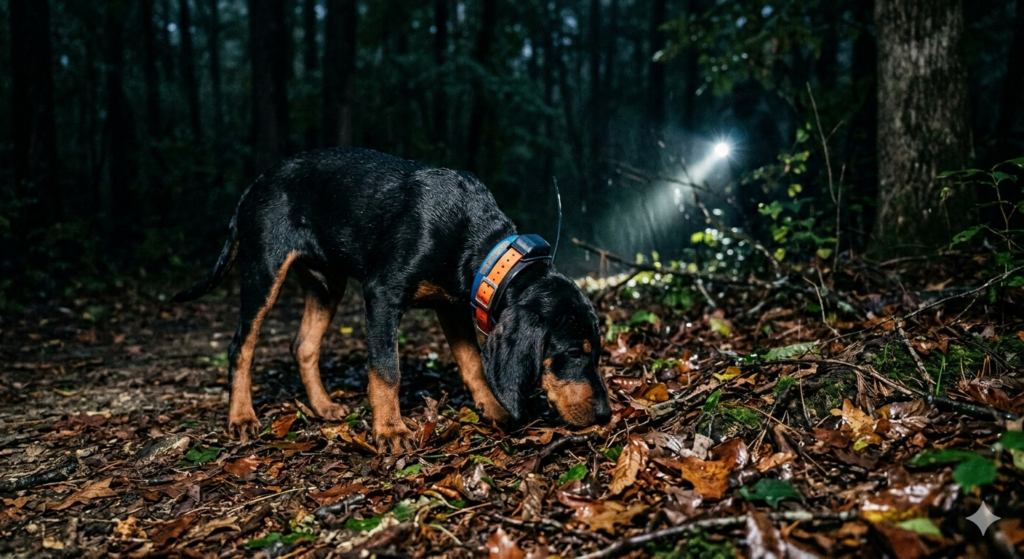
Use a GPS collar from the first hunt. Not to let the pup run wild and track it on a screen. Use it to know exactly when the dog is getting too far and call it back before the habit sets in.
Keep early hunts short. Forty-five minutes of quality hunting beats two hours of a pup wandering and learning nothing.
Reward the check-back. When a young dog circles back toward you on its own, that’s the behavior you want. Acknowledge it. Don’t just stand there.
Don’t Do That
Don’t brag about how far your pup is running at eight months. That is not the flex you think it is.
Don’t cast a young dog into a 500-acre clear-cut with no boundaries and call it training. That’s just letting a dog run.
Don’t wait until the dog is two years old to address wide-running. By then, it’s a deeply grooved habit, and the fix is a long road.
Don’t assume drive will self-correct into discipline. It won’t.
Devil’s Advocate
Some hunters are going to say wide-running pups just need time to mature and will naturally tighten up. And sometimes that’s partially true. A dog with real ability and a strong trailing instinct may develop better focus as it gains experience.
But “sometimes” and “may” are doing a lot of work in that sentence. Banking on natural maturity without any handler guidance is gambling with months of a dog’s development. The dogs that tighten up on their own were probably going to be exceptional regardless. The average dog needs direction. Don’t confuse exceptional outcomes with standard process.
Quick Fix Checklist
- GPS collar on every young dog, every hunt, no exceptions
- Keep early hunts under 60 minutes in tight cover
- Run young dogs with a steady, close-hunting older dog
- Call the pup back the moment it pushes past a reasonable range
- Reward every check-back, even a small one
- Hunt creek bottoms and thick cover to compress natural range
- Cut the hunt short if the pup is ranging wild and not responding
- Do not wait. Address wide-running the first time you see it, not the tenth
For more on building a well-rounded hound from the ground up, check out our full guide on coonhound training.