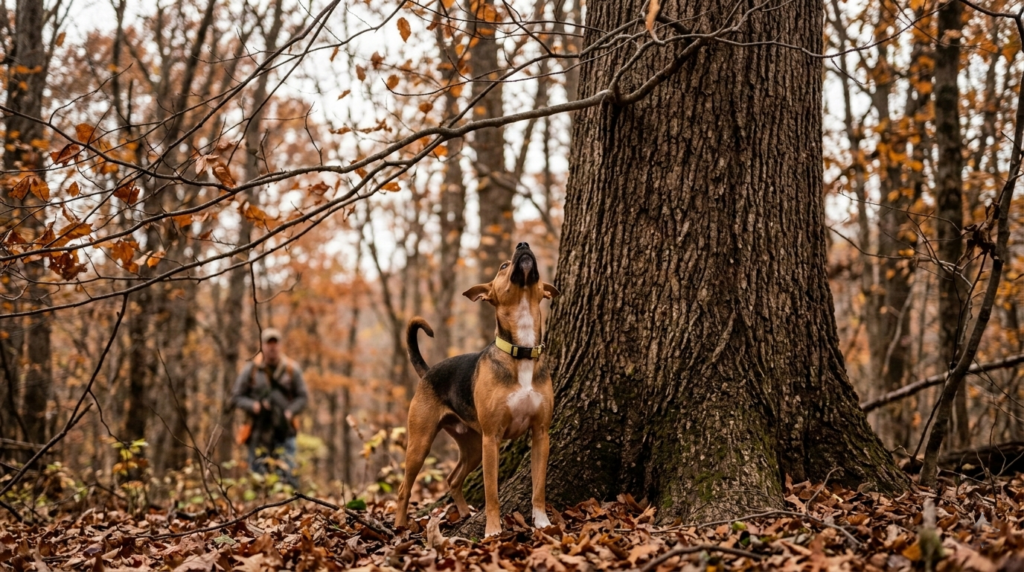
You watched that dog work all summer. Treed the wooden squirrel every time. Marked every toss. Locked up hard and barked like it knew exactly what it was doing. You were proud. You probably told somebody about it.
Then you walked into the woods.
First real timber hunt, that same dog is sniffing boot tracks, bumping through brush with no direction, and looking back at you like you’re supposed to tell it something. The confidence it had in the yard is gone. The focus is gone. You’re standing there wondering what happened to the dog you spent six months building.
Nothing happened to the dog. The yard happened to the dog.
The Yard Is a Lie and You Built It
That is not an insult. It is the truth about how most handlers approach starting young squirrel dog training without realizing the environment they control is also the environment that limits the dog.
In the yard, everything is predictable. The smells are familiar. The distractions are managed. The thrown dummy lands where you put it. The dog never has to sort out competing scent, navigate uneven ground, or make a decision without you nearby to confirm it.
Timber does not give the dog any of that.
Real woods have deer scent crossing squirrel scent. Wind shifting direction every hundred yards. Ground that holds scent different depending on moisture and temperature. Canopy so thick the dog cannot always wind a squirrel from below. And no one throwing anything.
A dog trained heavily in a controlled yard learns to perform. It does not learn to hunt. Those are two different skills and the woods will separate them in about fifteen minutes.
What Handlers Get Wrong During the Starting Phase
The biggest mistake is keeping the dog in the yard too long because it looks good there. The yard gives you feedback fast. The dog trees, you reward it, you feel like progress is happening. That loop feels productive.
But you are building a dog that is dependent on short distances, visible targets, and your presence as the anchor point.
Second mistake is flooding the dog with too much timber too fast once you do make the switch. The handler gets frustrated that the yard work is not transferring, so they take the dog to a big piece of hardwoods and turn it loose hoping it figures things out. That is not how a young dog learns. That is how a young dog learns to range out, get lost, and start making decisions based on panic instead of nose.
Third mistake is correcting the dog in the woods for behavior that is completely normal for a green dog. Sniffing the ground, circling, losing the track and picking it back up, barking at a tree and being wrong. That is a dog learning. If you are correcting that, you are correcting the learning process.
A GPS collar helps here. Not because you need to track every move, but because it lets you hang back and give the dog real freedom without the fear of losing it. A handler who is scared of losing a young dog in timber will hover. Hovering kills independence. The collar is a tool that solves a handler problem, not a dog problem.
The same pattern shows up in coonhound starts. If you have watched a young hound blow past cold tracks because it was only rewarded for hot action, you already understand how yard-heavy training builds habits that are hard to undo. That is covered in detail in Wide Too Early: How Young Coonhounds Learn Bad Habits That Stick.
Do This. Don’t Do That.
Don’t keep the dog in the yard past the point where basic drive is confirmed. Once it is marking and showing genuine desire to tree, it needs real cover.
Do start transitioning at four to six months into training by using edge cover. Field edges, brushy fence rows, small woodlots. Let the dog work natural scent in natural terrain before you take it into big timber.
Don’t stand still and wait for the dog to check in during every run. That builds a dog that hunts for you instead of hunting for itself.
Do move with the dog in early timber sessions. Not running behind it, but keeping enough forward pressure that the dog stays engaged with cover instead of turning back to locate you.
Don’t reward every bark in the woods just because the dog barked at a tree. That builds false confidence that turns into a sloppy, loose-mouthed dog.
Do reward effort and location. If the dog worked scent to a tree and gave you a solid locate, that is worth reinforcing even if the squirrel was not there. The nose work matters more than the result at this stage.
Don’t run the dog in mature, open timber with no understory. Big cathedral hardwoods are hard for a green dog. Scent disperses. There is nothing to hold the dog in.
Do find mixed timber with some understory. Squirrels use it. The cover gives a young dog something to work through and scent holds better close to the ground. For more on building patience and timing in early training, the breakdown on Teaching a Young Coonhound to Work Cold Tracks applies here even though it is written for hounds. Rushing a dog past its current skill level produces the same result regardless of breed.
Devil’s Advocate
Some handlers will tell you the yard is essential and that a dog needs to be solid there before it ever sees timber. They are not wrong about the yard having value. Drive and marking instinct are easier to identify and reinforce in a controlled setting.
But there is a difference between using the yard to confirm drive and using the yard as a substitute for real-world exposure. Most handlers who end up with a dog that falls apart in timber crossed that line without noticing it.
The counter-argument worth hearing is about confidence. Some dogs, especially young feists that tend toward the sensitive end, need early wins. A yard gives them that. And a dog that quits when things get hard in the woods might not have enough foundational confidence to work through the confusion.
The honest answer is that you have to read your individual dog. A bold, driven pup can move to cover earlier. A softer dog might need more yard time to build certainty before you introduce the pressure of big timber.
The mistake is applying the same timeline to every dog because it is easier for the handler. For a full breakdown of what the starting phase should look like, start with squirrel dog training and build from there.
Quick Fix Checklist
If your young squirrel dog is falling apart in timber, work through this before you change anything else.
- Move to edge cover before big timber. Brushy fence rows and woodlot edges let the dog find natural scent without the pressure of deep hardwoods.
- Stop anchoring the dog to you. Move forward during runs. The dog should be hunting cover, not checking your position every three minutes.
- Cut session length. Twenty to thirty minutes of real timber work is enough for a green dog. Fatigue produces confusion and confusion produces the bad decisions you will then try to correct.
- Stop correcting normal green-dog behavior. Wrong trees, lost scent, false starts. That is the learning process. Let it happen.
- Add squirrel contact. If the dog is not finding real squirrels, timber sessions will not click. Find a spot with actual squirrel activity. Pressure without contact is just confusion.
- Fix your reward timing. If you are marking the tree and not the nose work that got the dog there, you are reinforcing the wrong thing.
- Log your sessions. If you cannot tell someone what the dog did in the last three hunts, you are not watching closely enough to build on anything.
Closing
The dog did not get dumb when it hit the timber. You just found out what the yard never tested.
That is a fixable problem. Most handler mistakes at this stage are about timing and environment, not the dog’s ability. Start the timber transition earlier, manage your presence better, and stop rewarding the wrong moments.
The dog that looks confused in the woods today is usually the same dog that becomes a real hunter in six months if you handle the transition right.
Don’t waste that dog protecting your yard numbers.