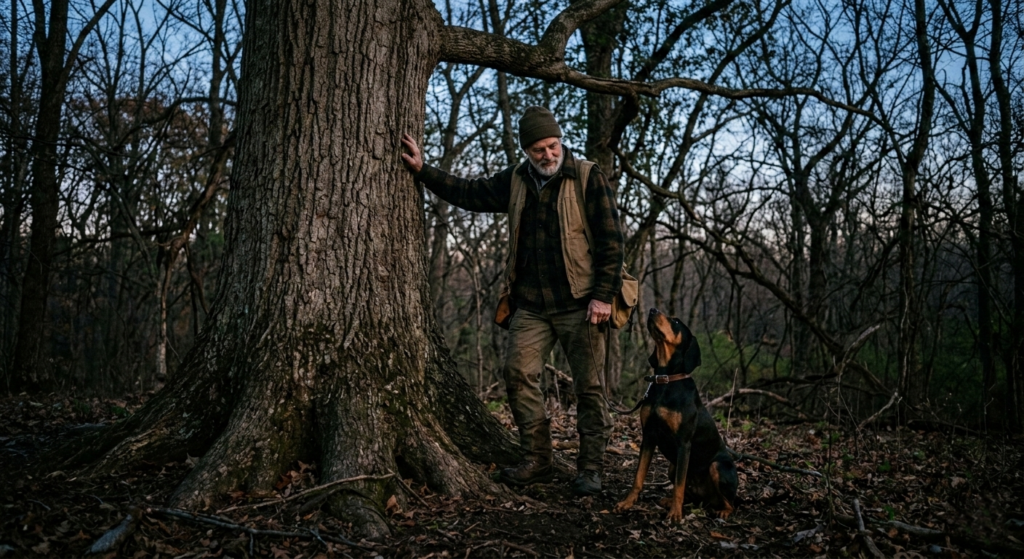
There is a version of this conversation happening right now in every hunting community that keeps tree dogs. A handler puts two or three seasons into a dog. Good exposure. Consistent work. Patient handling. And the dog is still not right. Not tree-oriented. Not using its nose the way it should. Not finishing. And somewhere around year three, that handler starts wondering what they did wrong.
Sometimes the answer is nothing. The dog just wasn’t built for it.
That is a hard truth in a space full of people selling training programs, miracle collar setups, and guaranteed methods. But the honest version of this conversation starts with genetics, not technique.
What Breeding Does That Training Cannot
Training is a refinement tool. That is all it has ever been.
A coonhound with a strong nose, natural tree instinct, and cold-trailing ability came into the world with those traits already developing. The breeding decision that produced that dog happened years before it ever touched a track. Training did not create those qualities. It shaped them, directed them, and gave them a framework to work inside.
Drive is the clearest example. When you watch a young dog that is genuinely driven, it shows itself early. That dog is restless at the box. It hits the ground hunting. It pushes through cover that stops a softer dog cold. You did not train that into it. That came from the sire and dam, and from the generations behind them.
Tree sense is another. Some dogs understand the relationship between a track and a treed animal in a way that seems almost intuitive. They work the base. They look up. They commit to the tree before they have proof. That is not a trained behavior in the early sense. It is an instinct that training later reinforces. A dog without it will slick tree, lose interest, or stand at the base looking confused while a finished dog would already be committed.
Nose is the most obvious and the least fixable. You can improve how a dog uses what it has. You cannot give it more. A dog working in dry conditions on a night when scent is low either has enough nose to stay on track or it does not. No training program adds olfactory tissue.
What training does is take a dog with natural ability and build a functional, repeatable hunter out of it. It teaches the dog where to channel what it already has. That is meaningful work. Training has a ceiling. That ceiling was set long before the dog ever saw the woods.
How Handlers Confuse the Two
Most handlers who end up in this situation did not make a bad training decision. They made a bad selection decision, and they did not know it at the time.
A pup can look promising at eight weeks. It can be bold, curious, and interested in scent. Those are good signs. But boldness is not drive. Curiosity is not nose. Interested is not obsessed. The gap between a pup that shows potential and a started dog that actually hunts becomes clear somewhere between ten and eighteen months, and by then a handler has already put time, money, and attachment into that animal.
The mistake that follows is understandable. The handler doubles down on training. More exposure. More woods time. More collar work. More pressure. Because training is the part they can control, they lean into it. But if the foundational ability was not there, more training does not close that gap. It just adds stress to a dog that is already working at the edge of its capability.
There is also a timing problem. Handlers sometimes blame themselves for a slow developer when the dog is genuinely still developing. That is a real thing. Some dogs, particularly in cold-nosed breeds, come into their own later than others. But there is a difference between a dog that is maturing and a dog that has been given every opportunity and is still missing the instincts the work requires.
Knowing the difference takes experience. It also takes honesty.
Poor training can bury good genetics faster than bad breeding can. That is worth sitting with before you write off any dog.
One of the clearest ways to check yourself is to look at the breeding. Not just the registered names, but the actual hunting history of the sire and dam. What did they do in the field? Were they consistent hunters or occasional performers? Were they bred to hunt or bred to show? A piece of coonhound training that rarely gets enough attention is what happens before training even starts. The pedigree is the first decision, and it is the most important one.
Do This / Don’t Do This
- Do evaluate a young dog against its breeding, not just against your expectations. If the sire and dam were marginal hunters, be honest about what the pup is likely to become.
- Do give a slow developer time. Eighteen to twenty-four months is not unusual for a tree dog to start showing its real ability. Pressure before readiness creates problems that are not the dog’s fault.
- Do keep records on what a young dog does in the field. Not to grade it harshly, but to see patterns. A dog that never shows interest in the base of a tree by fourteen months is telling you something.
- Don’t treat more training as the default solution to a lack of ability. Training is not a substitute for drive, nose, or tree sense.
- Don’t blame your collar, your timing, or your method before you honestly evaluate the dog’s natural talent. Handler error is common, but it is not always the explanation.
- Don’t breed a dog that you are still trying to convince to hunt. Marginal ability reproduces. Sometimes it gets worse.
Devil’s Advocate
Some experienced hunters will push back on this and say they have seen plenty of dogs come around with the right handler and the right exposure. That is true. Late bloomers exist. Dogs that struggled under one handler have gone on to hunt well under another. Environment and pressure matter.
But there is a difference between a dog that needed better handling and a dog that was missing foundational ability. A dog that needed better handling will show you something when the conditions are right. It will have moments. It will hit a track and stay on it. It will tree even if it does not do it consistently yet. Those dogs respond to good work.
A dog without the instincts will give you very little to work with regardless of conditions. That dog may still be a fine animal. It may be a good companion. But pushing it toward a role it is not built for is not fair to the dog, and it costs you years you could spend developing a dog that has what it takes.
The honest position is not fatalistic. It is just accurate. Genetics sets the boundary. Training works inside it.
Quick Fix Checklist
- Evaluate the sire and dam’s actual field performance before selecting a pup
- Do not begin pressure-based training before eighteen months unless natural ability is already showing clearly
- Watch for tree sense, nose, and drive as separate qualities, not one general score
- If a dog has been in the woods consistently for two full seasons and the instincts are still not showing, have an honest conversation with yourself about what you are working with
- Do not add more training volume as a first response to poor performance
- Consider handler error before concluding a dog lacks ability, but also consider the dog’s breeding before concluding it is a handler problem
- If the dog has natural ability but seems inconsistent, look at the training structure and environment before adding pressure
Closing
Genetics is not destiny, but it is the foundation everything else is built on.
A good handler can bring out what a dog has. Patient, structured work in the right environment can shape a capable hunter into a reliable one. That is real, and it matters. But no amount of patience pulls ability out of a dog that was not bred with it. The handler who understands that will make better selection decisions, spend time more honestly, and end up with dogs that actually fit the work.
The woods will always tell you what the paperwork would not.