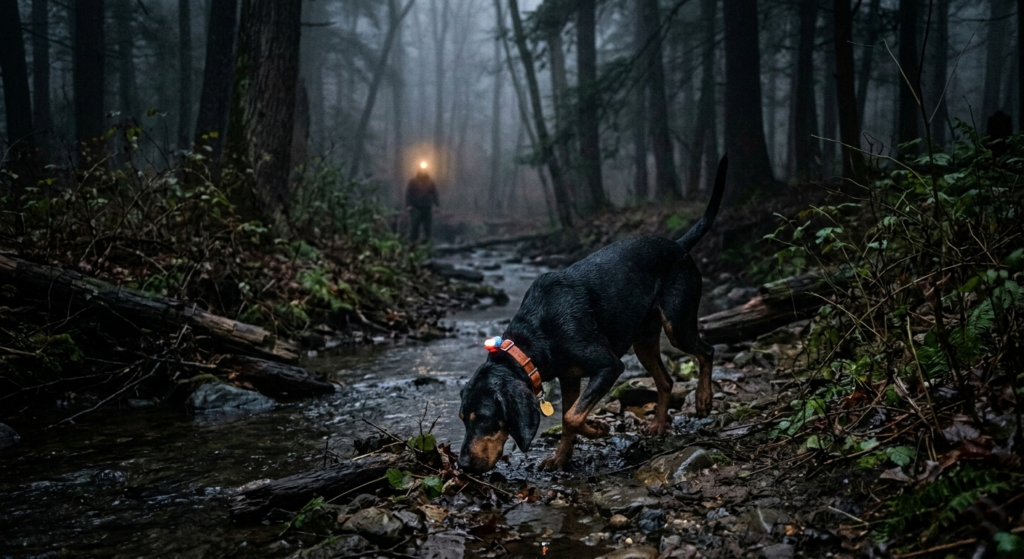
You turn your dog loose in the dark. It works the edge of a creek bottom, nose down, steady. No show. No fanfare. Just a dog doing what it was built to do.
Then somebody else’s dog blows through the timber, opens hard, and trees before yours even commits to the track.
Everybody at the tailgate nods. A couple of them glance your way.
Nothing changed about your dog. It is the same dog it was ten minutes ago. But something shifted in your head. And that shift, if you let it take root, can quietly distort months of careful development.
How Competition Pressure Distorts the Timeline
Cast pressure is real. You are standing in a group, dog in the truck, listening to everyone else talk about what their dog did last weekend. Scorecards get passed around. Bloodlines get bragged on. Someone mentions their 18-month-old finished in the top three at a local hunt.
And then the question hits you: should mine be doing that by now?
That question is where progression gets distorted.
Competition compresses timelines. It takes what should be a patient, dog-specific process and turns it into a race with someone else’s calendar. You start measuring in months instead of milestones. You start evaluating by what other dogs are doing instead of what your dog is actually showing you.
Talk after the hunt does the same thing. One conversation at the back of a truck can undo six months of patient work if you let it change how you see your own dog.
The Quiet Cost of Measuring Against Someone Else
Here is the part most handlers do not say out loud.
When you start measuring your dog against someone else’s timeline, you stop reading the dog in front of you.
You stop seeing what it is actually showing. You start looking for what it is not doing yet. That is a different way of watching a dog, and it produces different decisions.
Most of those decisions are not good ones.
This is not about confidence or attitude. It is about attention. The handler who is busy comparing has already mentally left their own dog. They are training the dog they think they should have instead of developing the one they do have.
What Comparison Does to the Development Process
This is where it moves from psychology into mechanics. Comparison does not just affect your mood. It produces specific, concrete mistakes that alter how a young dog builds.
Handlers rush range. The dog is hunting in tight and working cover thoroughly. That is exactly right for where it is developmentally. But after watching a wide-running dog get praised, the handler starts pushing out. The young dog loses the habit of working its way through a piece of ground before it ever fully develops it.
Handlers overcorrect silence. Their dog is working a cold track with its head down, taking its time. Another dog opened at 200 yards. Now every quiet stretch feels like a problem. The handler starts pushing the dog to open before it has enough information. That builds a noisy dog, not a honest one.
Handlers push older tracks too early. They saw someone else’s dog work a two-hour track and tree. They want that. Their dog is not ready for it. It needs to succeed before it needs to be challenged. But comparison pulled them past that stage without stopping.
Handlers force independence before it is built. A young dog needs structure and support before it can operate on its own. Comparison with a finished, confident dog makes the young dog look needy. So the handler backs off support too soon. The dog does not develop independence. It develops anxiety.
Handlers enter competition before foundation is ready. This one does the most damage. A dog entered too early, in the wrong conditions, against dogs it is not prepared for, comes out of that experience different. Sometimes it never fully recovers what it would have built on its own timeline.
For a grounded look at how coonhound development actually works from the ground up, the coonhound training resource at Big Man’s Sports and Outdoors covers the foundational stages without shortcuts.
Devil’s Advocate: Competition Has Value When Used Right
It would be easy to say competition is the problem and leave it there. That is not accurate.
Seeing a well-developed dog work can raise your standards. It shows you what is possible. If you have never been around a dog with a truly honest mouth, watching one work a track on a cold, dry night with a light wind can reset what you think good looks like. That is useful.
Competition can also sharpen your evaluation. Putting your dog in structured situations with other dogs exposes things that solo hunting does not. How does it handle cast pressure? Does it stay in its own game or get pulled off track by what other dogs are doing? Those are real questions with real answers, and competition gives you data.
The problem is not competition itself. The problem is letting someone else’s dog hijack your plan. There is a difference between using competition to refine your evaluation and letting it rewrite your entire development timeline based on one night in the woods.
Use what you see. Do not let it use you.
Quick Fix Checklist
Run through these honestly after any group hunt or competitive event:
- Did you change something in your training plan because of what another dog did that night?
- Are you adjusting your dog’s development timeline, or are you adjusting it to match theirs?
- Did you add pressure, increase expectations, or remove support after a comparison moment?
- Would you make this same decision if you had hunted alone last night?
- Is your dog failing to meet its own previous standard, or is it only failing to meet someone else’s standard?
- Have you written down your actual development goals for this dog in the last 30 days?
If you cannot answer these cleanly, sit with that before you change anything.
Stay With the Dog in Front of You
Another man’s dog does not define yours.
Development is built on consistent decisions made in response to the dog in front of you, not the noise behind you.
Development happens on individual timelines, not scorecards. The dog that works methodically through a creek bottom on a cold night with a 15-mph wind is building something. You may not be able to show it to the tailgate crowd in a way that gets nods. That does not change what is happening.
Stay with the dog in front of you.