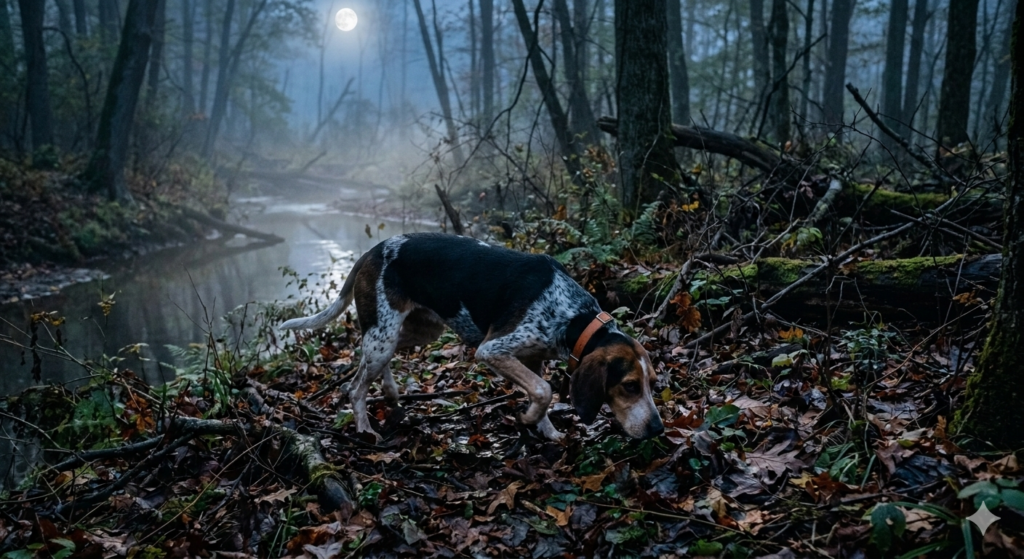
The track was there. You knew it. The dog knew it. But after a few circles and some frantic sniffing, the young hound left it and pushed forward into the dark, hunting for something easier to find.
That moment frustrates a lot of handlers into believing they have a nose problem. Most of the time they do not. What they have is an experience problem. The dog is not broken. It simply has not learned yet what cold scent means or how to work it.
Cold track work is one of the harder things a young hound learns. Not because it requires unusual ability, but because it requires patience — and patience is something excitement burns through fast.
Excitement Outruns the Nose
A young hound on a fresh track is a different animal than one working a track that is two or three hours old. Fresh scent is strong, directional, and easy to follow. The dog moves with confidence because the information coming off the ground is clear.
Cold scent is a different problem entirely. The scent cone is weaker. The direction is harder to read. Pooling can make the scent seem to come from multiple directions at once. A young dog that has spent its early months learning on fresh tracks arrives at a cold one and faces something that does not match what it has been trained to expect.
So it speeds up. That is the instinct. When the signal gets weak, push harder, cover more ground, find where it gets stronger again. That instinct works on hot tracks. On cold tracks it causes problems.
Sometimes the dog is not even trailing a line at all but drifting scent that has pooled in a low spot or carried on the wind. A dog working a hillside or a creek bottom may be responding to scent that has moved from where the animal actually walked. Young dogs cannot sort that out yet. That skill comes with time on cold ground.
The handler who starts screaming or who drags the dog back to the track every time it overruns is not helping. The dog is not ignoring the line. It is trying to solve a problem it has not solved before. That requires repetition, not correction.
What Cold Trailing Actually Looks Like
Most handlers picture a trailing hound as a machine that moves smoothly along a line with its nose down. That picture does not match what real trailing looks like on a cold track, especially with a young dog.
What you actually see: the dog hits the track, slows down, starts working in tighter arcs. It may circle the same area two or three times. It may appear uncertain or confused. Its body language changes. It is quieter, more deliberate. Some dogs will sit or stand still for a moment, just processing.
That is not a problem. That is the dog reading a hard puzzle.
Where handlers go wrong is misreading milling as failure. The dog is not lost. It is working. The scent is faint, the direction is unclear, and the dog is doing exactly what a developing hound should do — staying in the area and trying to sort out the line.
A finished hound does the same thing. The difference is speed and efficiency. A seasoned dog has worked hundreds of cold tracks and has developed a feel for how to interpret weak scent. A young dog is building that catalog entry by entry. It takes time. There is no shortcut.
When the Dog Leaves the Track and Hunts Forward
This is the part that confuses handlers most. The young hound mills around a cold track, seems unable to move it, then picks its head up and pushes forward — not on the line, just hunting. Some handlers panic. They read this as the dog giving up, quitting, or lacking the drive to finish. But take a look at this from another angle. You can read more about why comparison derails your expectations in Stop Comparing Your Coonhound’s Development. The hound that leaves an unmovable cold track and hunts for another one may actually be showing good judgment.
Finished hounds do this. A seasoned dog will attempt to work a track. If the scent has deteriorated past the point of being readable — rain, heavy dew, foot traffic, age — a smart hound eventually abandons it and looks for something it can actually hunt. That is not quitting. That is judgment.
The young dog doing it prematurely is a different matter. But the instinct itself is not wrong. The question is whether the dog worked the track hard enough before leaving it. A dog that mills for thirty seconds and bails is different from a dog that works the area for several minutes and still cannot advance the line.
Watch the effort before you judge the decision.
When to Let It Work and When to Step In
This is where a lot of handlers get it backwards. They intervene too early and too often, then wonder why the dog never learns to work a cold track independently.
Let the dog work. That means standing still, staying quiet, and not walking toward the area the dog is working. Your movement changes the scent picture. Your presence near a cold track can confuse a dog that is trying to sort out a faint line. Step back. Give the dog room and time. That same principle is one of the foundations of training a young tree dog: give the dog enough room to solve problems before stepping in, so independence develops instead of dependence on the handler.
Intervene only when the dog has clearly left the track area entirely and is not coming back on its own. At that point, calmly put the dog back at the last known point of the track. No drama. No correction. Just reset the starting position and let the dog try again.
Do not repeat this more than two or three times in a session. Cold track work is mentally hard on a young dog. Grinding a young hound on a track it cannot move for an hour builds frustration, not skill. Short sessions on cold tracks — where the dog works hard, makes some progress, and ends on something positive — build better trailing habits than marathon struggles.
The Difference Between Learning and a Real Trailing Problem
Not every dog that struggles on cold tracks is a dog in the process of learning. Some dogs genuinely lack the nose architecture to work scent that has degraded past a certain point. Understanding the ceiling of what training can build versus what a dog came into the world with is covered in Why Training Can’t Fix What Breeding Didn’t Build. That context matters before you decide what kind of problem you are actually dealing with.
Here is how to read what you are seeing:
A dog that is learning will show increasing engagement over time. Sessions on cold tracks will slowly produce more effort, more persistence, and eventually more success moving lines. The dog will still mill. It will still occasionally leave tracks it cannot advance. But the trend line moves upward.
A dog with a real trailing limitation shows a flat line or a ceiling. It works the same way at eighteen months that it did at ten months, even with consistent exposure and proper training. It may be a great hunting dog in other respects, but cold track work remains a hard limit.
Most young hounds are in the first category. Give them eighteen months to two years of proper exposure before making any serious assessments. A twelve-month-old dog struggling on a three-hour-old track in August is not a problem. That is a puppy doing puppy things.
Devil’s Advocate
Some handlers will say that letting a young dog leave a cold track reinforces quitting behavior. That there should be consequences for abandoning the line before it is worked out.
That argument has some validity at the right stage of development. A finished or nearly finished dog that has demonstrated the ability to work cold tracks but is choosing not to — that dog may need a different kind of pressure. But a young dog that genuinely cannot advance the line yet is a different situation entirely.
Correcting a dog for failing at something it does not yet have the ability to do consistently does not teach it to try harder. It teaches it to be anxious about the whole exercise. You will see dogs that have been overcorrected on cold tracks. They hesitate at the start. They check back toward the handler constantly. They look worried instead of focused.
Build the ability first. Apply pressure to performance later, and only after the foundation is there to hold it.
For a broader look at building a trailing dog from the ground up, the full coonhound training resource covers the foundational work that supports everything discussed here.
Quick Fix Checklist
- Do: Let the dog mill. Stay quiet and stay back.
- Do: Give young dogs time — most cold track problems are development problems, not nose problems.
- Do: Watch effort before judging the decision to leave a track.
- Do: Keep cold track sessions short. End on progress, not exhaustion.
- Don’t: Rush in every time the dog overruns the line.
- Don’t: Correct a dog for failing at something it hasn’t learned yet.
- Don’t: Make final assessments about nose ability before eighteen to twenty-four months of proper exposure.
- Don’t: Grind a young dog on an unmovable track for more than a few attempts per session.
What It Really Comes Down To
Cold track patience is not something you train into a dog in a weekend. It builds slowly, through repetition and exposure, over the course of a full season or two.
Most handlers who think they have a nose problem actually have a timeline problem. They are measuring a ten-month-old dog against a standard that belongs to a three-year-old one. The dog is not behind. The handler’s expectations are ahead of where the dog actually is.
Let the young dog work. Let it fail. Let it sort things out at its own pace. The ones with real ability will show you what they can do once their nose catches up to their drive.