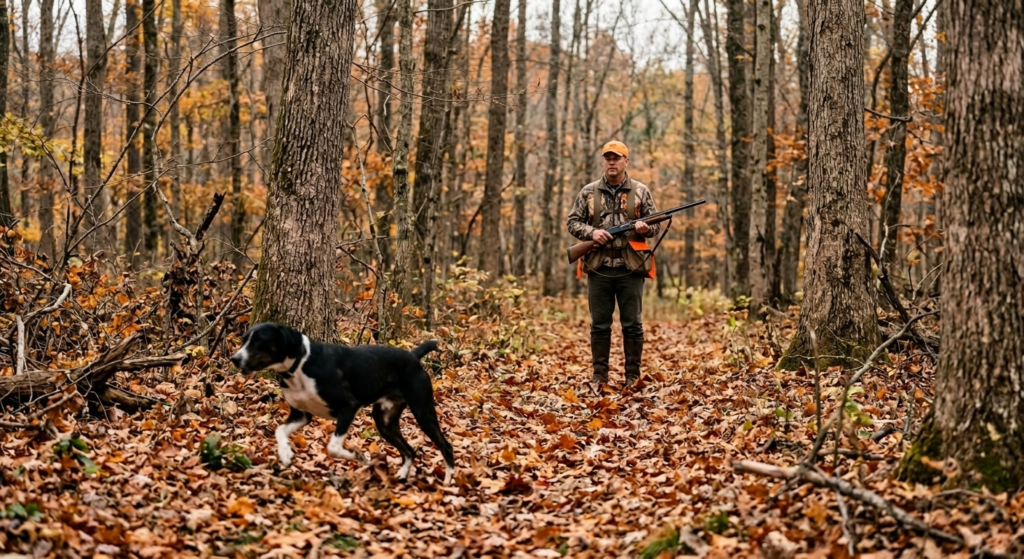
You cut the dog loose and it just follows you. Stays inside ten yards. Circles back every couple of minutes. You start walking faster to push it out and it just trots right along behind you, nose down on your boot tracks.
This is one of the more frustrating things a squirrel dog handler deals with, and it shows up in young dogs and older dogs alike. Most people blame the dog. The answer is usually somewhere else.
A squirrel dog that hunts under your feet is not broken. It is dependent. And dependence is almost always something the handler built, even when they did not mean to. The fix takes some woods time, some patience, and a willingness to change how you move and communicate in the timber.
Range is not something you demand. It gets built in layers over several hunts in the right conditions. For a deeper look at how independence fits into the bigger picture of developing a tree dog, the foundation work described in squirrel dog training covers the full arc from pup to finished dog.
What a Handler-Bound Squirrel Dog Actually Looks Like
Not every dog that hunts close is handler-bound. Some dogs are naturally medium-range hunters and that is fine. What you are dealing with here is something different.
A genuinely handler-bound dog stays inside shotgun distance the entire hunt. It does not push into cover on its own. It waits for you to move before it moves. When you stop, it stops. It checks back every minute or two whether there is anything pulling it back or not. It hunts your footprints before it hunts the trees.
That is not a tight hunting style. That is insecurity expressed through proximity.
Some dogs start naturally close and still develop into solid hunters given time and the right exposure. A pup in its first season is not the same as a two-year-old that has never learned to own ground. Read the dog in front of you, not the one you expected to have.
Why It Happens
The most common cause is yard-dog handling that carried over into the woods. The dog learned early that staying close was the right answer. It got praised for it in every other setting. Then you asked it to do the opposite the moment you stepped into timber, and the dog had no reason to believe that rule had changed.
Short, over-managed hunts do the same thing. When a handler walks quickly, calls frequently, and redirects constantly, the dog never gets a chance to figure out that the woods belong to it. It keeps its attention on you because that is where all the information has come from.
Dead woods make it worse. A green dog in timber with no squirrel activity has nothing pulling it forward. Repeated empty walks teach a dog to loaf and stay close because loafing and staying close never cost it anything.
Overuse of correction or e-collar pressure on a young dog can tighten things up fast. When distance starts to feel risky, a dog stops taking it. That is not stubbornness. That is learned caution.
Some dogs are just immature. They are not ready to hunt independently yet and they are telling you that. Pushing them before the confidence is there usually makes the problem worse, not better.
How to Fix It
Start by hunting the right woods. Go where there is actual squirrel sign. Fresh cuttings, active den trees, good mast, water nearby. A dog that finds something interesting in the first ten minutes learns quickly that moving out into the timber pays off. Dead woods produce close-hunting dogs.
Stop talking in the woods. This one is harder for some handlers than any training technique. Constant calling, whistling, and encouraging keeps the dog mentally attached to your voice. Quiet down and let it feel the space. The silence is part of the lesson.
Slow your own pace down. Stand still more. A handler who walks constantly is dragging the dog through the woods instead of letting it work. When you stop and hold position, you give the dog room to move outward. Many close-hunting problems solve themselves the moment the handler stops being the most interesting thing moving.
Think about where you cast the dog. Turn it loose where it can naturally move into timber, down a drain, along a ridge, or into an edge. Country that invites forward movement works better than open flat ground where there is nothing to pull the dog in any direction.
Do not reward every check-in. When a handler makes a big social event out of every return, the dog learns that coming back is the best part of the hunt. Acknowledge it quietly and send it back to work. The praise belongs to the hunt, not the check-back.
Hunt shorter and more often. A young dog learns more from six focused forty-minute hunts than from two three-hour slogs through empty timber. End sessions when the dog is still curious and working. That carryover energy shows up in the next hunt.
The Older Dog Question
Hunting a tight young dog with an older dog can help, but only if you have the right older dog. A dog that hunts out confidently and covers ground without drifting into trash or pulling the young dog into bad habits can show the pup a pattern worth copying.
The wrong older dog creates a new problem. A pup that becomes dependent on another dog is still dependent. It just transferred the attachment from you to a packmate. That is not independence.
Use an older dog as a short-term teaching tool if the option is there, then pull it and let the young dog hunt alone. True range almost always gets built in solo time. The dog needs to discover on its own that the woods are navigable and that moving out into them produces results.
Reading Progress Correctly
The first sign of improvement is usually not dramatic. A dog that was hunting inside ten yards starts hitting thirty. One that checked back every minute goes four or five minutes between returns. That is real progress, even if it does not look impressive from the outside.
Do not compare the dog to another handler’s dog or to some idea of what range is supposed to look like. Judge it against where it started and where it is now.
Season progression matters too. A dog that hunts relatively close in September sometimes opens up considerably by November when the leaves are down, scent conditions are better, and it has accumulated real squirrel experience. Some dogs just need the season to develop.
This patience-first approach is the same principle that applies when a squirrel dog quits and comes back to the handler mid-hunt. In both cases, the root issue is confidence, and confidence is not something you can rush or force.
Devil’s Advocate
Some handlers will push back and say their dog is just naturally close-working and they are fine with that. That is a fair point. Not every squirrel dog needs to blow through the country to be effective. In thick mountain timber or heavy creek bottom cover, a medium-range dog that works methodically can outperform a dog that ranges wide and loses contact.
The real question is whether the dog is finding squirrels. If a close-working dog is still producing consistent trees, the argument for forcing more range gets weaker. Do not chase somebody else’s idea of the perfect hunting style if what you have already works in the country you hunt.
Where it stops being acceptable is when the dog is so focused on the handler that it is not hunting at all. A dog that watches your feet instead of working timber is not a close-range hunter. It is a dog that has not been taught what its job actually is. That is worth fixing.
What Most Handlers Get Wrong
They expect wide range before the dog understands what it is hunting for. Range without purpose is just wandering. The dog needs to connect distance with finding squirrels before it has a reason to push out.
They praise every check-back and accidentally reinforce the habit they are trying to break. The dog learns that returning to the handler produces something good. Then the handler is frustrated when the dog keeps doing it.
They hunt bad woods and blame the dog for not reaching. A motivated dog still needs something to be motivated by.
They try to shock or scold a dog into leaving, which almost always makes a tight dog tighter. Pressure without understanding just adds another layer of caution to a dog that is already uncertain about moving away from you.
They never hunt the dog alone. If the dog has always had company in the woods, whether from the handler moving constantly or another dog working beside it, it has never had to own the hunt by itself. Solo time is not a punishment. It is where the job gets learned.
Understanding how to build early confidence matters here. The same principles that apply to avoiding rushed starts are worth reviewing, because many close-hunting problems in older dogs trace back directly to how the dog was started as a young squirrel dog.
Quick Fix Checklist
- Hunt woods with active squirrel sign, not dead timber
- Stop calling, whistling, and directing from the moment you step in the woods
- Slow down and stand still more. Give the dog room to move outward
- Cast into country that invites forward movement
- Do not make check-backs a social event. Acknowledge and move on
- Hunt shorter, more focused sessions and end while the dog is still working
- Introduce an older dog only if it hunts independently and does not create new dependence
- Pull the older dog and give the young dog solo time in the timber
- Measure progress against the dog’s own starting point, not another dog’s range
- Do not apply hard correction to a dog that is already hunting too cautiously
The Bottom Line
A squirrel dog that hunts under your feet is almost always telling you something about how it was handled, not about what it is capable of. Most of the time the answer is less pressure, better woods, and more room to figure things out on its own.
Independence does not get forced in. It gets built through structure and exposure, one good hunt at a time. Give the dog conditions worth hunting, get out of the way, and let it discover that moving out into the timber is where the job actually happens.
The dogs that end up with real range are usually the ones that got time to earn it themselves.