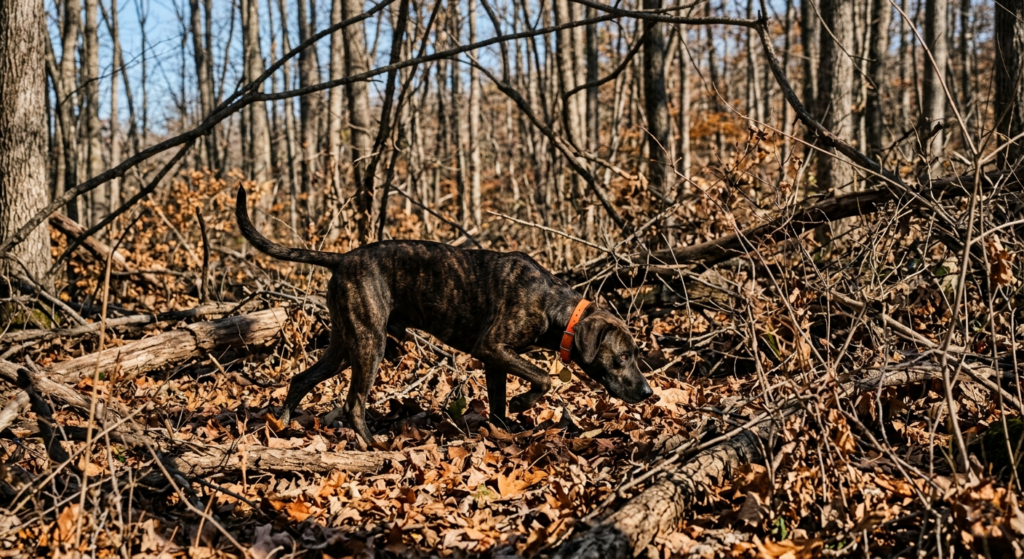
A young dog can do some exciting things. It might strike a track fast, push hard to the tree, and bark with authority before it has any real miles on it. That is not nothing. Early instinct is real and it matters. But it is not the whole story.
The problem comes when handlers start treating early talent like it is the finished product. They see two or three good hunts and start calling the dog a hunter. They bump up expectations. They add pressure. Then things fall apart and they cannot figure out why.
The reason is simple. Natural ability shows up early. Finished dog qualities take time.
This applies across the board, whether you are running coonhounds on night hunts or working squirrel dogs through hardwood timber on a fall morning. A dog that has tools can look special when conditions cooperate. A dog that is actually becoming finished can perform when conditions do not.
If you want to develop a dog the right way, start by learning how to train a tree dog before you start putting labels on what you have.
What’s Actually Happening
Natural ability is what a dog was born with. You can see it early because it does not require teaching. Strong hunt drive, early interest in scent, quick tree instinct, boldness in rough cover, and the kind of pattern recognition that lets a young dog figure out where game went before it has been shown. These traits are bred in and they surface fast in dogs that have them.
Finished dog qualities are different. They are earned through repetition, real conditions, and enough time in the woods to develop judgment. A finished dog is consistent night after night. It handles pressure without falling apart. It stays accurate when scent conditions are bad, company is rough, or the game makes things hard. It knows when to push, when to stay, and when to move on. It hunts right alone and it hunts right with others. That kind of steadiness does not come from a few good outings. It builds over time.
The gap between those two things, between raw talent and real polish, is where most dogs either get made or ruined. A lot of good prospects get hurt during that stretch because the handler starts training the dog they hope they have instead of the dog they actually have.
This is especially true with squirrel dogs. A young dog can find game fast in easy timber and look like it is years ahead of schedule. But the same dog may fall apart in thin game, windy conditions, or rough terrain. Early flash is not the same as development. Handlers who have watched a young squirrel dog look worse after showing promise know exactly what this feels like.
Part of the explanation is straightforward biology. Adolescent dogs go through real developmental changes that affect focus, confidence, and consistency. A dog that looked locked in at eight months may seem unfocused or uneven at twelve. That is not failure. That is development.
Why It Happens
Instinct develops before judgment. A pup may want to hunt and tree before it has any idea how to work out a hard track, manage bad scenting, or stay honest when pressure mounts. Desire comes first. Understanding takes longer.
Young dogs also look better than they are in easy setups. Hot tracks, thin game, soft cover, or hunting behind older experienced dogs can make a pup appear further along than it is. If the conditions always cooperate, the dog never gets tested. You are not seeing the dog, you are seeing the conditions.
Mental steadiness, patience, and self-control usually lag behind raw drive. A dog can have tremendous desire and still be nowhere near ready to be called a finished dog. Those things are not the same.
Once a dog shows talent, most handlers raise the pressure before the dog is ready. That is one of the most common development killers in this game. The dog showed promise, so expectations go up. Corrections get sharper. Standards get tighter. But the dog is still green, and now it is also confused.
Accuracy, independence, and staying power come from enough right experiences. Not one or two flashy hunts. Not one great season. Enough repetitions under real conditions over enough time for the traits to actually take root.
How to Fix It
Separate flashes from habits. Watch what the dog does regularly, not what it did one good night. If you are paying attention, keep notes on strike, track, tree, accuracy, and how the dog handles itself. Patterns are what matter, not highlights.
Hunt the dog where it can actually learn. That means real woods and real situations. Avoid leaning too hard on setups that create fake progress. Easy situations can feel productive but they do not build anything. The dog needs to encounter problems it has to solve.
Match pressure to maturity. Correct clear bad habits when they appear. But do not punish confusion, greenness, or lack of experience like it is stubbornness or defiance. There is a real difference between a dog that knows what you want and will not do it, and a dog that does not understand yet. Treating immaturity like defiance is where a lot of dogs get broken.
Judge progress in layers. First look for desire. Then look for understanding. Then look for consistency. Finally, look for reliability under pressure. Most handlers jump to the last step too fast because they see the first step and assume the rest will follow quickly.
Build finished traits through repetition in varied conditions. Alone time. Different terrain. Different weather. Different game movement. Nights when nothing comes easy. Those are the hunts that build a finished dog, not the easy ones.
Protect the dog’s confidence while you tighten standards. Early on, your job is to build desire and clarity. Later, once the dog knows its job, you can demand cleaner work. Trying to demand precision before the dog has real understanding is a fast path to a hesitant dog.
What Most Handlers Get Wrong
They brag on early tree instinct and ignore weak track work or poor accuracy. Tree instinct is the easiest thing to see. It is also one of the first things to show up. Calling a dog good because it trees early is like calling a quarterback good because he has a strong arm before he can read a defense.
They start calling a dog finished because it has style and excitement. Style is not steadiness. Excitement is not judgment. Those are different things.
They overcorrect immaturity and create hesitation. A dog that was bold and sharp at eight months can turn into a cautious, second-guessing animal by fourteen months if corrections came too hard and too early for things the dog was not ready to understand.
They hunt a talented young dog too much with older dogs and mistake covering for real progress. When a young dog is riding the work of older animals, it is not learning. It is just along for the ride. At some point you have to put the dog in a situation where it has to carry the load itself.
They panic when a naturally gifted dog hits a rough patch and start changing everything. Training programs, correction levels, hunting partners, terrain. When a talented dog goes through a flat stretch, the answer is almost never a total overhaul. Usually it is patience and consistency.
They compare one dog’s timeline to another instead of reading the dog in front of them. Some dogs are sharp at one year. Some dogs are not honest until three. Neither one is wrong. The handler’s job is to read where their dog is, not where someone else’s dog was at the same age.
This is a pattern worth taking seriously. Handlers who understand why young tree dogs regress after a few good hunts are better prepared to hold steady during those flat stretches instead of overreacting to them.
Devil’s Advocate
Some handlers will push back on this and say that raising standards early is what separates the good dogs from the average ones. That if you let things slide, you are letting the dog develop bad habits that are harder to fix later. That is not a wrong idea. There is real truth in it.
But there is a difference between holding standards and demanding maturity before it exists. Standards are about clear communication, consistent boundaries, and correcting actual defiance. Demanding maturity before it exists is asking a dog to perform at a level it cannot reach yet, and then treating the gap as a character flaw.
High expectations paired with appropriate timing produces finished dogs. High expectations paired with poor timing produces confused dogs. The standard is not the problem. The timing is.
When to Leave It Alone
Leave it alone when the dog is still sorting out normal age-related confusion. Young dogs go through developmental windows where everything seems to get worse before it gets better. That is not a training problem. That is biology doing its job.
Leave it alone when the mistake comes from lack of exposure and not from defiance. A dog that has not seen something before is not being stubborn. It is being a dog that has not seen something before. Those two things require completely different responses.
Leave it alone when the dog is improving overall even if some finished traits are not there yet. Overall trajectory matters more than any single session. If the dog is getting better across weeks and months, you are on the right track even if specific nights are still rough.
Leave it alone when a high-drive young dog is rough around the edges but still learning how to channel itself. Drive without direction is not a bad sign. It is a training opportunity. The dog has the fuel. Your job is to help it figure out how to use it.
Patience is not the same as being passive. You still guide the dog, hold your standards, and correct clear problems when they appear. But you do not force maturity before it arrives. Some finished qualities only come after enough hunts, enough seasons, and enough chances to learn from real game.
Quick Fix Checklist
Track patterns, not single performances. Notes help.
Stop hunting the dog only in easy setups. Put it in real situations.
Match your correction level to the dog’s maturity and understanding.
Judge development in stages: desire, understanding, consistency, reliability.
Give the dog alone time in real conditions. That is where finished traits build.
Stop comparing timelines across dogs. Read the animal in front of you.
Hold your standard. Adjust your timing. Not the same thing as lowering the bar.
The Bottom Line
Talent will show you what a dog might become. Finished qualities show you what the dog actually is.
Early signs matter. They are worth paying attention to and they tell you something real about what is inside the dog. But they are only the front end of the story. The back end is built through miles, conditions, repetition, and time.
Reward natural ability. Protect confidence early. Give the dog enough real hunting to develop steadiness, judgment, and honesty. Those traits do not rush. They build.