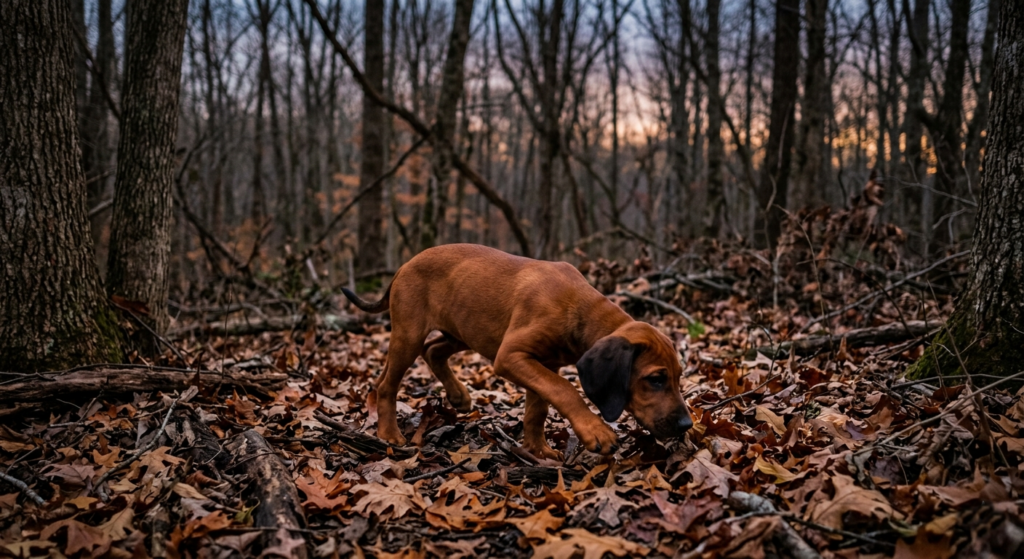
Most handlers know what a me-too dog looks like. The pup piles out of the truck, follows the pack straight to the tree, and gets praised for treeing. It looks like progress. It is not progress. It is a young dog doing nothing more than following a crowd, and every night you let that slide, the habit gets harder to break.
A me-too dog can fool you for a long time. Pack it with honest dogs and it will look like a hunter. Cast it alone and you will see the truth in about twenty minutes. The pup either wanders with no purpose or just stands near the truck waiting for direction that never comes.
The problem is usually built in by accident. Handlers pack young dogs with older, finished dogs too early and too often. The pup learns fast that it does not have to think. Something else does the thinking. All it has to do is show up.
This is a fixable problem, but it takes patience and a willingness to let your dog look rough for a stretch while real habits replace the borrowed ones.
What a Me-Too Dog Actually Is
The term gets used loosely, so let’s make it plain. A me-too dog is a dog that consistently borrows its hunting from other dogs instead of generating its own.
It hunts behind other dogs rather than out ahead. It falls in after another dog strikes, moves the track only after it hears barking, and covers trees without having contributed anything to putting the coon there. It waits on pack action before it shows real interest in doing anything.
There is a difference between a young dog that learns by watching and a young dog that becomes dependent on watching. The first is using company as a training tool. The second is using company as a replacement for learning.
A me-too dog often looks sharp when it is packed. It gets to trees fast, opens at the right time, and may even get loud. The handler brags on it. What the handler is not seeing is that the dog is not doing any of the actual work. It is riding the work of other dogs and taking partial credit.
Independence is a habit, not a talent. It is built through structure. It does not just show up on its own if you keep the dog in situations where depending on others is easier than thinking for itself.
Why It Happens
The most common cause is too much pack hunting too early. The pup gets dumped with finished dogs on every trip. It never has to figure out a track by itself. It never has to locate game, stay on a drift alone, or hold a tree with no backup. Finished dogs do all of that. The pup just follows the work.
Handlers who worry about a young dog going to the right posts on this are already thinking in the right direction. The deeper article on young coonhound training without older dog dependence covers this problem in detail, but the short answer is: if you keep putting the pup in situations where following is easier than leading, it will keep following.
Some older dogs are too dominant or too fast. The pup never has a chance to beat them to a track, never gets credit for a find, never finishes a tree on its own terms. It learns quickly that being second is the easiest path through a night in the woods.
Handler error plays a big role in all of this. The handler mistakes presence for contribution. The dog was at the tree, so it gets treated like it treed the coon. The dog barked, so it gets treated like it hunted. The reward structure teaches the pup that covering is enough. It is not enough, but the dog does not know that yet.
There is also the matter of confidence. Some pups lean on company when they are unsure. That is not unusual in young dogs. The problem is what you do with it. If you keep feeding the dependency instead of building the pup’s belief in its own ability, immaturity becomes habit. And habits set early in a coonhound are hard to remove.
How to Fix It
Step one is the hardest one. Cut way back on hunting with company. The fastest way to deepen a dependency is to keep feeding it. That means mostly solo hunts for a stretch, even if those solo hunts look rough at first.
The pup may look flat for a few nights. It may spend more time checking in near you than hunting out. That is normal. Do not panic and reach for an older dog to spark it. Let the pup work through the discomfort.
Pick spots where coon are workable. You are not setting the pup up to fail over and over. You are giving it a fair chance to solve problems and succeed on its own. Workable ground means enough game to give an honest young dog a reasonable shot. Rough conditions are fine once the dog has something to work with, but not before.
When you cast it, turn it loose and let it go hunting. Do not recast every ten minutes because nothing is happening. Give it time to get its nose into something, make a decision, and move. There is a difference between patience and just standing around wasting a night, but most handlers err on the side of too much interference rather than too little.
When the pup does something on its own, make it count. If it strikes first, moves its own track, or trees its own coon, praise and fur go to that dog. Not as a gift. As a record of what the dog earned. Independent work deserves a strong, clear marker that it was the right thing.
Be careful with correction during this period. You can make a timid or uncertain pup worse by punishing confusion. Correction only does useful work when the dog clearly understands what it did wrong. If the pup is still sorting things out, pressure adds noise, not clarity.
If you do use a second dog occasionally, pick one that is calm and honest, not one that runs everything down and leaves no room for the pup to do anything. One quiet, experienced dog used on purpose is different from full pack hunting every trip. Keep those hunts intentional and spaced out.
Watch for small signs that things are improving: the pup leaving the truck on its own initiative, taking a different drift from yours, checking away from another dog instead of toward it, staying at a tree even when nothing is reinforcing that from outside. Those are the markers that matter.
What Most Handlers Get Wrong
They think exposure automatically equals progress. It does not. Being in the woods does not mean learning to hunt. Being at trees does not mean the dog treed anything. Handlers who confuse the two end up with dogs that look like hunters at one year old and reveal themselves as borrowers at two.
They brag on a pup for treeing with old dogs when the pup has not contributed a step to the process. That praise teaches the wrong lesson every single time.
They try to fix a dependency problem with too much pressure. More correction, harder pressure, less patience. That approach usually makes things worse, especially with a pup that is already unsure of itself. Build the dog up first. Correct what is clear and obvious. Leave the gray areas alone until the dog has more confidence.
They expect independence overnight after creating a habit for months. That is not how this works. You are asking the dog to give up the easiest path it knows and replace it with something that requires real effort and real confidence. That takes time and consistent structure, not one or two solo hunts.
Handlers who want an honest read on where their young dog actually stands will benefit from the framework in how to judge progress in a young coonhound without lying to yourself. Grading a dog on pack performance is not grading the dog. It is grading the pack.
They hunt with too many dogs at once. A large pack hides weaknesses and rewards cheating. Four honest dogs running the same track reward every dog at the tree regardless of who did the work. The more dogs you add, the easier it is for a dependent dog to look like a contributor.
Devil’s Advocate
Some handlers will argue that coonhounds are pack animals and that pack hunting is natural and appropriate. There is truth in that. Coonhounds have been hunted in packs for a long time, and social hunting is a real part of how these dogs are wired.
The pushback here is not against pack hunting as a method. It is against pack hunting as a substitute for individual development. There is a difference between a dog that can work a pack and chooses to when the situation calls for it, and a dog that cannot work without one. The first dog is useful in both situations. The second is only useful in one.
Others will argue that some dogs are just more pack-minded by nature and that trying to force solo work creates problems of its own. That is also fair. Some dogs are naturally more social hunters than others. You should know your dog and work with its tendencies, not against them entirely.
But natural tendencies and deeply set bad habits are not the same thing. A dog that prefers company but will still hunt and tree on its own is a different animal from a dog that shuts down when cast alone. One is a personality trait. The other is a training problem.
When to Leave It Alone
Not every young dog that covers or follows a little is ruined. Very young pups need time before real solo expectations make sense. A four-month-old dog that stays near older dogs is not a me-too dog. It is a pup.
Leave it alone when the dog is still in early exposure stages, when it is beginning to range and investigate on its own between pack hunts, when its confidence is visibly improving week to week, and when the behavior looks like immaturity rather than dependency. Those are different problems that need different responses.
Do not try to force hard independence too early. Pushing a pup past what it can handle creates other problems: leaving tracks, babbling alone, becoming anxious in the field. The goal is a confident, independent dog. Pressure that kills confidence does not build independence. It just replaces one problem with another.
If you are uncertain whether you are dealing with immaturity or a real dependency habit, err on the side of less pressure, better conditions, and more time. The dog will usually show you what it is once you remove the crutch. Building confidence without forcing the pup past what it can handle is a principle worth keeping in mind every time you push a young dog toward solo work.
Quick Fix Checklist
- Cut pack hunting back to occasional and intentional, not routine.
- Hunt the pup in workable country with enough game to give it a fair chance.
- Cast it and give it time. Do not recast every few minutes out of impatience.
- Mark independent work clearly with strong praise and fur when earned.
- Hold off on heavy correction until the dog understands what it is being corrected for.
- If you use a second dog, pick one calm dog with purpose, not a pack.
- Watch for small signs: independent strikes, solo tree holds, ranging away from other dogs.
- Grade the dog on what it does alone, not on what it does with help.
Closing
Most me-too dogs are made, not born. The handler picked the easy path: more dogs, more action, less time spent letting a young hound figure things out on its own. The dog followed because following was what the structure rewarded.
A dog that cannot hunt alone is not a finished coonhound. It is a finished coonhound-shaped dog that needs a pack to fill in the gaps. There is a difference, and that difference shows up on the nights that count.
If you want to build an honest independent night dog, start by reading through the broader foundation work at coonhound training. The principles that prevent a me-too dog from forming are the same ones that build the kind of dog worth hunting for twenty years.
Less pack hunting. More intentional solo time. Reward original work. Be patient enough to let the pup struggle and learn from it.
The dog will tell you when it is ready to operate on its own. Your job is to stop telling it that it does not have to.