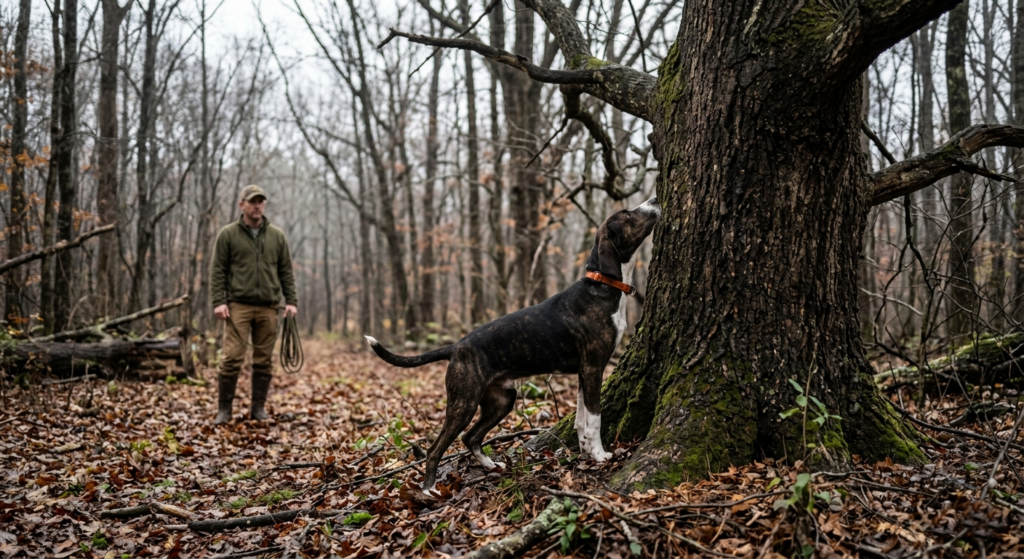
Most handlers start a young squirrel dog with the wrong goal in mind. They want action. They want to see the dog run, bark, and put squirrels in the bag. That is the wrong way to think about the first ten hunts.
Those first ten trips into the woods are not about squirrels. They are about building a pattern. The dog is learning how to hunt out, how far to go before checking back, how to handle the tree, and whether any of this is worth its energy. Everything that happens in those early hunts either builds that pattern or starts pulling it apart.
Search pattern, tree focus, and confidence are all connected. A dog that hunts with clear purpose usually gains confidence as that purpose pays off. A dog that gets crowded, overhandled, or dragged through wrong setups starts hunting short, losing focus at the tree, or losing interest altogether.
The first ten hunts should be simple on purpose. Not boring. Not easy. Simple. Tight objectives, clean setups, short duration. If you try to accomplish too much too fast, you are not pushing the dog. You are muddying the lesson.
Most problems that show up in a young squirrel dog by season two were built in during that first handful of hunts. The good news is the fix is usually just as simple as the mistake. Keep reading.
What’s Actually Happening on Those First Hunts
The dog is not just chasing squirrels. It is learning a system.
On every one of those early hunts, it is working out how far to travel before checking back on the handler, whether game is more likely to show up by hunting out or by staying close, and whether the tree is a rewarding experience or a confusing one. That last point matters more than most handlers realize.
Tree focus is not all instinct. It gets shaped by repetition. A dog that goes to the tree, stays on it, and gets a clear reward builds a cleaner tree picture every time. A dog that gets pulled off the tree, distracted by a noisy handler, or left waiting too long at nothing starts to drift. That drift becomes habit.
Understanding how to teach a squirrel dog the first 50 yards right is part of the same idea. The early pattern you build in the first stretch of every hunt shapes how the dog thinks about its job for a long time.
Some dogs come out of the box with more natural hunt than others. Some have stronger tree instinct. But even the most naturally talented young dog still gets its habits shaped by those first few trips. Natural ability gets you started. Those first hunts decide which direction that ability points.
Why Early Hunts Go Wrong
Too much pressure too early is the most common problem. Hunting a green dog in poor squirrel woods, high-traffic public land, or bad weather before it understands the game sets the dog up to fail the first test. Expecting a polished performance in the first few trips is a handler expectation problem, not a dog problem.
The handler who talks too much in the woods is wiring the dog to hunt the handler instead of squirrels. Calling the dog back constantly, walking it into every likely spot, and moving every time the dog looks uncertain all teach the same lesson: wait for the handler to do the thinking. That is not what you want.
Shooting too many squirrels out too early is another fast way to build the wrong habit. The dog starts watching the gun instead of finishing the tree. It learns that showing casual interest at a tree gets rewarded the same as locking on and staying. That is a hard thing to unwind later.
Hunt length is something most handlers get wrong without realizing it. Young dogs mentally fade before the handler thinks they do. Once a dog is mentally tired or overloaded, it starts making sloppy loops, standing around, or losing interest in squirrel contact. The second half of an overlong hunt often undoes what the first half built. This is one of the clearest reasons young squirrel dogs get worse when you hunt them too hard. The dog does not quit. The handler just ran out the clock.
Bad company also hurts early development. A rough, trashy, or overly competitive older dog can make a young dog wild or dependent. Hunting in loud groups turns a learning hunt into noise the dog does not know how to sort out yet.
Wrong woods is its own problem. Big open timber with no visible squirrel movement leaves a green dog hunting blind. Too many off-game distractions in the wrong terrain creates a pattern you did not intend to build.
How to Build the First 10 Hunts Right
Each hunt should have one main objective. Not five. If you go in trying to build hunt-out, tree focus, check-back, squirrel contact, and gun manners all in the same trip, you are not training. You are hoping.
Pick easy woods first. Hunt where squirrels are actually moving. Favor spots with enough game to create opportunity but not so much action that the dog gets wild. Early success matters for confidence. A dog that finds game in the first few hunts hunts with purpose. A dog that strikes out repeatedly starts to wonder why it is out there.
Hunt the dog alone or with one steady helper at most. Solo hunting shows you what the dog is actually doing. If you use an older dog, make sure it is straight, calm, and not so dominant that the young dog is just chasing it around the woods.
Keep hunts short. End while the dog is still hunting with interest. A clean forty-five minute hunt teaches more than a sloppy two-hour grind. The goal is quality of experience, not mileage covered.
Walk quietly and give room. Avoid constant commands. Let the dog cast, loop, and start building its own search pattern. The moment you start micromanaging every cast, the dog stops thinking and starts watching you for direction.
Reward hunt-out, not hanging around. When the dog goes on and hunts out, keep moving naturally and let that pattern pay off. Do not spend the whole hunt standing and talking while the dog mills around your boots.
Build tree focus carefully. When the dog shows interest at a tree, move in calmly. Give it time to work the tree before you rush in and create a circus. Petting, praise, and occasional fur at the tree should match where the dog is in its development, not where you want it to be.
Be selective about shooting squirrels out. Early on, only reward the right kind of tree behavior. Do not knock squirrels out to slick treeing, leaving the tree, or casual interest. The dog needs to learn that staying on the tree with purpose is what brings the payoff.
Help without overhelping. If the dog struggles on a lose, do not solve every problem instantly. Let it work, circle, and think. Step in only when confusion is clearly replacing learning.
End on a win when possible. A clean track, a hard-worked tree, or a good independent hunt-out can be enough. Not every hunt needs fur in the mouth to count as progress.
Watch for pattern changes across hunts. Is the dog hunting deeper each trip? Checking back less? Staying on the tree longer? Acting more sure of itself? Those are the early wins that matter more than the squirrel count.
Sample progression across the first 10 hunts:
Hunts 1 through 3: exposure, calm woods, short hunts, simple success. The goal is positive first impressions, nothing more.
Hunts 4 through 6: more independence, less handler interference, cleaner tree expectations. Start asking for a little more before the reward comes.
Hunts 7 through 10: reinforce the hunt pattern, expect a bit more tree stay, build consistency. The dog should be showing you something you can work with.
What Most Handlers Get Wrong
They mistake excitement for progress. A wild, noisy young dog is not always learning the right lesson. Chaos is not drive. Know the difference.
They shoot too many squirrels too early. A dog that expects the gun to finish every track did not teach itself that. The handler taught it.
They talk too much in the woods. Constant commands and chatter train the dog to wait for instruction instead of hunt independently.
They hunt too long trying to make something happen. Young dogs learn bad habits in the second half of overlong hunts far more often than they learn good ones.
They compare one dog to another. One dog may hunt out hard by hunt three. Another may not settle in until hunt eight. That is development, not failure.
They correct uncertainty instead of building clarity. A green dog that is unsure usually needs simpler setups and cleaner rewards, not more pressure. Pressure on confusion just creates a confused dog that is also nervous.
They crowd the tree. Too much noise and movement at the tree pulls the dog’s focus off the squirrel and onto the handler. That is the last thing you want to teach.
They count squirrels instead of counting habits. The real scorecard in the first ten hunts is search pattern, tree stay, and whether the dog wants to come back out again next time.
Devil’s Advocate
Some hunters will tell you they pushed hard from the start, their dogs turned out fine, and all this measured structure talk is overthinking it. That argument is worth hearing. Some dogs can absorb pressure early and still develop clean habits. Breeding matters. Some bloodlines are more forgiving of handler mistakes than others.
But here is what that argument leaves out: the dogs that turned out fine despite hard early pressure turned out fine in spite of what happened, not because of it. You do not know which dog you have on hunt one. You find out later. And the ones that could not absorb that pressure either washed out quietly or developed problems the handler learned to work around and called normal.
Structure early is not coddling. It is stacking the odds. If the dog can handle more, you will know soon enough and can push accordingly. If it needs time, you have not burned anything.
Quick Fix Checklist
Hunt where squirrels are actually moving, especially early.
Keep the first few hunts short and clean. End before the dog fades.
Walk quietly. Let the dog build its own search pattern.
Do not shoot squirrels out to casual interest. Reward the right tree behavior.
Avoid loud groups and rough dogs for early hunts.
Do not solve every problem for the dog. Let it think.
Watch for pattern improvement across hunts, not just squirrel count.
If the dog looks worse after a long hunt, you ran it too long.
When to Leave It Alone
Leave minor checking back alone if the dog is still young and gradually stretching its range. That is a natural development stage, not a problem.
Leave a little tree uncertainty alone if the dog is honestly trying and improving with exposure. It does not need to be finished. It needs to be pointed in the right direction.
Leave some early excitement alone if it is tied to learning and not causing the dog to blow off trees or lose its head on the track.
Leave style differences alone. Some dogs naturally hunt wider. Some tighten up on the tree slowly. Not every difference from what you expected is a problem that needs fixing.
Research on adolescent dogs supports what experienced hunters have known for a long time: young dogs become less handler-dependent and more exploratory as they mature. That shift is normal. Trying to fight it with constant correction usually creates a more dependent dog, not a more independent one.
The handler should step in when a pattern is getting consistently worse across multiple hunts, not when the dog shows normal immaturity on a single trip. If you react to every immature behavior with a correction, you are not building a dog. You are building anxiety.
The full picture of how early exposure ties into long-term development is covered in the main squirrel dog training guide, which is a useful reference point once these first hunts are behind you and you are starting to think about what comes next.
Closing
The first ten hunts are not about what the dog can do. They are about what you are teaching the dog to become.
A dog that leaves those first hunts with a clean search pattern, honest tree interest, and a willingness to go back out is a dog you can build on. A dog that leaves those hunts with a gun dependency, a handler dependency, or a sloppy tree picture is going to spend the next season unlearning what those first hunts taught.
Your job in those early woods is not to show off what the dog already is. Your job is to shape what it is becoming. Keep it simple. Keep it clean. Let the dog tell you when it is ready for more.