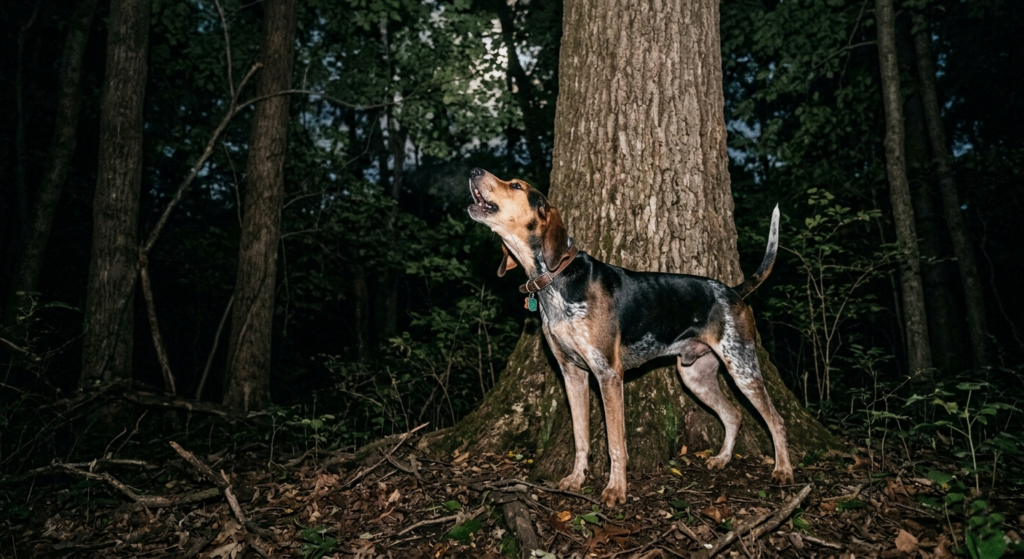
Some dogs can fool you for a full season.
You drop three dogs in the holler, the track gets hot, and your hound is right there with the best of them. It trees hard. It stays. It looks like it belongs. Then one night you decide to run it alone, and the whole picture changes. It works a track halfway, slows down near the end, mills around, and never settles on a tree the way it does in company.
That gap between what a dog does with others and what it does alone is important. And it is more common than most handlers want to admit.
This is usually not a tree problem in the purest sense. It is an independence problem, a confidence problem, or a habit problem that shows up at the tree. The dog has learned to lean on company somewhere in the process, and now the work only looks solid when another dog is there to prop it up.
Young dogs can struggle with this. Older dogs that were packed heavily from the start can too. Either way, the first step is calling it what it is. Another dog can hold one together that is not mentally settled alone. That is the plain truth of it. Understanding coonhound training from a foundation standpoint helps frame why independence has to be built deliberately, not assumed.
What Is Actually Happening
The dog is borrowing confidence from the pack.
There is a real difference between tree power that comes from inside and tree power that depends on another dog being in the picture. One is genuine. The other is borrowed, and it disappears when the loan gets called in.
When a dog falls apart alone, it can look a lot of different ways. Some dogs trail clean but never locate with any precision. Some locate and then leave. Some check back toward the handler instead of pushing through. Some mill around the area, get close to the tree, and drift off without ever locking down. Some bark some, fade, and wander. Some cover another dog’s tree confidently but cannot find their own.
All of those are symptoms. The root is usually the same: the dog never had to finish the job by itself.
Company can hide weak locating. It can hide a dog that lacks the confidence to stay under pressure at the end of a track. It can cover a dog that has gotten into the habit of waiting on another dog to confirm before it commits. When the pack is there, the weaknesses disappear into the noise. When the pack is gone, they surface.
This is handler-built more often than bloodline-built. The dog was not necessarily born this way. It was trained into it, or more accurately, it was allowed to develop this way because no one caught it early enough. If the dog has not been reading as a potential me-too dog, now is a good time to take a hard look at whether that pattern was started earlier than you realized.
Why It Happens
Too much pack hunting too early is the most common cause. The dog learned the game with help from the start. Another dog did the hard work at the end of the track, and this one got rewarded alongside it. Over time, it stopped having to solve the finish on its own because someone else always did.
Some dogs lack the confidence to close a track alone. They can move a track, get it going, push through the middle of it. But when the pressure builds near the end, where the coon came down or crossed, they get unsure. Without another dog to confirm the spot, they second-guess. That second-guessing becomes a habit.
Others become cover dogs more than true independent tree dogs. They learn that showing up at another tree is easier than finishing their own. It still gets praise. It still gets the handler walking over. Over time, covering becomes the default, and doing the job alone becomes something they avoid.
Handler mistakes drive a lot of this. When a handler praises noise and excitement instead of accuracy and commitment, the dog gets credit for barking in company, not for being right by itself. That is a small but important distinction, and it shapes what the dog thinks its job actually is.
Overcorrection can play a role too. A dog that has been corrected hard around slick trees, trash, or leaving may have learned to be cautious about settling in alone. When it is unsure, it does not need more pressure piled on. It needs the right kind of repetition to rebuild confidence in its own judgment.
Some of this is just immaturity. Young dogs need time. They need more right experiences before they will stand alone with any conviction. Not every dog is on the same clock, and pushing them into situations they are not ready for can create the very dependence you are trying to avoid.
How to Fix It
Start by hunting the dog alone on purpose and making that the main program for a while. Independence is not wished into a dog. It is built through repetition, through the dog having to carry the full job start to finish by itself. Consistent solo hunts matter more than long marathon sessions. Keep them focused and give the dog a fair shot to succeed.
Pick easier places when you are rebuilding. Hunt where coon are moving. Hunt where the dog has a real chance to finish clean. Avoid the toughest conditions and thinnest tracks while the dog is finding its footing alone. Stack clean wins early. Confidence comes from the dog being right, not from surviving hard nights.
Stop letting another dog finish the job for it. Dropping a weak dog with stronger dogs and hoping independence appears on its own does not work. Limit company hunts until the dog is carrying more of the work alone. If it cannot solo, adding a better dog just teaches it to lean harder.
When the dog finishes alone and stays, make that mean something. The reward does not have to be loud or dramatic, but the timing needs to be right and the dog needs to understand clearly that holding that tree by itself is exactly the right thing. Calm, well-timed praise does more than excitement.
Give the dog time at the tree. Some dogs need a minute to settle in and commit when they are alone. They are used to having company confirm the spot. Without it, they may hesitate. Do not rush in every time. Let the dog learn to hold the pressure of being there by itself. That is a skill it has to develop through reps, not through the handler arriving quickly and taking over.
One step that gets overlooked is separating the problem. If the dog cannot pin the end of a track, the work is on track-finish opportunities. If it locates the spot but then leaves, the work is on confidence and staying power. Those are different problems with different fixes. Reading which one is actually present matters. Handlers who skip this step spend time working on the wrong thing. The article on locating clean alone is worth studying if the dog’s issue shows up before it ever gets to the tree.
Cut back on unnecessary handling while the dog is working. Too much talking, too much calling, too much walking around while the track is being run keeps the dog tied to the handler. Let it work through problems without constant input. A dog that is used to being directed every few minutes will not develop the mental independence to carry a track alone.
Use company later as a test, not a shortcut. Once the dog improves alone, then hunt it with others and watch whether it keeps its own mind. Does it still locate and commit, or does it slide back into borrowing? The goal is a dog that hunts honestly either way. Company should be a reward for progress, not a substitute for it.
The SportDOG piece on starting young hounds makes a useful point about pulling a dog out to learn independence through one-on-one time when it starts leaning on the pack. That principle applies directly here.
What Most Handlers Get Wrong
They assume that a dog treeing hard in company is naturally solid. It looks good, so they keep running it in packs because it keeps looking good. The problem stays invisible because the setup keeps hiding it.
They confuse covering with tree instinct. A dog that shows up confidently at another dog’s tree can look like a tree dog. It is not. It is a follower with good instincts for finding where the work already finished.
They try to correct their way out of dependence. More pressure does not build independence. In most cases, it makes the dog more cautious and more reliant on another dog to confirm before it commits.
They hunt hard places when the dog needs confidence-building wins. The wrong setup at the wrong time sends a dog backwards, not forward. If the dog needs to learn to trust itself, it needs conditions where trusting itself pays off.
They expect independence before the dog has had enough solo reps. That is not a training problem. That is a math problem. The dog cannot develop something it has not had enough repetitions to build.
They make too much of one bad night and too much of one good night instead of looking at the pattern across several hunts. Patterns tell the truth. Single nights can lie in both directions.
They talk too much while the dog is working. Too much handler noise keeps the dog checking back instead of pushing through. It teaches the dog that the handler is part of the process, and the dog starts waiting on that input.
They do not separate immaturity from true weakness. A young dog struggling alone may just need more time and more right experiences. Labeling it faulty before it has had enough solo opportunity is premature and can push a handler toward the wrong fix.
Devil’s Advocate
Some handlers will argue that pack hunting is the point. They will say a dog that trees hard with company is doing exactly what they want it to do, and solo performance is secondary.
There is something to that in a narrow context. If a hunter runs cast dogs every night and never needs a solo performer, a dog that thrives in company may fit that program well.
But here is the problem with that argument. A dog that cannot function alone will also be harder to read as an individual. You will not know what it truly knows, what it is capable of, or where its actual weaknesses are. Company covers all of that. You end up with a dog whose real ceiling is unknown because the pack has always been doing part of the work.
Beyond that, dogs change situations. If the pack splits on a crossed track, if you need to pull one dog and give it a specific job, if the cast gets thinned for whatever reason, the dog that only works in company leaves you short. Its performance is borrowed, and borrowed performance is only reliable for as long as the conditions that make it possible stay in place.
Independence is not about making the dog flashy alone. It is about making sure the dog actually knows its job all the way through.
Quick Fix Checklist
- Pull the dog out of the pack and commit to solo hunts for at least a few weeks
- Hunt where conditions are fair and the dog can finish clean
- Stop rewarding presence at another dog’s tree
- Give well-timed, calm praise when the dog finishes and holds alone
- Let the dog sit at the tree and build the habit of holding pressure by itself
- Decide whether the weakness is in locating, commitment, or both
- Reduce handler noise while the dog is working a track
- Do not reintroduce company until solo performance shows steady improvement
- Separate immaturity from true weakness before labeling the dog
When to Leave It Alone
If the dog is young and showing steady improvement week to week, do not rush to label it. If it is starting tracks alone, locating with more confidence than it had before, and holding a little longer each time out, stay patient. Progress is the signal. Absence of overnight fixes is not failure.
If the weakness only appears in unusually tough conditions, thin tracks, or rough terrain, it may be more about experience and exposure than actual dependence. Some dogs need more time under those specific conditions before they trust themselves.
If the dog has a naturally tighter, more methodical style, do not try to turn it into something louder and flashier. That is not a flaw. Some dogs are quieter workers. Some settle in without drama. That can look like hesitation to a handler used to a different style, but it is not the same thing.
Leave it alone when the progress is real. Patience is not the same as ignoring a problem. If there is no progress, solo hunting, cleaner setups, and better timing are the next steps. If there is progress, even if it is slow, stay the course.
Closing
A coonhound that looks strong in company but falls apart alone is leaning on help somewhere in the process.
The fix is not complicated, but it does require honesty about what you have been doing. Hunt the dog alone. Set it up to win. Reward the right thing at the right time. Give it the reps to build the confidence to carry the job all the way through without another dog propping it up at the finish.
If the ability is there, the structure and repetition will find it. Hunt the dog alone long enough, and you will know exactly what you have.