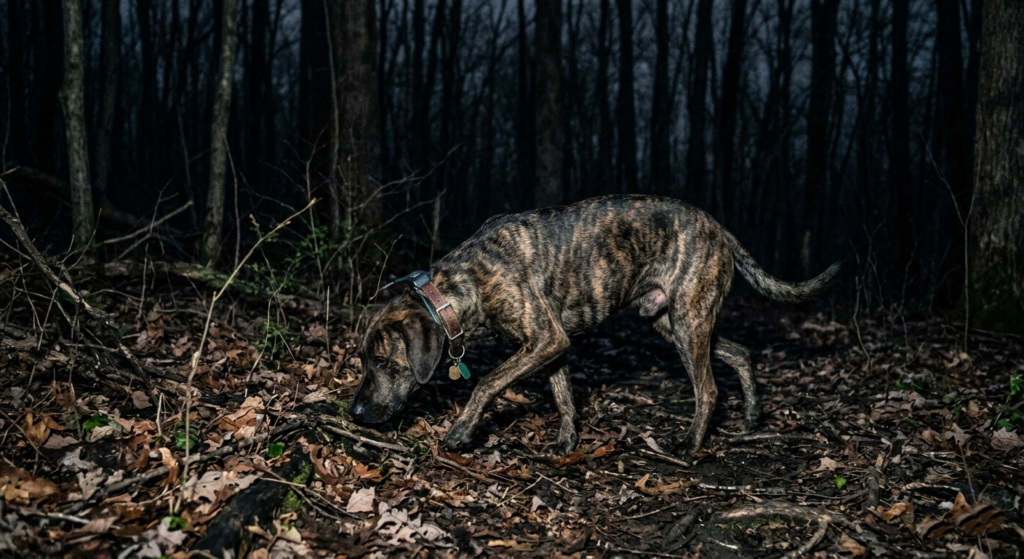
A young coonhound that keeps circling back toward the handler or waiting around for the other dogs to do something is not a mystery. It is a pattern. And in most cases, it was built by the training setup, not the dog.
Dogs started with too much company early on learn to borrow confidence. They borrow the first strike. They borrow the track work. They borrow the decision to push. When that borrowed support disappears, the dog has nothing to fall back on because it never had to build anything on its own.
That is what checking back is, in most cases. Not a lack of ability. Not a bad nose. Not a dog that does not want to hunt. It is a dog that was never put in a position where it had to carry the hunt alone long enough to get comfortable doing it.
This article covers what is actually happening when a young coonhound checks back, why it usually comes from the starting setup, and what you can do to straighten it out without shutting the dog down in the process. If you are working through the broader picture of how to develop a young hound from the ground up, the coonhound training guide covers the full foundation.
What Is Actually Happening
Checking back is a dependence problem before it is a hunting problem. Those are two different things, and treating them the same way usually makes things worse.
When a young coonhound is started with older dogs, it gets a free education. The older dogs find the track. They open first. They move game forward and create the pressure that puts the coon in the tree. The young dog follows the noise and ends up at the tree without ever having solved the problem itself.
That young dog may look decent in company. Active. Loud at the tree. Maybe even developing a strike. But strip the pack away and hunt it alone, and the picture changes. It hunts out a little, then swings back. Makes loops instead of driving. Perks up only when it hears another dog open somewhere off in the timber. On a hot night with a fresh track, it might look alright. On a cold night with a tough track, it falls apart.
There is a difference between a naturally close-hunting young dog, a dog that is briefly uncertain in new country, and a dog that was conditioned to rely on company. Age and new woods account for some of what you see. But when a young dog has been hunted regularly with a pack and the checking back keeps happening or gets worse instead of better, that points to a training setup issue, not just immaturity.
Some field signs to watch for: the dog hunts out a short distance and loops back before it has really committed to anything, stands around waiting for something to happen rather than making something happen, acts more independent when conditions are good but comes apart when things get tough, and shows more life and drive when it hears another dog than when it is working alone. Any one of those can be normal at a young age. All of them together, repeated across multiple hunts, points to borrowed confidence that was never replaced with the real kind.
Why It Happens
The most common reason is that the dog never had to solve problems alone. Too much pack exposure too early means the hard parts were always handled by someone else. The young dog tagged along and stayed in the game without carrying the workload. That is not the dog being lazy. That is the dog doing exactly what the setup taught it to do.
The handler usually makes it worse without meaning to. Walking around at the drop, talking, whistling, moving locations, recasting the dog before it has had time to find anything. All of that teaches the dog that the hunt happens around people. The dog keeps tabs on the handler because that is where the action has been.
This is the same dynamic that produces what most experienced hunters call a me-too dog. A dog trained into following company instead of carrying its own hunt. The pattern gets reinforced every drop where the dog stayed in the game by tagging along rather than leading.
Some lines and individuals mature slower than others. That is real. But slow maturity and handler-built dependence look different when you pay attention. A slow-maturing dog usually shows steady forward desire even when it is not effective yet. A dependent dog shows hesitation, backward movement, and a habit of waiting instead of working.
How to Fix It
Step 1: Stop feeding the problem.
Cut back on hunting the dog with company. Not forever, but for long enough that the pattern has a chance to break. Quit giving the dog repeated chances to lean on older dogs. You already know that setup produces checking back. Keep running it and you keep reinforcing what you are trying to fix.
Step 2: Pick the right spots.
Solo hunting works best when the conditions are stacked in the dog’s favor. Choose places with good coon movement, light hunting pressure, and room for the dog to move out. Avoid dead country, heavy competition areas, and rough conditions while you are rebuilding confidence. The goal right now is successful solo experiences, not testing the dog in hard country.
Step 3: Stand still and be quiet.
This one is harder than it sounds for most handlers. Let the dog leave. Do not pet up, chatter, whistle, or move around to manufacture action. Make the dog carry the responsibility of the hunt. The more you fill the silence, the less the dog has to figure out on its own.
Step 4: Give the dog time before you judge the drop.
Some young dogs look lost for the first ten or fifteen minutes before they settle in. That is not failure. That is a dog that is still learning what alone feels like. Do not rush to recast, move to a different spot, or step in to help. Patience at this stage is doing real work.
Step 5: Reward honest effort, not just big outcomes.
If the dog pushes out farther than it did last week, works a track on its own, or trees alone for the first time, that matters more right now than whether it was a long track or a champion-quality performance. Progress shows up before polished results do. Build confidence one solo win at a time.
Step 6: Correct only what you are sure about.
Do not overcorrect simple uncertainty. Correction is for confirmed unwanted habits, not for a young dog trying to gather itself. Heavy-handed pressure on a dog that is already mentally soft from being dependence-trained can make checking back worse, not better. Save correction for things you are certain about.
Step 7: Reintroduce company carefully.
Once the dog starts hunting out alone with more consistency, you can bring company back in a limited way. One honest dog, not a pack. Watch whether the young dog keeps its own hunt or falls right back into covering and following. That tells you exactly where you are. For more background on why young hounds need to learn independence before full pack exposure, that principle holds up in any starting program.
Step 8: Keep the pattern consistent.
Solo hunting needs repetition. Two or three good alone nights followed by a week of pack hunting can put the checking-back habit right back in. Structure is what builds a dog that leaves on its own without needing a crutch. Inconsistency is what keeps you stuck doing the same fix over and over.
What Most Handlers Get Wrong
They keep hunting the dog with company because it looks better that way. That is the exact opposite of fixing the problem. Activity in a pack is not the same as independent hunting. A dog that tags along and arrives at the tree looks productive. It is not learning anything new.
They over-handle at the drop. Talking, walking, recasting, moving before the dog has had time to work. Every minute of that teaches the dog that people are part of the hunt setup.
They apply pressure when the real issue is dependence and immaturity, not defiance. Pressure has its place, but putting it on a dog that is checking back because it was never taught to carry the hunt alone usually makes things worse. The dog is not ignoring you. It is lost without the pack.
They change spots too fast and never let the dog work through discomfort. A young dog hunting alone in unfamiliar country needs time to find its legs. Pulling up and moving before that happens denies the dog the experience it needs.
They compare young dogs to each other instead of reading the one in front of them. Every dog develops on its own timeline. Some of them need more solo repetition than others before independence settles in. That is not a problem. That is just dogs.
Most of this problem is handler-built. That is not a criticism. It is useful information, because handler-made problems can usually be fixed by changing how the handler operates.
Devil’s Advocate
Some handlers will push back and say that running young dogs with company is the traditional way to start them, and that the pack teaches things you cannot replicate with solo hunting. There is something to that. Watching an honest dog work a track does teach a young dog what the job looks like. That is not wrong.
The issue is not company itself. The issue is too much company, too early, with no solo work built in alongside it. A young dog that gets regular solo drops as part of its starting program can benefit from occasional pack time without falling into dependence. The checking-back problem shows up when company is the only diet, not when it is part of a balanced program.
There is also an argument that some dogs just need more time and that handlers are too quick to label checking back as a training failure. That is fair. Not every young coonhound that hunts close or checks back at six months old is a dependence case. Some of them are just young. The distinction worth paying attention to is whether the pattern is getting better over time or getting stronger. Better means time and patience. Stronger means the setup needs to change.
And if a dog is so far into the dependence pattern that basic solo work is not getting traction, that is a situation worth evaluating honestly. Some dogs started with too much company and no solo foundation will take a long time to rebuild. Knowing that going in sets realistic expectations.
When You Are Dealing With a Tree Dog That Has the Same Problem
A young coonhound that checks back in the hunt sometimes shows the same borrowed-confidence pattern once it gets to the tree. It goes through the hunting motions well enough in company but falls apart treeing alone. If that sounds familiar, the article on why a young hound trees hard in company but not alone covers that specific end of the dependence problem and is worth reading alongside this one.
Quick Fix Checklist
Work through this in order before making any bigger decisions about the dog.
- Cut pack hunting until the dog has a run of solo drops with forward effort showing
- Choose spots with good coon movement and room to work, not hard country
- Stand still at the drop, keep quiet, and let the dog carry the hunt
- Give the dog at least fifteen to twenty minutes before judging the drop
- Note any forward movement, longer pushes, or solo track work as progress
- Hold off on correction unless you are certain the habit is confirmed and deliberate
- When you reintroduce company, start with one honest dog and watch closely
- Keep the solo routine consistent across multiple weeks, not just one or two nights
Closing
A young coonhound that checks back after being started with company usually learned to do it. The older dogs did the hard parts, and the dog never had to figure out what it means to carry the hunt alone.
The fix is not more pressure. It is more structure, more solo time, better conditions, and less handler noise at the drop. Most of these dogs have the tools. What they are missing is enough solo repetition that being alone starts to feel like the normal working condition instead of something to get away from.
If the dog has ability, independence is built by making it work alone often enough and long enough that it stops looking for the pack to show up. That takes patience and a willingness to let the dog sit with discomfort for a few minutes instead of bailing it out. Most handlers can do that. The ones who do usually end up with a dog that hunts out hard and does not need anyone to get it started.