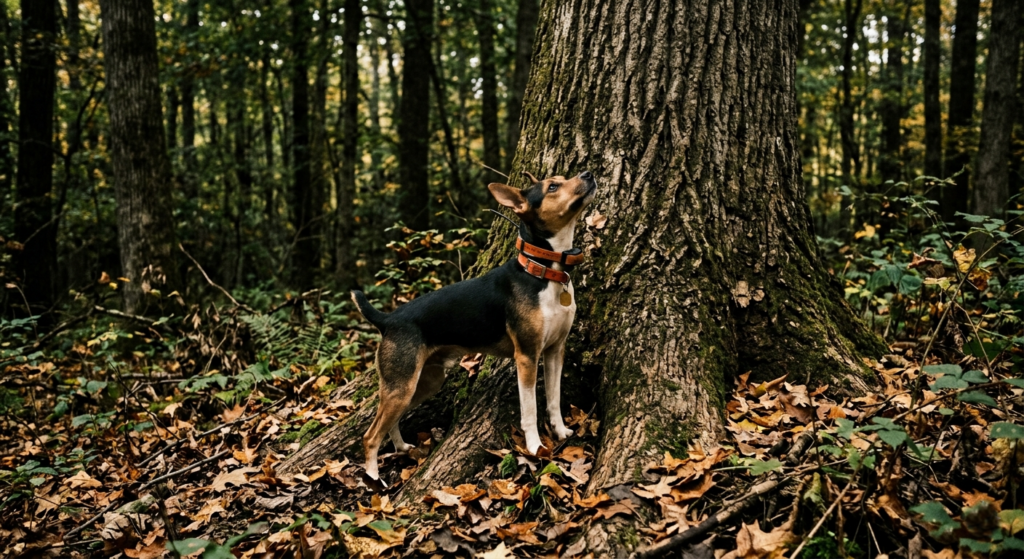
A dog can look sharp all winter long. Clean opens, good tree work, solid on the locates. Then the woods leaf out and that same dog starts acting like it forgot half of what it knew. It stalls. It circles. It quits tracks that should be workable and goes hunting for something easier.
That is not the dog getting worse. That is the dog getting exposed.
Easy conditions do that to young dogs. Open timber with light cover and good scent drop will make a green dog look farther along than it really is. The track practically runs itself. When the woods fill back in and scent has to be sorted from limbs, trunks, and broken canopy, the holes in a dog’s foundation show up fast. If you want to understand how to build through it, the starting point is solid squirrel dog training fundamentals before conditions get hard.
The dog was not lying to you in easy cover. It was just working a problem that was not really that difficult yet.
What’s Actually Happening
Leaf cover changes how squirrel scent moves. In bare or lightly covered timber, scent falls cleaner to the ground. A dog can push it from the dirt and the bark and stay connected to the track without working too hard.
Once the canopy fills in and the leaves pack down, that scent does not always reach the ground the same way. It hangs in the brush. It clings to trunks at mid-height. It drifts with whatever air is moving through the canopy. A dog that has only worked clean, obvious scent is suddenly dealing with a track that is scattered vertically instead of laid out flat.
Some of what looks like quitting is not quitting at all. The dog opens early because the scent is obvious close to where the squirrel dropped from the tree. Then the track splits or lifts, the dog loses the thread, and it starts checking. That is normal behavior for a dog learning how scent works in layered cover.
The problem is what happens next. A dog with track education will slow down, circle, check the air, and work to relocate. A dog without it will drop the track and go find something fresher. That gap right there is the difference between a young dog learning and a young dog quitting.
You will know which one you have by watching the body language. The learning dog stays active around the last known area. The quitting dog leaves the scene in a hurry.
This connects directly to what good handlers already know about judging a dog honestly. A dog that looks sharp on good days but falls apart when scent gets difficult has not been proven yet. How a dog handles difficult conditions is the real test. If you want a deeper look at that standard, the article on being effective on slow days lays it out straight.
Why It Happens
Most of the time, a dog that quits in thick cover was made on conditions that asked too little of it.
Open timber rewards a dog for covering ground and stumbling into fresh scent. That is not the same as teaching a dog to solve a problem. A dog can run up a lot of squirrels in easy cover and still have almost no track education when scent gets difficult.
Ground scent reliance is another piece of it. Young dogs often learn to push what is on the leaves and dirt because that is where the reward is early on. When the track lifts into the canopy, they do not know to slow down and work the air above their head. They keep hunting low when the scent is high.
Overhandling sets this up too. A handler who talks constantly, recasts the dog every time it bogs down, and walks it to likely trees is doing the work for the dog. The dog learns that when the track gets hard, it just needs to wait for direction. That works fine until the handler cannot see what is happening and the dog has to figure something out on its own.
Pressure is part of it as well. A dog that has been corrected around mistakes on hard tracks learns to abandon the track before it makes an error. It is not being stubborn. It is avoiding the thing that caused pressure last time. The fix is not more correction. It is more honest track time without the handler making things worse.
Rushing a young dog through its early season also creates this problem. Too many easy knockouts in good conditions builds a dog that expects success to come fast. When it does not, the dog leaves. That is why young dogs that get hunted into the ground often regress right when you expect them to be hitting their stride. The article on why young dogs get worse when you hunt them too hard explains that pattern in full.
How to Fix It
Reset what you are expecting from the dog first. Leaf-on season is a harder test than open timber. If the dog was a seven in easy cover, do not expect it to look like a seven when conditions get real.
Hunt the dog where it can struggle without getting overwhelmed. Dense, tough cover on every drop is not going to build anything. Pick spots with enough squirrels to give the dog legitimate track work, but manageable enough that it can start making connections between effort and success.
Give the dog time on the track once it has opened. Do not pull it off after two minutes of checking. Let it circle. Let it sort. That is where the overhead scent sense gets built, in the minutes when the dog is working something it does not fully understand yet.
Stop helping so much. Stay back. Stay quiet. If the dog stalls on a genuine hard track, let it work. Most handlers move too fast to the dog when it bogs down. Every time you do that, you are taking a lesson away from the dog.
Put the dog in varied conditions on purpose. Morning hunts with damp leaves and still air, midday with dry conditions and some wind, heavy canopy, mixed timber. The dog needs exposure to how scent behaves in different situations. One good hunting day every two weeks in ideal conditions is not enough repetition to build that.
Keep pressure low during this stretch. Stalling on a hard overhead track is not a punishable offense. Correct clear trash, disobedience, and definite bad habits. Leave the dog alone when it is honestly trying to work out a difficult problem.
Understanding how scent actually works helps you stay patient as a handler. Dogs process the world almost entirely through smell, and how dogs use smell to navigate their environment is far more layered than most people realize. A dog sorting broken overhead scent in heavy timber is doing something genuinely difficult. Give it room to figure it out.
What Most Handlers Get Wrong
They think the dog got worse. It did not. The conditions got harder. That is a different problem with a different fix.
They confuse excitement with track skill. A dog that opens loud and runs hard in easy cover looks impressive. That does not mean it has learned to solve problems. Excitement is not the same thing as track education.
They recast off tough tracks. Every time you call a dog off a hard track and move it somewhere easier, you are teaching the dog that quitting is the right answer. The dog learns it faster than you think.
They talk too much in the field. Constant commentary and direction from the handler keeps the dog’s attention split. It is working the track and waiting to hear what you want. One of those has to give, and usually it is the track.
They expect a young dog in its first full leaf-on season to finish tracks like a finished dog. That is not a reasonable standard. Some dogs need a full season of honest hunting in mixed conditions before overhead scent work starts making real sense to them.
They brag on or breed from a dog that only looked sharp in easy cover. A dog that has never been tested in difficult conditions has not told you what it actually is yet.
Devil’s Advocate
Some handlers will say the dog is just not cut out for heavy cover. That maybe the breeding is not there for tough timber work.
That might be true in some cases. Ability is largely bred in and you cannot train a dog into something it does not have the nose for. But most dogs that fall apart in leaf cover are not failing because of genetics. They are failing because of the training environment they came up in.
A dog that was made on forgiving conditions and handled too much has not had the chance to show what it actually is. You do not know what the ceiling is until the dog has real track education in real conditions. Writing it off in its first or second leaf-on season is almost always premature.
Give the dog a season of honest work in mixed conditions with light handling before you decide what it is. Some dogs that looked average in easy timber turn out to be very good once they learn how to work a hard track.
Quick Fix Checklist
- Stop judging this dog by how it looked in easy timber
- Hunt spots with enough squirrels but manageable cover until the dog builds confidence
- Give the dog time to circle and check after it stalls on a hard track
- Stay back and stay quiet when the dog is working through a problem
- Vary your hunting conditions on purpose: damp mornings, dry days, heavy canopy, mixed timber
- Pull pressure back on tracks where the dog is honestly trying and just lacks experience
- Do not recast the dog off a tough track. Let it be responsible for the finish
- Judge the dog by how it finishes hard problems, not by how it opens easy ones
- If the dog stayed engaged and kept searching even when it could not close it out, that is a dog still in the game
When to Leave It Alone
Leave it alone when the dog is still hunting hard and showing effort even if the finish is rough.
Leave it alone when the dog is circling and checking and genuinely trying to sort out where the scent went. That dog is doing its job. It just has not solved this kind yet.
Leave it alone when the dog is young and the only real issue is that it has not seen enough leaf-on track work to understand how scent behaves in the canopy. That is a time problem, not a talent problem.
The difference between a dog learning and a dog quitting is what it does after the track gets hard. The learning dog stays in the area. It checks, circles, rechecks. It stays engaged with the problem even when progress is slow. The quitting dog leaves the scene and starts hunting for something easier. Both dogs may look similar to a handler who is not paying close attention, but the body language is different if you watch for it.
Not every stall needs a fix. Some of them just need woods time and maturity. The season is long enough for a young dog to get better in it if the handler gives it room to learn.
Thick leaf cover does not create the weakness. It reveals it.
A dog that looked sharp in open timber may still be green when scent has to be worked overhead. That is not a character flaw. It is just a gap in education that easy conditions never asked the dog to close.
Let the woods do the teaching. Handle less. Judge the dog by how it finishes the hard ones, not by how pretty it looks when the scent runs straight and easy.