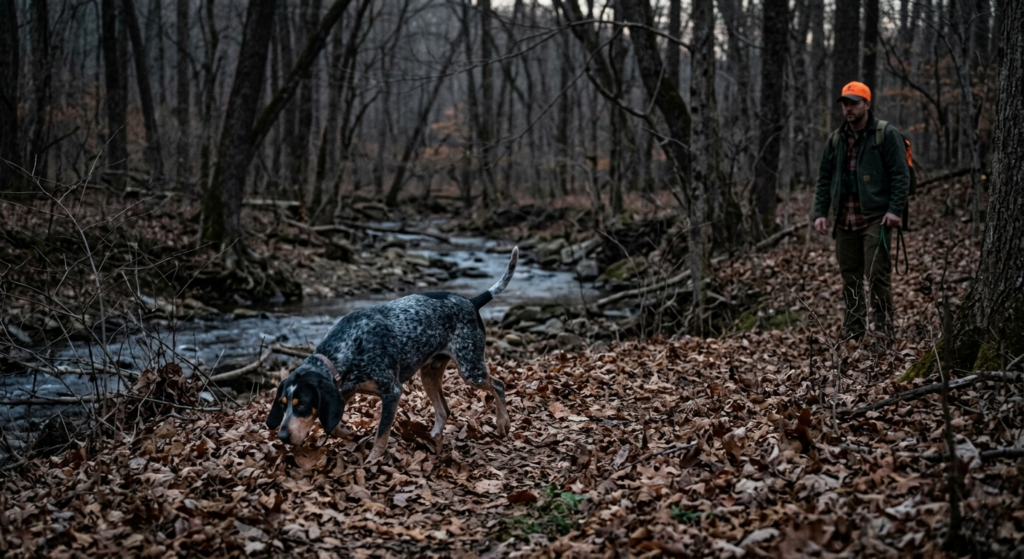
You had a young dog doing right. Working tracks clean, finishing, showing you the ability you hoped for. Then something shifted. Now it blows past tracks it should work or leaves an area before it sorts anything out.
The first instinct is to think the dog has a nose problem. It does not. This is almost always a handler-made issue that crept in while things were going well.
Too much early success can dull a young coonhound just as fast as too much failure. When a dog gets steady hot drops and quick trees, it stops building the track mind it needs for the long run. Understanding that is the first step toward fixing it.
If you want to understand why handler decisions at this stage shape everything that follows, the foundation is laid out in how to train a tree dog the right way.
What Is Actually Happening
The dog is not getting lazy. It is getting conditioned. Every time it got turned loose on a hot track and ran straight to the tree, it learned that good things happen fast. Now it is hunting for that same feeling instead of working the problem in front of it.
Tracks that do not fire immediately get left. The dog overshoots turns because slowing down has never been rewarded. It starts drifting, covering ground without committing, looking for the next easy score.
Mentally the dog has shifted from track-focused to tree-focused. Or worse, it has slipped into a mode where it is just running through the woods without a real purpose. The nose did not get worse. The brain stopped using it correctly because it stopped having to.
This same speed-over-accuracy breakdown shows up differently in older dogs too. How to handle a coonhound that trees fast but misses under hunt pressure covers what happens when that habit gets locked in and how to address it before it becomes permanent.
The nose is still there. The patience is not. And patience on a track is something a dog has to learn through repetition. If it never needed patience, it never built it.
Why It Happens
Too many hot tracks in a row. The dog never had to solve anything. The coon was always close, the track was always fresh, and the tree came quick. There was no reason to slow down and puzzle through a difficult piece of scent.
Reward came too fast. Treeing became the only goal the dog understood. Tracking became something to rush through on the way to what it actually wanted. That is backwards. The track is the work. The tree is the result of doing the work right.
Hunting too frequently without variety is part of it too. Same conditions, same cover type, same coon density. The dog never had to adjust. It developed one gear because one gear was always enough.
Handler pressure on speed made it worse. A dog that gets praised every time it trees fast learns to tree fast. If track accuracy is never noticed or rewarded, it fades. What you reinforce is what you get.
And some young dogs simply hit mental overload. Too much stimulation, too many hunts, not enough time to process. A dog that is mentally fried will look like it forgot everything it learned.
How to Fix It
Step 1 is to slow everything down. That means hunting less for a short stretch, not more. The dog needs to reset mentally before new habits can build. Pushing harder when things start slipping almost always makes it worse.
Step 2 is to hunt worse conditions on purpose. Cooler tracks, drier ground, thinner country. You want the dog to have to actually use its nose instead of relying on momentum and a hot line. Make it earn the information it needs to keep moving.
Step 3 is to hunt alone. No pack, no competition. A dog that runs in company can hide behind the other dogs. Alone, it has to figure the track out by itself. That pressure, handled correctly, is what builds a real track mind.
Step 4 is to let bad tracks play out. Do not pull the dog off a difficult piece just because it is slow. Let it work. The concept of rebuilding patience through harder tracks is covered in detail in how to teach a young coonhound to slow down on cold tracks, and the same patience-building logic applies directly here.
Step 5 is to correct the quit, not the mistake. If the dog overruns a turn and has to circle back, that is fine. That is learning. If the dog leaves a workable track entirely and starts hunting on its own terms, that is where correction belongs. There is a difference between struggling through a track and abandoning it.
Step 6 is to quietly change what you favor. Pay attention to how tracks are worked, not just whether the tree came. A dog that slowly works a hard track to a tree has done more than one that burned through an easy one in three minutes. Adjust what you notice and what you respond to.
What Most Handlers Get Wrong
The most common mistake is hunting harder when the dog starts slipping. More nights out, more hot coon, trying to get the dog back on a roll. That is the opposite of what it needs. More hot drops at this point just deepens the problem.
Handlers also tend to assume the dog is losing ability. It is not. They created this situation with their hunting choices and they can fix it the same way.
Switching methods too fast or piling on pressure is another mistake. The dog does not need harder correction on its track mistakes. It needs to be put in conditions where its track mind has to wake back up.
Bragging on speed when the dog was young set this up. A young hound that trees fast gets praised. The handler tells everybody about it. Nobody talks about the tracks that got overrun to get there. That selective attention shapes what the dog practices.
The hardest thing to admit is that most cases of a young dog skipping tracks trace back to a run of good hunting. Success created the problem. That is uncomfortable, but it is usually accurate.
Devil’s Advocate
Some handlers will push back and say their dog has always hunted fast and it has never been a problem. That may be true if the dog is finishing tracks accurately and not missing coons. Speed is not the issue. Speed without accuracy is.
There is also a real argument that some dogs are just built to hunt at a different pace than others and that trying to slow them down creates more problems than it solves. That is worth considering. If a dog is genuinely tracking and committing and the tree is just happening fast, leave it alone. This article is about a dog that is skipping tracks it should be working, not a dog that works them quickly.
The question worth asking is whether the coon is actually being treed accurately or whether the dog is just treeing in areas where coons should be and getting lucky. Those two things can look the same on a good night and very different on a bad one.
Quick Fix Checklist
- Cut back hunting frequency for two to three weeks
- Move to cooler, drier, harder tracking conditions
- Run the dog alone — no pack, no company
- Let slow tracks play out instead of pulling off
- Correct the quit, not the overrun
- Stop rewarding speed and start noticing track commitment
- Give the dog time to reset before evaluating results
When to Leave It Alone
Not every dog that runs fast is broken. If a young dog is still finishing tracks consistently and the coon is genuinely where it said it was, you may not have a problem.
A young dog going through a temporary rough stretch after a run of good hunts is not the same as a dog that has permanently lost its track mind. Watch for a week or two before making changes. One bad night is not a pattern.
If accuracy and track commitment are still there and the dog occasionally skips a track that was not workable to begin with, do not micromanage that. Young dogs make mistakes. The measure is whether they are committed when the track is actually there to be worked.
Coonhounds are bred with strong trailing instinct, and that foundation does not disappear when a young dog hits a rough patch. According to
According to the United Kennel Club’s coonhound breed information, trailing ability and desire are core breed traits — the work at this stage is about conditioning that ability properly, not rebuilding something that was never there.
Closing
This problem usually comes from giving a young dog too much easy success too fast. A coonhound needs some struggle to develop a real track mind. That struggle is not failure. It is how the dog learns to commit.
If you see one start skipping easy tracks, back up and change the conditions before you change anything else. Make the dog think. Let it work through something difficult without interference. That is when the track mind comes back.
The goal was never a fast dog. It was a dependable one that can move any track it comes across, in any conditions, on any night. Build that and the speed will take care of itself.