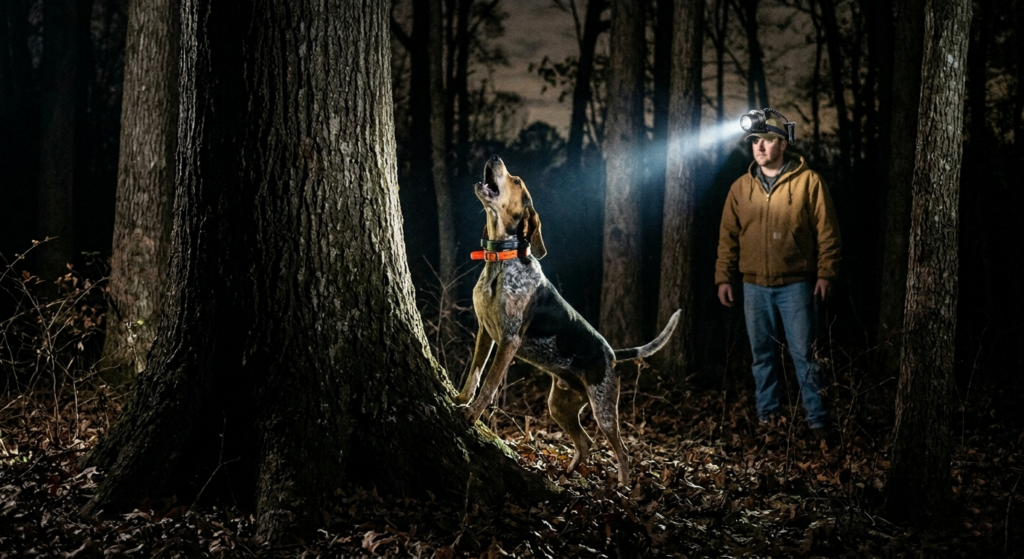
Every night in the woods, you are building something. Whether you know it or not, every reaction you have to your dog is a lesson. Every bit of praise, every moment of silence, every correction that comes a second too late is shaping what that dog understands about how to hunt.
Most handlers think about training as the deliberate sessions, the commands, the drills. They don’t think about the thousand small moments in between, the ones where the dog did something and the handler responded from emotion instead of intention. That gap, between what you meant to communicate and what the dog actually received, is where most coonhounds go wrong.
The dog is not being difficult. The dog is doing exactly what it has been consistently told is correct. If you want to understand why your hound hunts the way it does, stop looking at the dog. Start looking at what you have been rewarding. Solid
The foundation of this thinking goes back to the core of all coonhound training: a dog runs the program you built. If the program is producing bad results, the problem is in the program, not the dog.
What’s Actually Happening
A coonhound is running a simple equation. Behaviors that produce a response get repeated. Behaviors that produce no response fade out. That is not a training philosophy, it is biology. A dog adjusts what it does based on what follows the behavior. Handlers assume they are rewarding the right things when often they are reinforcing something else entirely.
Take a common example. A young dog hits a tree hard and opens up with a big, impressive voice. The handler lights the tree, sees nothing, but praises the dog anyway because the effort was real and the enthusiasm was visible. That happens three times. Five times. Fifteen times over a season.
What has the dog learned? That hitting a tree hard and opening up earns praise regardless of what is actually in the tree. The dog has not learned to be honest. It has learned to perform.
This is not the dog’s fault. It is doing exactly what the pattern of feedback told it to do. The problem lives in the handler’s response, not in the dog’s instinct. And because the pattern was built slowly, a little praise here and a little excitement there, most handlers never see it being constructed.
Why It Happens
Three patterns drive most reward-based problems in coonhounds, and all three come from the handler side of the line.
The first is rewarding what looks exciting rather than what the situation actually warrants. A loud mouth, a hard-running dog, a fast tree: these things feel like progress even when the underlying work is sloppy. When the emotion of a good night is running high and the air is cool and the leaves are crisp underfoot, it is easy to praise before thinking.
The second is inconsistency. A dog that slicks a tree gets corrected one night and praised the next for the same behavior because the handler was tired, or in a group, or didn’t want to look critical in front of other hunters. That inconsistency teaches the dog that rules are situational. It creates a hound that learns to read the handler’s mood instead of reading the track.
The third is rewarding effort instead of accuracy because the handler doesn’t want to discourage a dog that is trying. That instinct is understandable. Nobody wants to flatten a young dog. But there is a real difference between withholding a reward and actively praising wrong behavior. Not saying anything when a dog slicks a tree is neutral. Praising a dog that slicked a tree because you felt bad for it is a deposit into the wrong account.
Each of these patterns adds noise to the signal the dog is trying to read. Dogs learn from clarity. When the reward signal is muddy or inconsistent, the dog does not learn nothing. It learns the wrong thing.
How to Fix It
The fix is not complicated but it requires more discipline from the handler than from the dog.
Do This: Decide before the hunt what earns praise and what does not. A dog that trees correctly and holds gets rewarded. A dog that opens on an empty tree gets silence, not correction, just silence. Withholding the reward is enough to let the dog sort it out in most cases. If that same dog leaves the empty tree, circles back to the track, and works it correctly to a tree that has something in it, that is the moment to make the praise count. Big, clear, immediate.
Do This: Wait for commitment before rewarding. A dog nosing around a tree and making intermittent noise is not the same animal as a dog that has worked the track clean, circled, checked, and is now standing at the base with its whole body locked in and its voice steady. Those are two different behaviors. The first needs more time. The second has earned something.
Do This: Be consistent between nights. The standard that applies on a good night with humid air and easy scent applies on a hard night when everything is cold and dry and the track is two hours old. The only thing that should shift based on conditions is your expectations for speed and range. Accuracy is always the standard, regardless of how difficult the conditions make it.
The habit of treeing fast and missing is one of the clearest signs that enthusiasm has been rewarded over accuracy. If that specific pattern has taken hold in your dog, how to handle a coonhound that trees fast but misses under hunt pressure breaks down what that looks like on the track and how to walk it back without breaking the dog’s desire in the process.
Do Not Do This: Praise a dog to keep it from feeling discouraged. A coonhound that makes a mistake is not going to be damaged by silence. Silence is neutral information. What hurts a dog’s development is mixed signals delivered by a handler who cannot hold a standard across nights.
Do Not Do This: Let the social environment change your standard. When you’re hunting with a group and other handlers are praising everything, the pull to do the same is real. That pressure is the enemy of clear feedback. Your dog does not care about the social dynamic. It only cares about what the pattern of consequences tells it is correct.
What Most Handlers Get Wrong
Most handlers look at a dog with a slick treeing problem or a dog that runs trash and immediately ask what is wrong with the dog. They try different corrections, different timing, different pressure levels. None of it works because the problem is upstream of all of that. The dog has been running a reward program that nobody deliberately designed but everybody contributed to.
Research on working dog training confirms what experienced hunters have observed for generations: behavior increases or decreases based on what consistently follows it. A peer-reviewed study on working dog training published by the National Institutes of Health examines how consequence shapes behavior across working dog contexts far beyond simple obedience commands, noting that what a dog finds reinforcing, and when that reinforcement is delivered, determines which behaviors strengthen over time. That research is worth reading for any serious handler at pmc.ncbi.nlm.nih.gov/articles/PMC8353195.
Most handlers also underestimate how quickly a pattern locks in. Ten nights of inconsistent feedback can establish a habit that takes thirty nights of clean, consistent feedback to undo. Young dogs are especially fast to build reward associations because they are in an active learning phase. What you reinforce in the first season sets the tone for years of hunting.
The fix is not to be harder on the dog. The fix is to be clearer. Clarity is kind in training because it gives the dog real information to work with. A dog that understands the standard is a dog that can rise to it.
Devil’s Advocate
Here is the other side of this argument. Some experienced hunters will tell you that you cannot nitpick every tree, that dogs need encouragement especially in the early going, and that being too stingy with praise creates a timid dog that stops trying. There is truth in that position.
Overcorrecting a young dog that is making honest mistakes while genuinely trying to figure things out is a real way to ruin potential. A dog hunting in cold, dry air on a quarter-mile-old track that gives its honest best and still comes up short on a tree does not need silence. It needs acknowledgment for the effort on the track, not the result at the tree. Those are different things.
The doctrine here is not about praising less. It is about praising correctly. A handler who withholds praise from everything out of fear of reinforcing a mistake is making the same error as one who praises everything out of excitement. Both are operating from emotion rather than intention.
The goal is precision. Praise the behavior that warrants it, clearly, immediately, and without hesitation. Let everything else go quiet. That combination, accurate praise delivered at the right moment, is more valuable to a young coonhound than any correction you will ever design.
When to Leave It Alone
There are nights when the right answer is to say nothing at all. When a dog is working a cold track in rough conditions, scent dragging across wet hardwood leaves with the temperature dropping and the wind shifting, the last thing it needs is the handler talking at it. Silence is not indifference. Silence is respect for the work.
Young dogs sorting out their first solo nights need to make decisions without interruption. If you step in every time the dog hesitates or takes a wrong line, you are training it to wait for your input instead of developing the judgment to solve problems on its own. That crutch is hard to remove later.
Part of knowing when to stay quiet is being honest with yourself about what you are actually seeing. Separating a dog that is improving from a dog that just had a good night under easy conditions requires the kind of handler discipline discussed in how to judge progress in a young coonhound without lying to yourself. Staying out of the way at the right time is one of the harder things a handler learns to do.
There is also a version of this where the dog is simply grinding through a hard night and needs to work it out. Not every slick tree on a cold, still, dry night is a reward problem in development. Conditions matter. Context matters. The pattern across many nights is what tells the truth, not a single bad tree when the scent is terrible and the air has not moved in three days.
Quick Fix Checklist
- Decide what earns praise before you leave the truck, not after the dog trees
- Wait for full commitment at the tree before rewarding, not just noise and effort
- Use silence, not correction, when a dog trees empty on most nights
- When a dog self-corrects and finds the right tree, make the reward count immediately
- Hold the same accuracy standard regardless of who is watching
- Be consistent night to night, same standard on easy nights and hard ones
- Know the difference between rewarding accuracy and rewarding enthusiasm
- If a dog leaves a bad tree on its own and works back to the right one, that earns more praise than a clean tree on an easy night
A coonhound does not arrive in the dark woods with a plan to fool you. It shows up with instinct, desire, and a willingness to go find something. What it becomes over the next two or three years depends almost entirely on what you tell it is correct. That information is not delivered in training sessions or careful planning. It is delivered in real time, every time you react or fail to react to what the dog does in the night.
A finished night dog is built on consistent feedback delivered with honesty over time. Not harshness. Not endless encouragement. Honest feedback, applied at the right moment, held to the same standard across all conditions and all company.
The dog becomes what the reward pattern teaches. Make sure what you are teaching is what you intend to build.