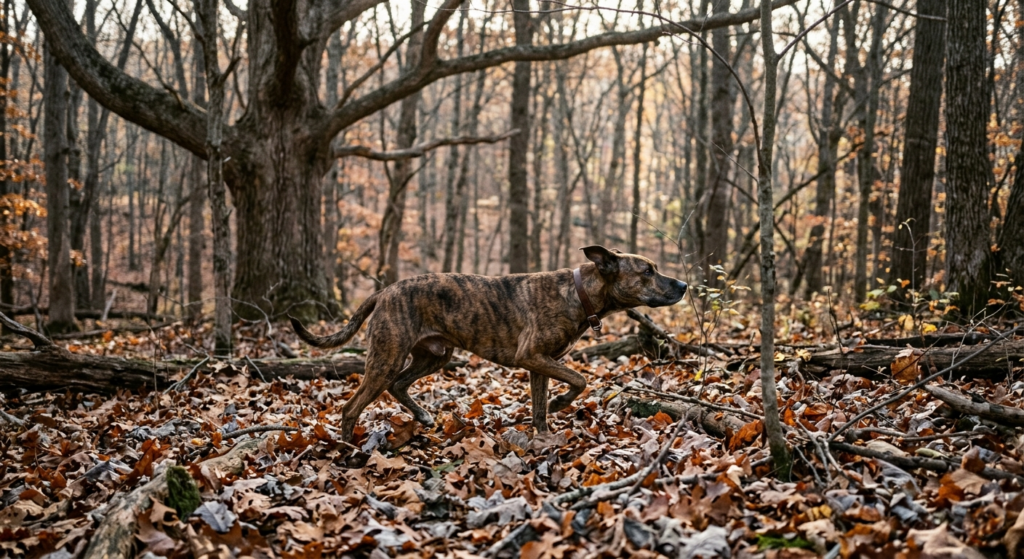
Most handlers come to their first squirrel dog with a picture in their head. Fast, wide-ranging, honest at the tree, independent. Something impressive. Something that reflects well on the handler who picked it and put the time in.
The dog arrives with something different. Not a blank slate. Not a problem to be managed. A set of instincts, tendencies, and biological wiring that has been in development for longer than the handler has owned it. The capability is there or it isn’t. The style is going to emerge whether the handler shapes it correctly or not. And the ceiling on what that dog can become was largely established before the handler ever put it in the woods.
The job is to create the right conditions for that to reveal itself. Then stay out of the way long enough to see what you actually have.
What most handlers do instead is try to manufacture something. They run the dog too hard, correct too early, make every session about producing visible progress instead of building real ability. They end up with a dog that has been shaped by constant intervention instead of one that learned how to think in the timber on its own terms. That is the more common outcome, and it is almost always the handler’s contribution to the problem.
The foundation of all of this is covered in the broader work of squirrel dog training: build clean conditions, reward the right things, and let development happen on the dog’s timeline. That principle does not get easier to apply just because you understand it. It gets harder.
What’s Actually Happening
A squirrel dog is not a general-purpose animal that you can train from scratch. It is a working breed or cross that has been selected over generations to express specific behaviors — hunting drive, scent discrimination, treeing instinct, independence in the timber — that are substantially genetic in origin. What the handler does with the dog refines those traits. It does not create them.
Research published through the National Institutes of Health confirms what experienced breeders have observed for generations. A peer-reviewed study examining behavioral genetics across more than 14,000 dogs found high levels of heritability for core working behaviors, with a mean among-breed heritability of 0.51 across 14 behavioral traits. The working behaviors that define a squirrel dog — drive, ranging tendency, independence, hunt style — are exactly the kind of traits that research identifies as strongly genetic. The full study is available at pmc.ncbi.nlm.nih.gov/articles/PMC6790757.
What this means in the woods is that the dog you got is largely the dog you are going to have. The training you do either allows that potential to develop cleanly or introduces interference that buries it. Most handlers, without realizing it, spend a significant portion of a young dog’s first season doing the latter.
The reveal happens naturally when the right conditions are in place: regular exposure to squirrel country, reasonable hunt lengths, solo work at an appropriate age, and a handler who is willing to watch what the dog does without constantly redirecting it. When those things are present, the dog shows you what it is. What it does on its own, when there is nothing guiding it, is the most honest data you will get about its real potential.
Why It Happens
Handlers manufacture problems for two reasons.
The first is that visible progress is reassuring. A dog that looks like it is improving — finding squirrels faster, ranging wider, treeing with more confidence — gives the handler feedback that the work is paying off. A dog that is slowly developing on its own internal timeline, making mistakes, working through problems without obvious breakthrough moments, creates anxiety. That anxiety pushes handlers to intervene when intervention is the last thing the dog needs.
The second reason is expectation mismatch. Every handler has a mental model of what a good squirrel dog looks like, usually built from watching finished dogs or hearing other handlers describe theirs. A young dog at six or eight months does not look like that. It looks like a mess. That gap between the mental model and the dog in front of you creates pressure that almost always results in overhandling.
The cumulative effect is that the dog never gets clean, uninterrupted development time. Every session has some level of handler input layered on top of what should have been the dog sorting things out on its own. Some of that is appropriate early on. Most of it, delivered in the amounts most handlers apply it, is not.
How to Fix It
The fix is a commitment, not a technique.
Do This: Hunt the dog in good squirrel country at an appropriate age and let it work independently. The handler’s job during those sessions is to stay quiet, stay out of the hunt, and observe. Not passive indifference, but active, disciplined observation. You are gathering real information about what the dog does naturally. That information is worth more than any correction you will ever apply.
Do This: Let mistakes complete. A dog that false trees on an empty limb and gets no reward, then corrects itself and trees something real, has just done the most useful training available. That process happens without handler intervention. The reward pattern teaches accuracy better than any correction. The dog that is allowed to be wrong and then make it right on its own is developing real judgment, not just conditioned responses.
Do This: Calibrate your expectations to the dog’s actual stage. A seven-month-old dog that ranges fifty yards, finds two squirrels on its own, and trees them honestly is doing well for a seven-month-old. Judging it against a finished dog’s output is not useful information. Build accurate pictures of what good looks like at each stage of development and hold to those, not to an idealized finished image.
Don’t Do This: Correct what you cannot clearly identify as a pattern. One missed tree on a cold dry morning tells you nothing about the dog. Ten missed trees across ten separate hunts in good conditions starts to mean something. React to patterns, not incidents.
Don’t Do This: Add pressure during the primary development period. A dog that is still figuring out what squirrels are, how scent works in different conditions, and how to navigate timber on its own is not ready for correction-based training. What it needs is exposure, time, and success. Pressure introduced too early teaches the dog to manage the handler’s expectations instead of developing its own hunting instinct.
Don’t Do This: Override the dog when it is working. Steering a dog toward game it has not found on its own, closing the gap when it stalls, or calling it off a cold track before it has had time to work it out — these are all forms of interference that accumulate into dependency. The patterns that build handler-dependent dogs are covered in detail in what watching your squirrel dog fail costs you, and the cost is exactly what it sounds like.
What Most Handlers Get Wrong
The most common mistake is treating development as a project instead of a process.
A project has milestones, deliverables, visible progress toward a defined outcome. That mental model works for a lot of things but it is the wrong frame for a working dog. Development is not a project. It is a biological process with its own timeline that the handler can facilitate but cannot accelerate past certain limits.
Handlers who treat development as a project look for signs that the dog is responding to the training inputs they are providing. When those signs are slow to appear, they assume the inputs need to be increased or changed. They add more pressure, more repetition, more correction. What they are actually doing is adding noise to a process that runs better with less interference.
The second common mistake is deciding too early what kind of dog they have. A slow starter gets labeled as a dog without drive. A wide ranger gets labeled as a dog without focus. A dog that takes a full second season to come on gets written off before it ever had a chance to show what it was. These judgments, made on immature dogs in early development, are almost always wrong. The problem is that they shape what the handler does, and what the handler does then shapes the dog.
It is worth separating the question of whether a dog has ability from the question of whether the handler is creating conditions for that ability to show up. When a dog looks like it is coming up short, both questions need to be answered before the handler draws any conclusions.
Devil’s Advocate
Here is the honest challenge to this doctrine. Not every dog that looks like it needs time actually does. Some dogs are genuinely limited. Some lack the nose, the drive, or the instinct to develop into useful squirrel dogs, and the handler who waits for a development breakthrough that is never going to come has wasted a season or two that could have been spent building a better dog.
The counterargument is real, and it matters. Patience has a cost. Over-waiting on a dog without ability is not virtue. It is poor judgment dressed up as doctrine.
The distinction that matters is this: patience is appropriate when the dog is showing legitimate working behavior — hunting out, using its nose, showing interest in game — but doing it slowly or with less polish than the handler expected. That is development. That is worth waiting for.
Patience is not appropriate when the dog shows no genuine desire to hunt, no natural interest in scent, and no forward motion when put in good squirrel country across multiple sessions. That is a different situation. Waiting does not fix a dog that lacks the instinct to work. It just postpones an honest evaluation.
The tool for telling the difference is honest observation over time in good conditions. Get the dog in the right country. Hunt it in appropriate conditions. Give it enough solo sessions to show you what it actually does when everything is set up correctly. If the picture that emerges over weeks is consistently poor, that is real information. If there are sessions where the dog shows you something real, that is also real information. Do not let impatience turn a slow developer into an early retirement.
When to Leave It Alone
Leave it alone when the dog is covering ground with clear purpose and you are watching from the outside.
Leave it alone when the hunt is hard and the dog is continuing to try. Cold, dry mornings with poor scent conditions are not the right context for evaluating a young dog’s ceiling. What the dog does in those conditions while continuing to hunt is about character, not ability. Worth noticing. Not worth acting on.
Leave it alone when the dog is in its first full season of real solo work. A dog that has only recently started hunting independently is still building the mental map that tells it how to create its own hunt from scratch. That process has its own timeline and it takes longer than most handlers allow. The patterns around why young squirrel dogs stall when hunting alone almost always point back to the same prescription: more time and better conditions, not more input from the handler.
Leave it alone when what you are reacting to is how the hunt looks rather than what the dog is actually doing. Slow and methodical in open hardwood timber does not look impressive. It often produces the best dogs.
Leave it alone when you notice you are reacting to your own discomfort with watching the process rather than anything real about the dog’s behavior. That discomfort is the most honest signal you have that it is time to stand still and let the dog work.
Quick Fix Checklist
- Let the dog complete its own hunts start to finish before drawing conclusions
- Hunt in adequate squirrel density early, not thin timber that overwhelms a young dog
- React to patterns across multiple hunts, not single sessions or single bad mornings
- Let false trees stand and complete without interruption or comment
- Stay out of the hunt while the dog is working a track or a locate
- Give genuine solo hunters full seasons before evaluating their ceiling
- Separate the question of ability from the question of conditions and handler management
- When in doubt about whether to step in, wait longer than feels comfortable
A squirrel dog shows you what it is through its behavior in the timber over time. That reveal is the most honest training data available, and it is available only if the handler creates clean conditions and then gets out of the way.
Most handlers will never know what their dog could have become because they shaped it into something more manageable before it had a chance to show them. The dogs that get a clean development window and a handler disciplined enough to read what it produces are the rare ones that come out the other side looking like something real.
Read what is actually there. Not what you hoped would be there. Not what you wanted when you bought it. What is showing up in the timber, in real conditions, over time.
Build from that.