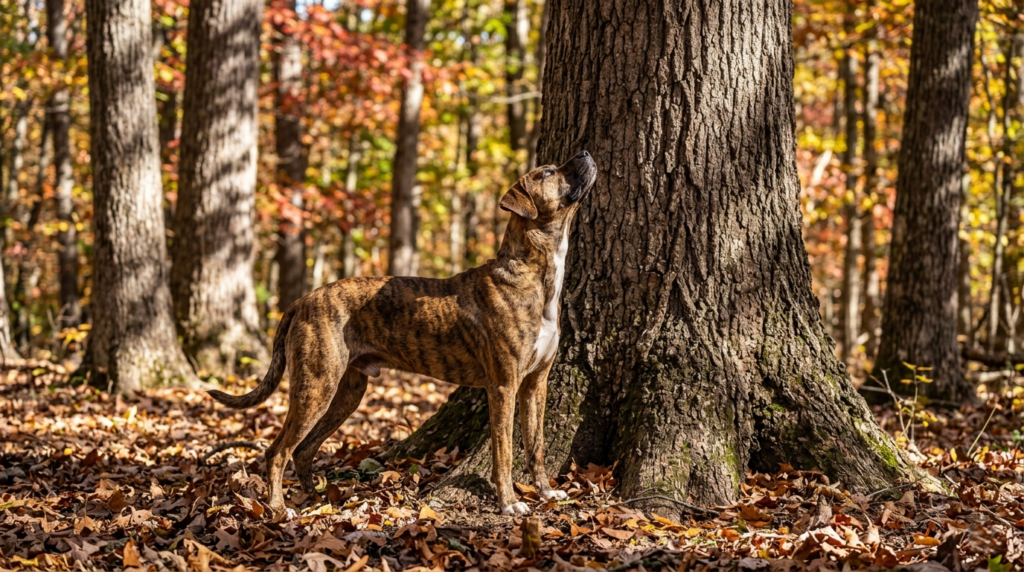
Most handlers buy a pup from proven bloodlines and immediately get to work. They watch videos. They read forums. They put together a schedule: first the yard, then the woods, then real game. They want to do this right.
The problem is not the effort. The problem is the assumption underneath it. Most training programs treat a squirrel dog pup like an empty container waiting to be filled. They assume the dog arrives knowing nothing, and the handler’s job is to build hunting ability from the ground up.
That assumption is wrong. It quietly ruins more dogs than anything else in this sport.
A good squirrel dog from serious bloodlines does not arrive empty. It arrives loaded. The drive to hunt, the instinct to tree, the ability to use scent and eyes together in daylight timber, the desire to work independently rather than look to you for direction, these things are encoded in the dog before you ever put a collar on it. What you’re really managing in the first year is not instruction. It’s exposure. There is a significant difference between those two things.
If you’re building a plan for squirrel dog training, understanding that distinction changes everything about how you approach those first sessions in the timber.
What’s Already Inside the Dog Before You Begin
Research published in Frontiers in Veterinary Science has established that specialized behavioral traits in dogs, including hunting and predation behaviors, are directly shaped by selective breeding at the genetic level. The genes responsible for hunting-specific drives have been refined over generations of purposeful selection.
When a cur or feist breeder talks about proving bloodlines, that is exactly what they mean. They have been selecting for the traits the dog needs to tree squirrels season after season. The ability to track, the desire to tree, the instinct to use both nose and eyes together in daylight conditions, those traits have been written into the breed over decades of selection pressure.
That means when you bring home a pup from a line of dogs with a long history of field work, the core abilities are already present. Not fully developed. Not finished. But present. The dog does not need to be taught what squirrels are. It does not need to be taught why trees matter. It does not need to be programmed to think independently. It needs time, exposure to real conditions, and a handler who can tell the difference between helping and interrupting.
The goal isn’t to manufacture hunt drive or tree instinct. It’s to develop what is already there without getting in the dog’s way. That’s the foundation behind our full guide on how to train a tree dog.
Why Handlers Assume They Need to Teach More Than They Do
Part of the problem is cultural. A lot of squirrel dog advice comes from the broader sporting dog world, where you will still hear the phrase squirrel dogs are made, not born. Compared to a pointing dog that lifts a paw by instinct in its first few months of life, it can feel like a squirrel dog requires more active teaching. That impression is not entirely wrong, but it is misread.
What is true is that a squirrel dog needs more contact with its quarry before its instincts fully fire. The treeing behavior in curs and feists is not as immediately visible as pointing. It takes a few real encounters with live squirrels before the full sequence starts to lock in. That lag between birth and visible instinct expression makes it look like a teaching gap. It is not. It is an activation gap.
Handlers fill that gap with drills, repetition, and constant praise. The dog gets rewarded for effort rather than accuracy. It starts to hunt for your approval instead of for the squirrel. The instinct is still there, but now it has to compete with everything the handler has layered on top of it.
How Interference Breaks What Instinct Was Building
The pattern shows up predictably. A young squirrel dog starts working the timber with honest effort. It hits a track, loses it, circles back, tries again. The handler watches this and gets impatient. The handler calls the dog in, redirects it, gives it a command. The dog complies. In that moment, the dog has learned something: when things get uncertain, look at the handler.
That single lesson, repeated across a season, creates a dog that cannot problem-solve on its own. Not because the ability was never there. Because every time the dog was about to figure something out, the handler intervened first. The dog learned that its own judgment does not matter when things get hard.
This is the pattern that fills the troubleshooting corners of every squirrel dog forum. Dogs that will not hunt solo. Dogs that abandon a cold track after two minutes. Dogs that check back constantly instead of committing to the work. In almost every case, those are not dogs with ability problems. They are dogs whose independence was trained out of them before it had a chance to solidify.
The Difference Between Developing a Dog and Building One
There is an important distinction that most beginners miss, and it shapes everything that follows.
Building a dog means adding something that is not there. You start with raw material and construct a behavior through training. This model is correct for obedience work. Behaviors like sit and come are not instinctual and do genuinely need to be installed through repetition and reward.
Developing a dog means allowing what is already present to express itself fully while protecting it from interference. This is the correct model for instinctual hunting behavior in dogs from serious bloodlines.
You are not building the drive to tree squirrels. That drive was placed in the dog over generations by the breeders who selected for it. Your job is to create conditions where that drive can grow without being crushed or redirected. Fewer commands. More squirrels. Less correction. More time.
What Real Development Actually Looks Like
A young squirrel dog that is developing correctly will frustrate you in the first season. It will range farther than you are comfortable with. It will commit to a slick tree and seem convinced when nothing is there. It will lose a track in dry leaves and cast around looking lost. It will sometimes walk away from a tree and keep hunting, and you will wonder if it just gave up.
None of that is failure. That is a dog working out the mechanics in real time. Problems that surface around tree checking, like a dog that commits to a tree without circling the base first, are almost always rooted in this same issue. The dog was never given enough space and time to work out the habit on its own terms.
The handler who understands genetic development holds back at the slick tree instead of immediately calling the dog off. That handler watches the dog reconsider, circle again, and leave the tree on its own if nothing confirms. That moment, the dog choosing to walk away from a bad tree without being told, is more valuable than any drill you could design. It is the dog learning to trust its own nose over its own excitement.
Good development also looks like irregular progress. A dog will improve, then seem to regress, then improve again. That is normal. Season one is mostly contact with real game. Season two is where the pattern begins to hold together. Some dogs do not fully arrive until season three. The handler who pushes that timeline creates problems. The handler who follows it builds a dog that works.
What Most Handlers Get Wrong
The most common mistake is treating early immaturity like a training deficit. The dog loses a track. The handler assumes the dog needs more tracking work. The dog slicks a tree. The handler applies a correction. The dog ranges too wide. The handler adds range training. In almost every case, the dog needs one thing: time.
Early immaturity looks identical to a training deficit on the surface. The difference is that a deficit requires intervention and immaturity requires patience. When you apply intervention to immaturity, you add pressure before the dog has the foundation to absorb it correctly. The result is a dog that becomes cautious, handler-dependent, or simply shuts down. The handler who over-corrects creates one kind of broken dog. The handler who lets a young dog run wild without structure creates another. Both errors start from the same misread of what training is actually for at this stage of development.
The second most common mistake is social hunting too early. Squirrel dogs hunt with their eyes and nose together in daylight, reading terrain constantly. That skill requires independent judgment to develop. A dog that spends its first season running with a finished dog learns to follow, not to hunt. Pull that dog out solo and the wheels come off. It hesitates. It mills. It looks for guidance that is not there. Solo hunting first, every time. Without exception.
Devil’s Advocate: Can a Dog Really Train Itself?
No, and that is not what this argues.
A squirrel dog needs squirrels. Consistently. It needs to encounter them in real hunting situations with enough frequency to activate and reinforce the instincts it was born with. Without that exposure, those instincts will not fully develop regardless of how clean the bloodlines are. A dog that never sees a live squirrel will not become a squirrel dog. This is not up for debate.
What this doctrine argues against is the idea that the handler is the primary teacher. The woods are. The squirrels are. You are logistics and management. You put the dog in a position to learn from the environment, protect it from experiences that would damage confidence before the foundation is solid, and stay out of the way while learning is actually happening.
The point is not that you should do nothing. The point is that most handlers would produce better dogs by doing less, and by doing what they do later and more carefully. The dog already knows more than you are giving it credit for. That knowledge deserves some room to grow.
When to Leave It Alone
Leave it alone when the dog is problem-solving.
If the dog has lost a track and is circling trying to reacquire it, that is not the moment to call it in. That is the most important learning moment in the dog’s day. Let it work. If it does not find the track, that is fine. It just learned what does not work. That lesson cost you nothing and taught the dog something a drill never could.
Leave it alone when the dog is at a tree.
If the dog has committed to a tree and you have no squirrel, the instinct is to call it off immediately and keep moving. Hold back. Give the dog thirty seconds to reconsider. Some dogs will walk off a slick tree on their own given silence and time. Others will intensify, telling you to look again. That process of self-correction is exactly what builds the kind of honest treeing behavior that holds up season after season.
Leave it alone in the first season, almost entirely.
Season one is for contact with game, building confidence, and getting the dog comfortable in real timber conditions. Corrections should be rare. Praise should be tied to actual accuracy, not excitement or effort. The handler’s main job in the first season is to be present, stay quiet, take notes, and give the dog the next opportunity.
Quick Fix Checklist
- Before adding a drill, ask yourself: is this a training gap or just immaturity?
- Hunt the dog solo before running it with finished dogs
- Let the dog work a lost track before calling it in
- Do not reward every tree. Make the dog earn it by being accurate.
- Keep first-season sessions short, 20 to 30 minutes, focused on game contact
- Praise accuracy, not excitement
- Do not correct confusion. Correct deliberate wrong behavior the dog already understands.
- Give the dog at least one full season before drawing any conclusions about ability
- A dog that improves in fits and starts is developing normally. Stay out of the way.
Closing
A squirrel dog from proven bloodlines is not a blank slate. It is a dog that carries the accumulated selection of every generation that came before it, every ancestor that hunted, treed honestly, and passed the ability on.
Your job is not to program that dog. Your job is to protect what is already there from being interrupted, undermined, or discouraged before it has a chance to fully arrive. Most of the teaching is already done. The breeders handled it. Your season one is not instruction. It is permission.
The handlers who build the best squirrel dogs are not the ones who work the hardest at the task of teaching. They are the ones who understand when to stop. They get out of the way, put the dog in front of game, and let instinct and experience do what generations of selection prepared them to do.
Show up. Stay quiet. Let the dog tell you what it already knows.