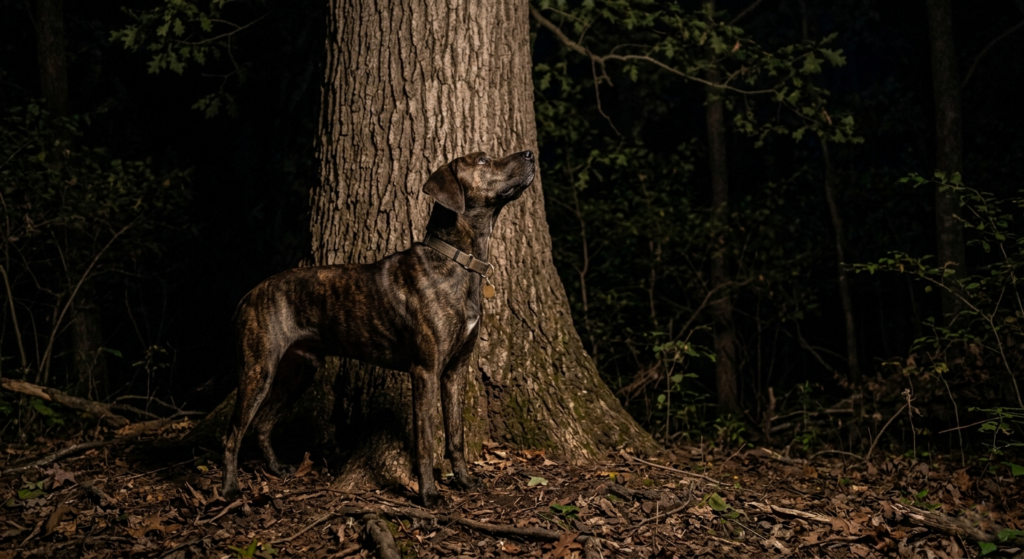
You’ve watched this dog hunt at home dozens of times. It ranges wide, opens clean, and stays honest at the tree. You know what it can do. So you enter it in a nite hunt, pay your entry fee, draw out in a three-dog cast, and the judge calls cut them loose.
The dog you’ve been watching all season is gone. It creeps out of your hand like it’s never seen dark timber before. Another dog opens first and yours starts following instead of hunting. It slicks a tree. Maybe it babbles on a cold spot. You walk back to the truck embarrassed and confused, wondering what happened to the dog you know.
Here’s what happened: the cast didn’t change your dog. It revealed it.
Every new variable the nite hunt format introduces — strange dogs, strange ground, a judge watching, handlers standing still instead of moving through the timber — exposed something that was always there. Not a fault in your dog’s breeding. A gap in its preparation.
Most handlers never learn this because they blame the environment. Cold night, bad draw, off game in the area. That’s the easy explanation. The harder one, and the more useful one, is that the cast is a diagnostic. It tells you exactly where your foundation is soft, if you’re willing to look at it straight.
What’s Actually Causing the Problem
A coonhound that performs well at home and falls apart on a cast is experiencing something specific. It isn’t stage fright. It isn’t a bad night. It’s the absence of the conditions it learned to rely on.
On your home ground, there are familiar variables your dog has come to depend on without you knowing it. It knows the terrain. It knows where coons move, where the creek bends, where the ridge drops off. It has been reinforced on that ground dozens of times and has a mental map of where success usually comes from. More importantly, it knows you. It knows your pace, your habits, how you move through the woods, when you tend to call and when you stay quiet.
Strip all of that away and put the dog on unfamiliar ground with two strangers’ dogs and a judge following the cast, and you’re not testing what you built. You’re testing how much the dog can operate without the crutches you didn’t know you were providing.
The most common version of this problem isn’t a lack of ability. It’s a lack of independence. A dog that hunts well with you on familiar ground may be doing so partly because of that familiar context. The cast strips that context and what’s left is the dog operating on its own resources.
The second cause is handler behavior. When there are points on the board and a judge watching, most handlers stop being themselves. They get tighter. They call more. They try to manage the cast from the ground instead of letting their dog work. That handler energy travels down the lead and into the cast. The dog reads it and either shuts down or starts looking back at the handler for direction instead of hunting forward.
The most reliable sign of this problem is a dog that keeps drifting back toward the handler during the cast. There is a direct line between that behavior and the conditions the dog was built in. If you have dealt with that pattern before, the work on building independence after too much company covers the root cause in detail.
What to Do Differently
The fix is not a competition strategy. It’s a training correction that has to happen before you ever pay an entry fee.
The single most important thing you can do to prepare a coonhound for the cast is put it on unfamiliar ground, alone, repeatedly, before it ever sees another dog in competition. Not unfamiliar as in the next county over one time. Unfamiliar as in: this dog has never worked this creek before, doesn’t know where anything is, and has to find game the same way it would need to on a cast it’s never seen. That’s the environment that builds the independence the cast demands.
If your dog hasn’t been required to solve unfamiliar terrain on its own, it hasn’t learned that it can. When the cast puts it on strange ground, the dog has no evidence from its own experience that it knows how to handle conditions like these.
The second correction is exposing your dog to other dogs in non-competition settings before putting it in a scored cast. Not running it with your familiar pack. Getting it around dogs it has never met, on ground it hasn’t worked, and requiring it to hunt independently rather than trail off those dogs. If a young dog draws a cast with a polished, fast-opening Treeing Walker it has never encountered before, it will follow. That following habit will cost it points and cost you the cast.
The third correction is the hardest: learn to stand still and stay quiet during the hunt. The dogs are doing the work. Your job is to stay out of the way. Every time you break silence to encourage or redirect your dog during a cast, you pull it back toward you instead of letting it hunt forward.
For handlers who have watched a young dog go up and down in its work — committed one night and sluggish the next — the confusion is often about what that inconsistency means. Most of the time it is not a warning sign. That question is covered directly in the article on whether a young hound lacks drive or is just learning to hunt alone, and the answer matters before you enter a dog in competition.
Common Mistakes Handlers Make
The first mistake is entering a dog too early. A handler who has watched a young dog look good on home ground for a few months decides it’s ready. Good performance on familiar ground is not evidence of competition readiness. Competition readiness means the dog has solved problems on unfamiliar ground, without another dog to follow, in conditions it couldn’t predict. If you haven’t tested that, you don’t know what you have yet.
The second mistake is treating a bad first cast like a character flaw. The dog fell apart, so the handler concludes something is wrong with it. More dogs have been written off after one bad competition night than from any actual deficiency in breeding. One cast tells you almost nothing about a dog’s ceiling. It tells you about that specific night under specific conditions. Take the information, adjust the preparation, and run the dog again.
The third mistake is changing your behavior on the cast compared to what you do in training. Handlers who normally give their dog room and silence get tight and verbal when points are being scored. The dog notices every bit of that shift. If your training has been quiet and the cast is not, the dog is operating in an environment it wasn’t prepared for — and you put it there.
The fourth mistake is drawing out before studying the format. The United Kennel Club’s coonhound program provides a clear overview of how a nite hunt works, including how dogs are scored on speed and accuracy, how a cast is organized, and what the rules require of both dogs and handlers. Reading that before you enter removes a category of first-cast problems entirely. You can find the overview at ukcdogs.com/coonhound-about. Showing up without that knowledge is a preparation failure, not a dog failure.
The fifth mistake is blaming off game, the draw, or the ground. Those factors are real and they affect every dog on the cast equally. If another dog scores and yours does not, the ground wasn’t the problem.
Do This / Don’t Do This
Do this:
- Run your dog on unfamiliar ground alone before entering it in competition
- Expose it to other dogs in low-stakes settings before its first scored cast
- Stand still and stay quiet during the hunt — let the dog work
- Read the UKC or AKC nite hunt rules before you draw out
- Give a bad first cast realistic weight — which is not much
- Look at what the cast revealed and train specifically to close that gap
- Enter the Registered category first and give the dog time to learn the format
Don’t do this:
- Enter a dog because it looks sharp on your home ground
- Call out or encourage your dog during the cast
- Write the dog off after one bad night
- Blame the draw, the terrain, or the other dogs on the cast
- Assume a dog that hunts well with its packmates will operate independently with strangers
- Enter a dog that hasn’t learned to solve problems alone on unfamiliar terrain
Devil’s Advocate
Here’s the conventional take: put your dog in as many casts as possible and let the experience teach it. Repetition fixes everything. Get the miles in and the dog will figure it out.
There’s something to that. A dog that draws out regularly will eventually acclimate to the format. It will learn to manage the pressure of strange dogs and strange ground over time.
But here’s the problem. Dogs that learn in competition learn under scored conditions, and the habits they form in those conditions are shaped partly by the pressure of points. A dog that figures out how to cope with a cast by trailing the dominant dog, or by babbling on cold ground because other dogs are opening, is not learning to hunt better. It’s learning to get through the cast. Those are different outcomes.
The more reliable approach is to build the foundation that makes the cast manageable before the dog ever draws one. That means unfamiliar terrain, solo work, and exposure to other dogs in non-scored settings. The cast then becomes a test the dog is actually prepared for, not a lesson it has to survive. That difference shows up in the scorecard and in the dog’s long-term development.
Quick Fix Checklist
If your dog fell apart on its first cast, run through this before the next hunt:
- Three or four trips to ground the dog has never worked before, run solo
- At least one run with an unfamiliar dog in a low-stakes, unscored setting
- An honest look at whether your behavior during the cast matched your behavior in training
- Read the scoring rules so you understand what the judge is evaluating
- Give the dog at least one more cast before drawing any conclusions about its ability
The cast doesn’t lie. That’s what makes it useful and what makes it hard to hear. When a dog that looked sharp all summer goes quiet the first time it draws out with strangers on unfamiliar ground, it isn’t telling you something is broken. It’s telling you exactly what it was built on and what it still needs.
Solid coonhound training is built on the ground before it’s tested in competition. The handlers who bring consistent performers to a cast didn’t find better dogs. They built them on harder conditions before the points started. That work doesn’t show up on a scorecard until the night you cut your dog loose on strange ground and it hunts like it belongs there.
That’s the dog you’re building. Get there the right way.