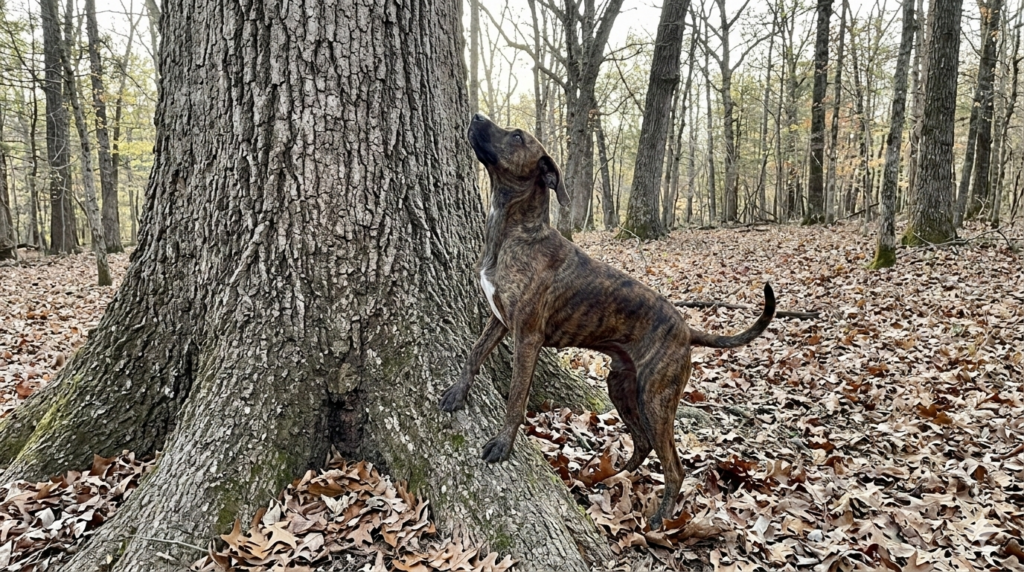
The question comes up every time a hunter decides they want a squirrel dog: which are the best squirrel dog breeds for the ground they hunt? It is a reasonable question, but the honest answer is that it depends more on your ground and your hunting style than on any ranking somebody put together online.
There is no single best squirrel dog breed. There are breeds that fit certain terrain, certain hunting pressure, and certain handler preferences better than others. Understanding what each breed tends to bring to the woods helps you make a smarter choice before you bring a pup home.
What follows is a plain look at the breeds most commonly used in squirrel hunting, what they are known for, and where they tend to shine.
Mountain Cur
The Mountain Cur is one of the oldest working dog breeds in American squirrel hunting. It was bred in the mountains of the South and Midwest by settlers who needed a dog that could handle game of all kinds, squirrels included.
In the squirrel woods, Mountain Curs tend to be aggressive hunters. They cover ground well, handle rough terrain without complaint, and most of them tree with real conviction. They are not delicate dogs. They were built for hard country and they show it.
The breed varies considerably from one bloodline to the next. Some lines run heavier and slower with a deeper, more deliberate track. Others are faster and more likely to range out. If you are buying a Mountain Cur pup, the bloodline matters as much as the breed.
Mountain Curs tend to do well in timbered terrain with moderate to heavy squirrel populations. They are a solid choice for hunters who want a dog with some size and drive and are willing to work with a dog that has an independent nature.
Feist
Feists are small, quick, and wired tight. They were bred to work close, get into tight cover, and tree fast. In the right conditions, a good Feist will put more squirrels in front of a hunter than almost anything else in the woods.
The term Feist covers a loose group of small hunting dogs with similar traits rather than one strictly defined breed. You will hear them called Mountain Feists, Thornburg Feists, and a handful of other regional names. What they share is a compact frame, high energy, and a nose tuned for squirrels.
Feists work best in areas where squirrels are concentrated and cover is manageable. They tend to tree quickly and bark with urgency. Their smaller size lets them move through brush that would slow a bigger dog down.
The tradeoff is that some Feists can be intense and may not suit every handler. They need an outlet for their energy. A Feist sitting in a kennel between hunts without enough activity can develop habits that are harder to manage in the woods.
For hunters who want a dog that works close and trees hard, a Feist is worth serious consideration.
Kemmer Cur
The Kemmer Cur came out of Robert Kemmer’s breeding program and was developed specifically as a squirrel dog. That focused origin shows in how these dogs hunt.
Kemmer Curs are known for being tractable, biddable, and consistent. They tend to be easier to handle than some of the more independent Cur lines, which makes them a reasonable choice for hunters who are newer to squirrel dogs or who prefer a dog that stays in contact more regularly.
They are reliable treers with good noses and steady dispositions. They do not typically have the raw intensity of a Mountain Cur or the tight, close-working style of a Feist, but they are well-rounded dogs that perform consistently across a variety of conditions.
If you are starting a young squirrel dog for the first time, a Kemmer Cur can be a forgiving breed to learn with. The disposition tends to make early training less complicated than it might be with a more hardheaded line.
Kemmer Curs have a strong following among dedicated squirrel hunters, and the breed club has done a good job of maintaining consistency in the line.
Treeing Feist
The Treeing Feist is a recognized breed through the United Kennel Club and represents one of the more refined versions of the small squirrel dog type. Where the broader Feist category is loosely defined, the Treeing Feist has a breed standard and more consistency in what you are getting.
Treeing Feists are quick, agile, and built to move through dense squirrel habitat with efficiency. They tree sharply and tend to have good voices for their size. Most of them work at a moderate range, close enough to stay connected with the hunter but wide enough to cover ground and find squirrels independently.
They handle well in mixed timber and brushy terrain. In areas with heavy hunting pressure and spooky squirrels that spend more time in the canopy than on the ground, a Treeing Feist that works the base of trees and reads wind scent well can be a real advantage.
For hunters who want the compact, fast-working style of a Feist with a bit more predictability in build and temperament, the Treeing Feist is a strong option.
Crossbred Squirrel Dogs
Some of the best squirrel dogs out there do not fit neatly into any breed category. Crossbred dogs, intentional or otherwise, have a long history in squirrel hunting. A Mountain Cur crossed with a Feist, for example, can produce a dog with the size and range of the Cur and the tight-treeing intensity of the Feist.
Individual ability outweighs breed every time. A well-bred crossbred dog from proven hunting parents will outwork a poorly bred purebred nine times out of ten. Pedigree matters, but pedigree means the dogs behind the dog, not just the name on the papers.
If you are looking at a crossbred pup, find out what it is crossed from and what those parents and grandparents produced in the woods. That tells you more than the label does.
Evaluating what a dog is actually doing once it starts hunting is where the real information lives. Understanding how to tell if your squirrel dog is tracking or guessing applies just as much to a crossbred dog as it does to any purebred. The woods do not care about papers.
How Terrain, Hunting Pressure, and Handler Preference Shape the Choice
Breed is only part of the equation. The ground you hunt and the way you hunt it will shape which dog fits your situation better than any breed ranking will.
Terrain. Open hardwood timber with good sight lines favors dogs that range wider and tree high. Thick creek bottoms and brushy hollows favor tighter-working dogs that can move through cover efficiently. A Mountain Cur built for ridgetop hardwoods may not work a swampy creek bottom the same way a close-working Feist would.
Hunting pressure. In areas with heavy hunting pressure, squirrels learn to be quiet and stay in the canopy. Dogs that work wind scent and read trees carefully do better in those conditions. In less pressured areas with active squirrels moving on the ground, a faster, wider-ranging dog can cover more ground productively.
Handler preference. Some hunters want a dog they can watch work a track across a hillside. Others want a dog that stays close and trees fast so they can walk from tree to tree. Neither preference is wrong. But matching a handler’s style to a breed’s natural tendencies makes the hunting experience better for both of them.
The full picture of how breed, training, and handler relationship fit together is covered in the squirrel dog training pillar, which walks through development from selection to finished dog.
Devil’s Advocate
Some hunters will tell you breed does not matter at all. That a good squirrel dog is a good squirrel dog and bloodlines are just marketing. There is a grain of truth in that.
Individual dogs vary enormously within any breed. A mediocre Mountain Cur will not outwork an exceptional Feist just because of what it is. And the best squirrel dog some hunters ever owned was something they could not explain on paper.
But dismissing breed entirely misses something real. Breed tendencies exist for a reason. They reflect generations of selection pressure for specific traits in specific conditions. Understanding those tendencies helps you ask better questions when you are evaluating a litter or a started dog. It gives you a framework, not a guarantee.
Use breed as a starting point. Let individual merit close the deal.
Quick Fix Checklist
- Match breed tendencies to your actual hunting terrain, not an ideal scenario
- Ask about the parents and grandparents, not just the breed name
- Consider hunting pressure in your area when selecting for range and treeing style
- Do not overlook crossbred dogs from proven hunting bloodlines
- Be honest about your handler preference before committing to a high-intensity breed
- Visit the dogs in person when possible before buying a pup
- A Kemmer Cur or Treeing Feist may suit a first-time squirrel dog handler better than a more independent Cur line
Find the Dog That Fits Your Woods
Breed gives you a starting point. It tells you something about how a dog is likely to work, how much range to expect, and what kind of handler relationship tends to bring out its best.
But the dog that fits your ground, suits your pace, and connects with how you hunt is more valuable than any breed title. Those things only reveal themselves over time, in the woods, with miles behind you.
Pick thoughtfully, start right, and let the dog show you what it is.