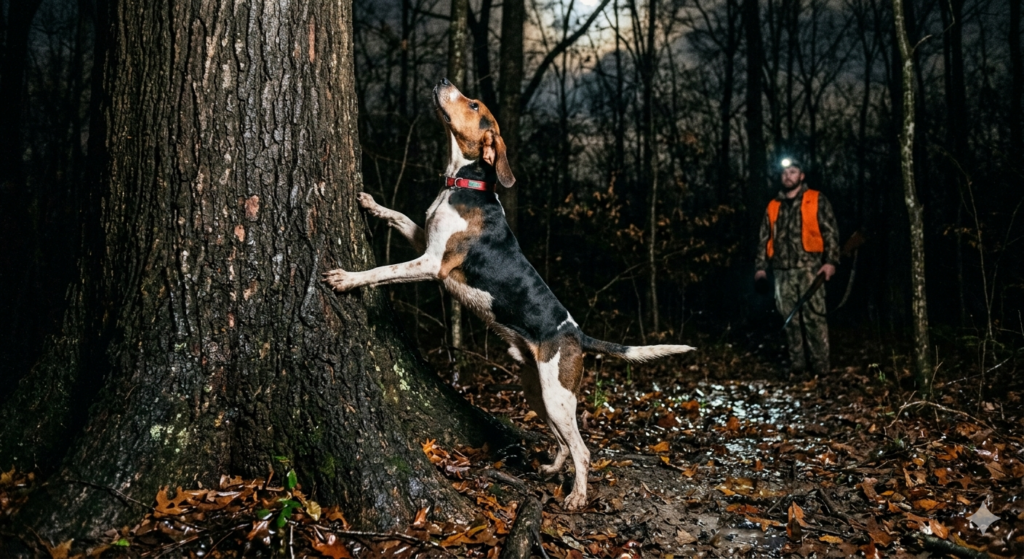
A young dog that barks at every dark tree it passes is not treeing. It is performing. There is a difference, and handlers who cannot see it early will spend the next two years trying to fix something they built.
A real locate is not a bark. It is a moment. The track tightens, the dog drops its nose to the base, scent rises, and the bark changes when the dog is convinced. That is the thing worth building. Everything else is noise.
Most guessing tree dogs are not born that way. They get built one rewarded mistake at a time. If you want to understand coonhound training at a level that produces honest, useful night dogs, this is where it starts: accuracy before style, certainty before performance.
This article is about what a real locate looks like, why young dogs start guessing, and what to do about it before it becomes a permanent habit.
What’s Actually Happening
When a young coonhound approaches the end of a track, several things are supposed to happen in sequence. The track tightens as the ground scent gets older and the coon started moving up. The dog drops lower, slows down, and starts checking the base of nearby trees. Scent starts rising off the bark. When the dog connects those two things and the picture clicks, the bark changes. That bark change is the locate. That is what honest tree instinct sounds like when it is working right.
A dog that is checking is not a dog that is guessing. Checking is part of the process. A young dog may circle, back off, nose the ground again, and test two or three trees before it settles. That is not a problem. That is a dog solving a problem.
A guessing dog looks different. It slams trees fast, usually the first big one it runs into near the end of the track. It may bounce from one tree to another without working the base of any of them. It is easy to pull off because it was never sure in the first place. It locates before it ever works the bad end of the track.
This pattern overlaps with what happens when a dog trees fast but misses under hunt pressure. Speed gets rewarded, accuracy does not, and the dog learns to beat the gun to the tree instead of learning to be right. Those are two versions of the same problem.
Some young dogs have more natural tree instinct than others. A dog born with strong tree drive will want to bark early and often. That is not a flaw. It is a gift if handled right, and a liability if you start rewarding it before the dog understands why it stopped there.
Why It Happens
Most slick treeing in young coonhounds is handler-made. That is a hard thing to say but it is usually true.
The most common cause is early reward. The pup runs to a tree, opens up, and the handler walks in fast, gets excited, or shows game on a tree the dog was never sure about. The dog does not learn what it did right. It learns that barking treed gets a response. So it barks treed.
Too much easy setup work builds the same problem from a different angle. Repeated drags, short flips, and feeder bucket drops are useful in very early stages, but they can create a dog that expects track problems to resolve quickly and close. When real hunting starts, the dog wants the same short payoff and starts cutting to the tree before it works the end.
Hunting with rough, speed-focused older dogs makes it worse. A young dog that packs with dogs that grab trees fast and loud will start copying noise and movement instead of learning to solve scent problems on its own. It learns the look of treeing without building the foundation underneath.
This is why starting a young hound the right way matters more than most hunters realize. The decisions made in the first season shape what the dog thinks treeing is supposed to mean. If treeing means getting to a tree fast and making noise, that is what the dog will do. If treeing means finishing a track correctly and being sure, the dog will work toward that instead.
Pressure at the wrong stage is another common cause. Correcting a young dog every time it hesitates at the tree pushes the dog to commit faster to avoid being wrong on track. The dog learns that uncertainty is punished, so it stops being uncertain. It picks a tree and stays there. That looks like confidence. It is not.
How to Fix It
Start by slowing down your own reaction. The handler’s excitement at the tree is often the biggest driver of guessing behavior. When you walk in fast on every tree, you are telling the dog that barking treed matters more than being right. Change that.
Only make a genuine event out of trees where the dog worked into the end honestly and looked right. On questionable trees, stay calm, stay back, give the dog time to figure it out. If it does not sort out, lead it off quietly. No drama. No correction. Just nothing.
Hunt for track finish, not tree style. Watch whether the dog is moving scent correctly toward the tree. Look for honest checking, base work, and the bark change. If those things are there, you have something to build on. If the dog is skipping the track end and jumping straight to the bark, that is what needs fixing.
Use good scenting conditions and easy coon carefully. Those setups are useful for building finish confidence, but they can also teach a dog to expect short, fast resolutions. Keep setups limited. Make sure the dog is still working a real track end before the payoff comes.
Leave bad trees empty. On a slick or obvious guess tree, lead the dog off calmly. Do not praise it. Do not linger. Do not give the performance any attention at all. Let the lesson be simple: guessing gets nothing.
Give the dog enough solo time to develop its own locate. A dog that always hunts with company never has to finish a track alone. It learns to follow excitement instead of scent. Solo hunts force the dog to solve the end of the track without guidance. That is where the locate becomes real and personal. It is also where you learn what you actually have.
When the dog gives a genuine locate, that is the moment for quiet, calm approval. Not wild celebration. Not a sprint to the tree. A steady, measured response that tells the dog: you got it right. Match the reward to the certainty, not the volume.
Repetition matters, but only clean reps. A few honest trees in a season teach more than a pile of rewarded guesses. Quality of experience builds accuracy. Volume of experience builds habits, good or bad depending on what you are reinforcing.
Devil’s Advocate
Some people will push back on this and say a young dog needs to build confidence, and that being too strict about slick trees will make it gun-shy about treeing at all. That is worth taking seriously.
It is a real concern if you apply pressure too hard, too early, or too often. A young dog that gets corrected every time it hesitates or checks two trees before settling will tighten up. It may stop offering tree behavior altogether, or it may start going to trees and barking without any conviction just to avoid the correction. Both outcomes are bad.
But there is a difference between withholding a big reward on a guess tree and punishing a dog for trying. Calm, neutral withdrawal of attention on a slick tree is not the same as a hard correction for checking behavior during an honest locate. One removes reinforcement. The other creates confusion and anxiety.
The goal is not to make the dog scared to tree. The goal is to make the dog understand that accuracy is what gets the response. That lesson lands through patterns over time, not through a single dramatic correction. If you are patient and consistent, you are not teaching the dog to be timid. You are teaching it that being right is what matters.
Also worth saying: some dogs take longer to sort out tree accuracy than others. A dog that is naturally high-drive and treey may guess more early on simply because its enthusiasm runs ahead of its experience. That is not a character flaw. It is a development timeline. Let the dog get older in the head before deciding you have a real problem on your hands.
What Most Handlers Get Wrong
The most common mistake is thinking more treeing equals more progress. It does not. A young dog that slams twenty slick trees in a night is not developing. It is practicing a bad habit at scale.
Confusing intensity with accuracy is close behind. A dog that trees hard and stays put looks finished. But finished-looking and honest are not the same thing. A dog can stay on an empty tree all night if staying there has always gotten a reward.
Pushing a pup to stay treed before it understands why it stopped is another one. Stay training has its place, but not before the dog has a real foundation for what it is staying at. Forcing commitment to a location does not build a locate. It builds a position.
Making excuses for slick trees because the dog is young and stylish is how most of these problems compound. Style and accuracy are different things. A stylish dog on a slick tree is still on a slick tree.
Hunting the dog with company so often it never learns to finish alone is a quiet mistake that shows up late. The dog looks fine in a pack. Then you run it solo and watch it mill at the end of the track with no idea what to do next.
Letting pride get in the way is the last one. Handlers who want their young dog to look good in front of people will plus trees they should have walked away from. The dog pays for that later.
Quick Fix Checklist
Run through this if your young dog is showing slick tree tendencies:
Slow down your own reaction at the tree. Stop running in on every bark.
Only make it a genuine event when the dog worked the track end honestly.
Lead the dog calmly off guess trees. No drama, no praise, no correction.
Cut back on easy setups or make sure they still require a real track end.
Give the dog more solo time. At least some nights alone, working its own problems.
Watch for honest checking behavior and stop correcting it. It is part of learning.
Match your reward to certainty, not to noise or speed.
Be patient with a young dog that is genuinely trying to sort it out. Not every rough tree end is a guessing problem.
The Long Answer to a Short Problem
A real locate comes from understanding the end of a track, not from teaching a pup to bark treed as fast as possible.
Guessing tree dogs are built one rewarded mistake at a time. Each slick tree that gets a big response is a brick in a wall you will eventually have to tear down. The work to prevent it is easier than the work to fix it later, and the fix is never as clean as the original.
Let the dog get older in the head. Reward certainty. Ignore empty guessing. Protect accuracy while the tree instinct is still taking shape. The dogs that develop into honest, reliable night dogs are almost always the ones that were given time and structure early, not the ones that looked finished at eight months and were never quite right after that.