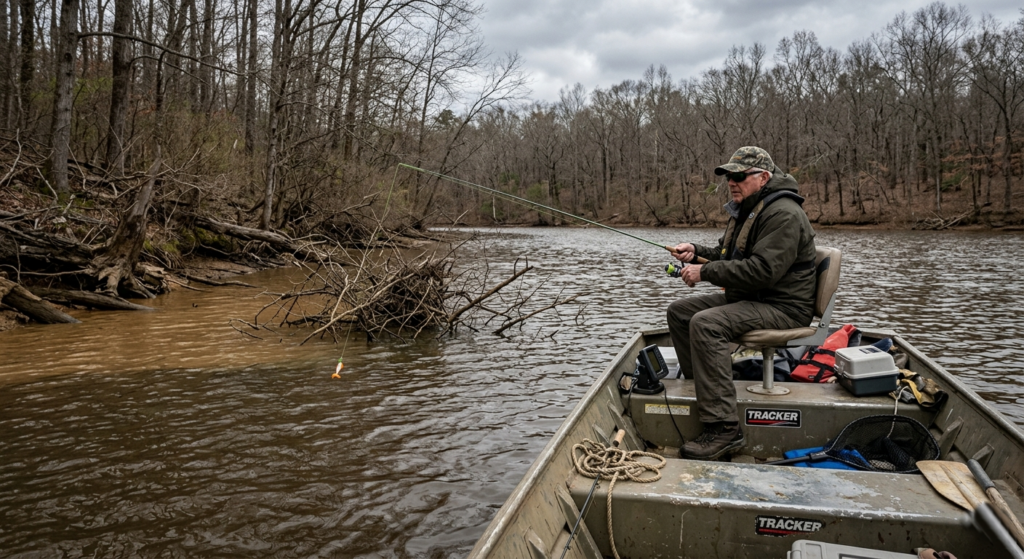
Spring should be one of the best times of year to chase crappie. The water is warming, fish are pushing shallow, and the bite is usually reliable. Then a hard rain rolls through, the creeks start dumping runoff, and suddenly the water looks like chocolate milk.
A lot of anglers pack it in at that point. That’s a mistake.
Crappie don’t disappear when the water gets muddy. They reposition. They tighten up. They get a little harder to find and a little pickier about what they can actually sense. But they’re still there, and they’ll still bite if you adjust your approach.
The key to crappie fishing in muddy water during spring is understanding what changes and what doesn’t. Once you know why fish move and how their strike zone shrinks, the adjustments you need to make become obvious. This article walks you through all of it.
Why Muddy Spring Water Changes the Crappie Bite
Understanding what muddy water actually does to crappie helps everything else make more sense.
Visibility Drops and the Strike Zone Shrinks
Crappie are visual predators. In clear water, they might dart several feet to grab a bait. In muddy water, that reaction distance collapses. A fish that would have moved three feet to eat your jig might now need it within inches before it commits. That’s not a reason to give up. It’s a reason to slow down and fish tighter.
Runoff Changes Temperature and Current
Spring rain often brings cold water into the system. Creek inflows carrying runoff can be significantly colder than the main lake water, and crappie are temperature-sensitive enough to notice. When cold dirty water pushes in, fish often back away from the source and find more stable conditions nearby. At the same time, current from runoff can disorient baitfish and make crappie less aggressive.
Crappie Hold Tighter to Cover
When visibility drops, crappie tend to compress against structure. They don’t roam and hunt as actively. Instead, they park close to a dock piling, pressed tight to a brush pile, or tucked behind a laydown. This is actually useful information because it tells you exactly where to put your bait.
The Dirty-to-Clean Edge Is the Most Important Concept
Here’s the thing most anglers miss: crappie don’t just scatter randomly when the water muddies. They often stack right at the line where stained water meets cleaner water. Find that transition zone and you’ve found the most productive water on the lake. More on how to find it in a minute.
Where Crappie Go in Muddy Spring Water
This is the question most anglers are asking when they pull up to a lake after a few days of rain. Here’s how to think about it.
Start With the Cleanest Water You Can Find
Before you even pick up a rod, look at the lake. Which coves look clearest? Where is the main lake water least affected by inflow? Which creeks are dumping the most? Start your search where conditions are best, not where you always fish.
On most lakes, the main body of water clears faster than the backs of creek arms. Protected secondary coves that don’t receive direct inflow often hold better water. Marinas, docks along main lake banks, and riprap near dam structures sometimes stay fishable when the backs of creeks are completely blown out.
Focus on Transition Lines
The place where muddy water meets cleaner water is almost always worth spending time. Crappie often stack along this seam because it gives them slightly better visibility while keeping them close to their pre-spawn staging areas. If you can see a visible color change in the water, that’s your starting point.
Secondary Coves Over the Backs of Creeks
When a main creek arm is pumping in muddy runoff, the very back of that arm is usually the worst place to fish. But secondary coves branching off the main creek arm, especially those with no direct inflow, often stay cleaner. These spots can hold fish that have slid away from the muddy inflow but haven’t abandoned the general area.
Wood, Brush, and Docks Near Spawning Flats
Crappie in spring are thinking about spawning even when the water is dirty. They don’t totally abandon their pre-spawn staging areas. Look for any laydowns, brush piles, dock pilings, or stumps that sit close to shallow spawning flats. These are ambush points where fish can hold tight and wait out the dirty water without moving too far from where they want to be.
Don’t Ignore Shallow Fish During Warm Stable Periods
If the rain has passed and temperatures are rising again, crappie might actually push shallower despite the dirty water. Muddy water absorbs heat faster than clear water in some conditions, which can warm shallow areas quickly. During stable warming trends after rain, check the shallows before you assume fish have pulled deep.
A Step-by-Step Plan for Catching Crappie in Muddy Spring Water
Here’s how to put it all together on the water.
- Eliminate the dirtiest water first. Don’t waste time where visibility is near zero. Identify which areas of the lake are least affected and start there.
- Find the transition. Look for the seam between cleaner and murkier water. That edge is your highest-percentage starting point.
- Find cover near spawning areas. Once you’ve identified a zone with decent water clarity, look for structure. Brush piles, dock pilings, laydowns, and channel swings adjacent to spawning flats are your targets.
- Fish tight. The strike zone is small. Don’t just cast near the cover. Put the bait right in it. One foot off a brush pile might as well be a mile in low visibility.
- Slow down. Work each target thoroughly. Give the fish time to find the bait. Muddy water is not a situation where burning through spots pays off.
- Adjust depth in small increments. Start at the depth you’d normally expect spring fish, then work up and down by a foot at a time. One-foot adjustments can make a real difference.
- Stay mobile but not frantic. If a spot doesn’t produce after a thorough effort, move. But don’t abandon a good-looking area after two casts. Fish tight, fish slow, fish every piece of cover before you leave.
Best Baits for Muddy-Water Spring Crappie
Bait selection in dirty water comes down to one question: can the fish find it?
Go Bigger Than You Normally Would
Finesse baits that shine in clear water often disappear in muddy conditions. Larger profiles are easier for crappie to detect through their lateral line and easier to see when visibility is limited. If you normally fish a 1.5-inch tube, try a 2.5-inch grub or paddle tail. The extra bulk doesn’t spook fish the way it might in clear water, and it gives them something to lock onto.
Jig Styles That Work in Dirty Water
Paddle tail grubs and curly tail grubs produce good vibration that crappie can sense even when they can’t see well. Tube jigs work because they push water and have a profile that shows up against structure. Hair jigs and marabou jigs have natural movement that can trigger fish when worked slowly around cover. The key is choosing something that moves water and holds a visible profile at slow speeds.
Live Minnows Are Hard to Beat
When artificials are struggling in dirty water, live minnows have an advantage that goes beyond what we can replicate with plastics. They put off natural scent, vibration, and movement that fish can detect even in low visibility. If you have access to lively minnows and the bite on jigs is slow, switching to a minnow under a slip float or on a tight-line rig can absolutely change your day.
Vertical Jigging vs Casting
Both work, but in muddy water, vertical jigging over known cover is often more efficient. It lets you keep the bait in the strike zone longer with fewer wasted casts. Casting has its place, especially along seam lines and transition zones, but when you’re over a specific brush pile or dock, dropping straight down and working slowly is usually the better call.
Best Colors for Crappie in Muddy Water During Spring
Color choice in dirty water is really about one thing: contrast and visibility.
Dark Colors Create Silhouette
Black, dark purple, and dark blue create a strong silhouette against murky backgrounds. Even when a fish can’t see color detail, it can often see the dark shape of a bait. This is why black and chartreuse is such a reliable combination in stained water. The dark body gives outline and the bright tail adds a visible pop.
Bright Colors Give Flash and Visibility
Chartreuse, pink, orange, and white show up well in dirty water, especially when there’s any light penetrating the surface. Solid chartreuse or white can be highly visible from a short distance even in significant turbidity.
Two-Tone Combinations Are Often Best
Pairing a dark body with a bright tail, or a bright body with a dark head, gives crappie both a silhouette and a flash target. Black and chartreuse, black and orange, and white and chartreuse are all reliable starting points for muddy spring water.
Light Conditions Matter Too
On overcast days, brighter colors like chartreuse and white often outperform. On bright sunny days, even in dirty water, darker silhouette colors can get more bites. When in doubt, try chartreuse first and then go darker if fish aren’t responding.
How Deep to Fish for Crappie in Muddy Spring Water
Depth is not one-size-fits-all, and it changes with conditions.
Warm Stable Weather After Rain
If temperatures have been climbing and the muddy water has been sitting for a few days without more rain, crappie may actually be in surprisingly shallow water. Muddy water warms faster in shallow areas, which can accelerate the spawn timeline and pull fish up even when visibility is poor. Don’t automatically go deep just because it’s dirty.
Cold Rain and Unstable Conditions
When the rain is recent, the water is actively rising, and temperatures are dropping, fish often back off the shallows and hold at mid-depth staging areas. Near channel swings, deeper brush, and drop-offs adjacent to flats are better targets during these conditions.
Use a Depth Check System
Before you start experimenting, fish your most likely depth based on the conditions. If it’s warm and stable and you’d normally find fish in four to six feet near spawning cover, start there. If you’re not getting bites, work up to three feet, then down to eight. Move in small increments. The fish are somewhere in the column. Your job is to find them efficiently.
How Fast to Fish for Spring Crappie in Dirty Water
Most anglers fish too fast in muddy water. This is one of the most common ways people come home empty-handed.
Slower Is Usually Better
When visibility is low, crappie need more time to locate and commit to a bait. A jig that sweeps through the strike zone quickly might never be detected. Slowing your retrieve, extending your pauses, and holding the bait in the zone longer all give fish more opportunity to find it.
What “Slow Enough” Actually Looks Like
Around brush or docks, slow means dropping the bait in, letting it settle, giving it a gentle twitch or shake, and then holding it still for a full two to three count before moving it again. It means making four or five presentations to the same target instead of one. It means not moving the boat until you’ve genuinely worked the cover from multiple angles.
When Current Is a Factor
If there’s some current from runoff, your bait will be moving faster than you think. Account for the drift and use enough jig weight to stay in contact with the bait. In current situations, positioning the boat upstream and letting the bait swing naturally through the strike zone can sometimes trigger fish that won’t bite a jigged presentation.
Mistakes That Ruin Muddy-Water Crappie Trips
Avoid these and you’ll be ahead of most anglers on the water.
- Fishing the absolute dirtiest water on the lake. If the creek is dumping in turbid runoff and visibility is near zero, there’s no presentation that fixes that. Find better water first.
- Using baits that are too small or too subtle. Finesse works in clear water. In muddy water, give the fish something they can actually detect.
- Covering water too fast. The mindset should shift from “find active fish quickly” to “locate the right area and then thoroughly pick it apart.”
- Ignoring shallow water during warming trends. Muddy water doesn’t always push fish deep. If it’s warm and stable, check the shallows.
- Making one cast per target. In dirty water, fish that are tight to cover might not react to the first presentation. Work the same spot multiple times from different angles before moving on.
- Refusing to switch from casting to vertical. When you find a specific piece of cover holding fish, vertical presentations often outperform repeated casting in muddy conditions.
How to Adjust for Different Muddy-Water Spring Conditions
Muddy water isn’t just one thing. Here’s how to think about different scenarios.
- After a cold rain: Cold runoff suppresses the bite. Focus on the clearest available water, go slightly deeper than usual, and slow everything down. Fish will be less aggressive.
- After several warm, stable days: Even if the water is still stained, warming trends activate fish. Don’t be afraid to go shallow and expect more aggressive bites.
- Rising water vs falling water: Rising water often pushes fish off their normal spots. Falling or stable water tends to settle fish back into predictable areas. Fishing a falling, stable lake after a rain event is often better than fishing during the rain itself.
- Light stain vs heavy chocolate mud: Light stain changes color choice more than location. Heavy mud changes everything: where you look, what you throw, and how deep you fish.
- Reservoirs vs small ponds and rivers: On reservoirs, you have the option to move to cleaner sections of the lake. On small ponds with no inlet, muddy water is more uniform and color and depth adjustments matter more than location changes. On rivers, find slack-water areas, backwaters, and eddies where fish stack to avoid current and muddy conditions.
Bank Fishing vs Boat Fishing for Muddy-Water Spring Crappie
Bank Anglers
If you’re fishing from the bank, focus on protected areas: the inside of coves with no direct inflow, shaded banks, dock areas, and any visible cover near where you’d expect pre-spawn crappie to stage. Look for the clearest water you can reach from the bank and work cover thoroughly before moving.
Boat Anglers
A boat lets you quickly assess multiple zones and find the cleanest water on the lake. Use that mobility to eliminate bad areas fast, then slow down once you find a productive zone. Electronics help in murky water because you can see fish holding tight to cover even when you can’t see them through the water.
Fishing Without Electronics
You don’t need a graph to catch crappie in muddy water. Focus on visible cover, fish tight, fish slow, and trust the process. Docks, laydowns, and bridge pilings are all easy targets you can see without electronics. Work each one thoroughly before moving to the next.
When the Water Is Just Too Muddy to Stay Committed
There are limits. If you’re fishing water where visibility is less than a few inches, crappie fishing becomes a very low-percentage game regardless of your adjustments. Signs that it’s time to move or come back another day include:
- Complete absence of any bites after thorough, slow presentations across multiple spots
- Actively running muddy current with no visible edge or transition
- Water temperature dropping significantly from the recent runoff
When that happens, the honest answer is to find cleaner water elsewhere on the lake, or wait. Crappie don’t feed as well in truly blown-out conditions. No presentation completely overcomes zero visibility.
FAQ: Crappie Fishing in Muddy Water During Spring
Can crappie still bite in muddy water during spring?
Yes. Muddy water changes their positioning and shrinks the strike zone, but it doesn’t shut the bite down. Focus on the cleanest available water, fish tight to cover, slow down your presentation, and use more visible baits.
What color jig is best for crappie in muddy water?
Black and chartreuse is one of the most reliable combinations. The dark body creates a visible silhouette and the bright tail adds flash. Solid chartreuse, white, orange, and dark blue are also productive. Two-tone combinations typically outperform solid colors in dirty water.
Do crappie go shallow or deep in muddy water?
It depends on conditions. During warm, stable periods after rain, crappie may stay surprisingly shallow because muddy water warms quickly in the shallows. During cold rain events or unstable conditions, fish often drop to mid-depth staging areas. Start at the depth you’d normally expect for the season and adjust from there.
Are minnows better than jigs in dirty water?
Live minnows have a real advantage in muddy water because they produce natural scent, vibration, and movement that crappie can detect even with limited visibility. When jigs aren’t producing, switching to a lively minnow is worth trying.
How soon after rain should you fish for crappie?
Falling or stable water is usually better than actively rising water. If the rain has stopped, temperatures are climbing, and the lake is stabilizing, that’s often the best time to get out. Fishing during heavy runoff and rising water is the hardest scenario.
Where is the best place to look after spring runoff muddies the lake?
Start with secondary coves that have no direct inflow, main lake banks near structure, and any visible transition line where cleaner water meets stained water. Avoid the backs of creek arms receiving direct runoff until conditions improve.
Do crappie leave the backs of creeks when the water gets muddy?
Often, yes. Fish that were staging near the back of a creek may slide toward cleaner water in the main creek arm or secondary coves. They don’t always travel far, but they do reposition. Check secondary pockets and transition lines near where you’d normally find them.
Is vertical jigging better than casting in muddy spring water?
Over specific cover, yes. Vertical jigging lets you keep the bait in the strike zone longer with fewer wasted casts. Casting is still useful for covering transition lines and searching, but once you locate fish, going vertical over the cover is usually the more efficient approach.
Closing Thoughts
Muddy spring water is a presentation and positioning problem, not a dead-end situation. Find the cleanest water available on the lake, look for transition lines between stained and clearer water, work cover that sits near pre-spawn staging areas, slow down your presentation, and use baits with enough profile and color to be detected in low visibility.
The crappie are still there. You just have to meet them where they are and give them something they can actually find.