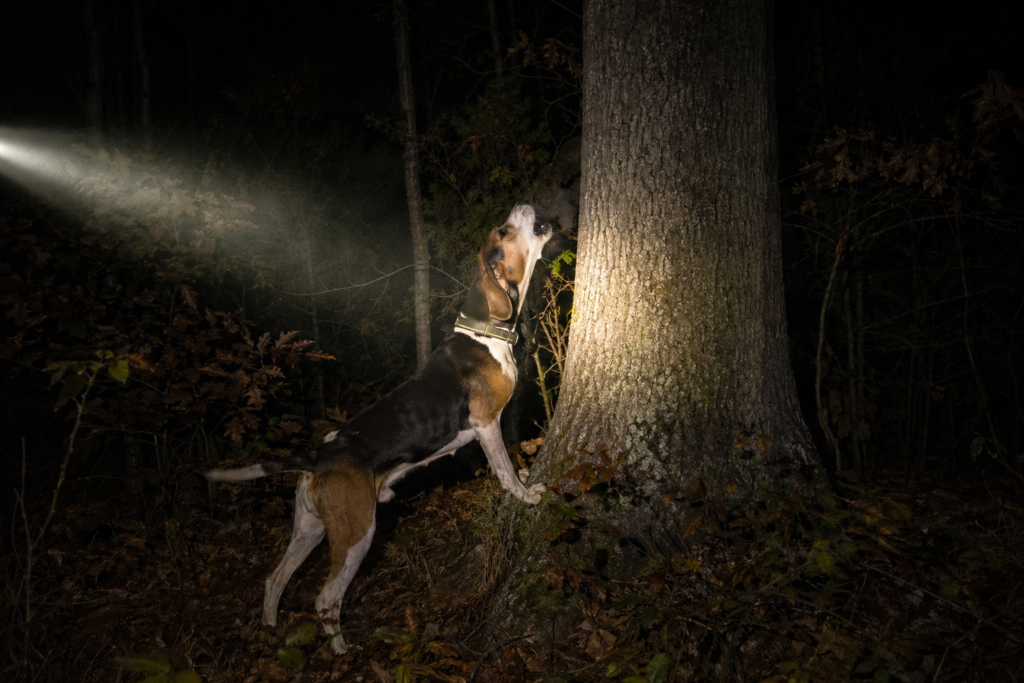
You are standing in the dark, somewhere in a creek bottom, and you have no idea where your dog went.
A minute ago, the dog was working the edge of the timber above you. Now there is nothing but crickets and your own breathing. You start to wonder if something went wrong. Then you hear it. One bark. Then two. Then a steady rolling bawl that starts to move through the woods, getting faster, more urgent, closing the distance between the dog and something it has found.
You start walking. Your headlamp bounces off the trees. The bawling gets louder. Then it changes. The tone shifts, tightens, and steadies out into a rapid, chopping bark that stays in one place. The dog is not moving anymore.
The dog is treed.
You walk to it. You shine your light up into the branches. Two eyes stare back at you from thirty feet up, bright orange and glowing in the beam. Your dog is below, locked on, telling the whole county about what it found.
That is coon hunting. The dog did every bit of the real work. You walked through the dark and pointed a light at a tree. But if you have never felt that moment before, it is hard to explain what it does to you. Most people who go once never completely stop.
This guide is for people who want to get into coon hunting but do not know where to start. Not a gear shopping list. Not a breakdown of the cost. The real information about how the sport works, what you need, and what your first nights in the woods are actually going to look and feel like.
What Coon Hunting Actually Is
Coon hunting is a night hunting tradition built entirely around the dog. You are not the hunter in the way most people think of hunting. You are the person who holds the light and makes the shot if you choose to. The dog does the hunting.
The basic sequence works like this: you find a piece of property with raccoon sign, you get out after dark, and you turn the dog loose. The dog moves off into the timber and starts working scent. When it finds a fresh track, it opens up with a strike bark, a rolling call that tells you something has been found. It follows that track, bawling as it goes, until the raccoon runs out of options and goes up a tree. When the dog arrives at the base of that tree and commits to it, the bark changes completely. It goes tight, rapid, repetitive. That is the tree bark. You walk to it, shine your light up into the canopy, and find the coon in the branches.
Some hunters shoot the coon. Some tree it and walk away, leaving everything where it is. Pleasure hunting, where the goal is hearing the dog work and experiencing the tree, is a big part of the sport. You do not need to harvest anything to have a good night.
Understanding the dog’s role is the first thing a new hunter needs to absorb. Detailed work on how that relationship develops over time is covered in depth at our coonhound training pillar, but for right now, know this: your job on the first night is mostly to stay out of the dog’s way and listen.
The Dog Comes First
The most important decision you will make before your first night in the woods is the dog. Everything else is secondary.
There are six UKC-recognized coonhound breeds: Treeing Walker, Bluetick, Redbone, Black and Tan, English Coonhound, and Plott. Each breed has its fans and its characteristics. Walkers are fast and common. Blueticks are known for their cold-nose ability on difficult tracks. Redbones are steady and reliable. Plotts were developed for big game, but make outstanding coon dogs. For a beginner, the breed matters less than the bloodlines behind the individual dog. A mediocre dog from a great breed is still a mediocre dog.
The United Kennel Club’s coonhound breed guide has breed-specific information and a list of registered breeders if you want to start there. Use it as a starting point, not a final answer. The best breeders in any breed are found through the coon hunting community, not a registry search.
When you are new to the sport, you have three options for getting a dog:
- Finished dog: A proven, hunting dog that already knows its job. Expensive, often $1,500 to $3,500 or more for a quality animal. But it hunts on your first night out.
- Started dog: A young dog that has been exposed to the woods and has shown some ability. Less expensive, still developing. You will learn alongside it.
- Puppy: The cheapest entry price. You start from scratch and build the dog yourself. Takes time, and you will make mistakes.
The honest advice for a brand-new coon hunter: buy a finished or started dog. Starting a pup is a rewarding process, but it requires you to know what you are looking for, what is normal, and what is a problem. When you do not know the sport yet, you will misread the dog at every turn. Get a dog that can show you what coon hunting is supposed to look like. Once you understand the sport, starting a pup is something you will want to do.
If you are committed to starting a young dog from scratch, read up on training a tree dog before you buy anything. Going in with the right expectations changes everything.
Gear: Keep It Simple
You do not need much to go coon hunting. The gear lists you will find online are full of products you do not need on your first night. Here is what actually matters:
- Headlamp: A quality headlamp with both walking and spotlight settings. You need to be able to shine a tree canopy from fifty feet away. Do not skip this.
- GPS tracking collar: This is the one piece of gear you do not skip under any circumstances. A dog working in the dark on a fresh track can cover a lot of ground fast. Without a GPS collar, you will spend your night driving roads listening for a bark instead of hunting. Garmin and Dogtra both make reliable systems that new hunters use.
- Waterproof boots: Coons live near water. You will cross creeks. Your feet will get wet without them.
- .22 rifle or .410 shotgun: If you plan to harvest coons, a .22 LR is the standard. A .410 works well in timber. Neither is expensive.
- Dog box for your truck: If you are hunting with a started or finished dog, you need a way to safely transport it. A basic wooden or aluminum box in the truck bed works.
That is the list. Everything else can come later.
What Your First Night Actually Looks Like
You need somewhere to hunt. This is often the first real obstacle for new hunters. Coon hunting requires land access, and if you do not own property or have family who does, you will need to knock on doors or get connected with a local hunting club.
Public land works in some states, but is restricted in others. The best first step is finding an experienced coon hunter in your area and asking if you can ride along. This is how most people learn the sport. A night in the woods with someone who knows what they are doing is worth more than anything written here.
Assuming you have a place to hunt and a dog ready to go, plan to be out after dark. Raccoons move at night. The summer months are slower. Fall and early winter are when the sport is at its best. Cool temps, leaves down, dry conditions with low humidity make for good scenting. A damp night after a light rain is often excellent. A hard rain ruins it.
Turn the dog loose and give it room to work. Your instinct as a new hunter will be to follow close, keep eyes on the dog, stay in contact. Fight that instinct. The dog needs space to figure out what is out there. Walk the edges, stay quiet, and listen.
When the dog is working cover and not barking, that does not mean nothing is happening. A dog working scent can be completely silent for long stretches. If you want to understand what a dog that appears to be doing nothing is actually doing in those early hunts, this breakdown of young hounds learning to hunt alone explains it well.
When the strike bark starts, stop moving. Listen to where it is going. Let the dog work the track. Your job at this point is to be patient and stay out of the way. Most new hunters move too early and push noise through the timber before the dog has the track settled.
When the bark changes tone and stays in one place, you are hearing the tree bark. Walk toward it steadily. Do not run. Do not shine your light into the canopy from a distance. Get to the tree first, then light it up slowly from the base of the trunk upward. Running in fast and flooding the tree with light can push a coon out before you get there. Move like you belong in those woods.
When you find the coon in the branches, take a moment. Let the dog work. Let the excitement settle. If you are shooting, make a clean shot. If you are just treeing for the experience, spend a minute at that tree and then call the dog off and move on.
What Most Beginners Get Wrong
Most first-night mistakes are not about the dog. They are about the hunter.
The biggest one is noise. New hunters talk. They call the dog. They bang around in the timber. They pull out their phone. Every bit of that disrupts the dog’s work and teaches it that your presence means the hunt stops. A coonhound needs quiet to work. The night does the talking. Your job is to listen.
The second most common mistake is land selection. Going to a piece of property that looks like good hunting and hunting it hard before you know whether coons are actually moving there is a good way to have a lot of empty nights. Coons are concentrated around food sources and water. An oak bottom along a creek, a pecan grove near a field edge, a farm pond surrounded by timber. Find where the raccoons are before you find out your dog needs them to practice on.
The third mistake is trying to cover too much ground. New hunters think more miles means more coons. It does not. Coon hunting is not about covering distance. It is about putting a dog in a productive area and letting it work. A seasoned hunter can have an excellent night on a forty-acre bottom that a beginner would drive past.
Do This / Don’t Do This
Do This
- Turn the dog loose and step back. Give it room to find a track without you in the way.
- Listen more than you move. The dog’s voice is your information. Stay quiet and pay attention to what it is telling you.
- Walk to the tree, do not run. A slow, controlled approach keeps the coon in the tree and the dog focused.
- Put a GPS collar on the dog before you turn it loose. Every single night. No exceptions.
- Scout your property during daylight. Look for tracks in creek mud, coon sign on fence posts, and active den trees.
Don’t Do This
- Don’t call the dog back when it is working. Every time you call a dog off a track before it finishes, you are teaching it that finishing is optional.
- Don’t flood the tree with light from a distance. Get close before you shine up. Spotlighting a tree from fifty yards out is how you lose the coon before you get there.
- Don’t take a puppy on your first hunt expecting it to tree a coon. Managing your own learning curve and a pup’s at the same time is a fast road to frustration for both of you.
- Don’t hunt the same piece of land every night. Coons get wise to pressure fast. Rotate your properties.
Devil’s Advocate: You Don’t Actually Need an Expensive Dog to Start
Every corner of coon hunting culture will tell you to buy a finished dog. Spend the money up front. Do not mess around with young dogs when you are new. There is real wisdom in that advice.
But here is the other side: the most important thing a dog needs is honest breeding. A $400 started dog from a hunter who selects for ability, temperament, and desire will outperform a $2,500 finished dog from a kennel that breeds for show titles and registration papers. Price does not equal quality in this sport. Network does.
Before you buy anything, spend time with local coon hunters. Go to a club hunt. Ride along on a cast. Find the people in your area who have been doing this for twenty years and whose dogs actually tree coons on hard nights. Buy from those people, at whatever price point their dogs are available.
The mistake is not buying cheap. The mistake is buying blind.
Quick Fix Checklist
Before your first night out, run through this:
- GPS handheld and collar are charged and fitted on the dog
- Headlamp with a charged battery, walk and spot modes tested
- Hunting license for your state and any required permits in your pocket
- Waterproof boots on, property access confirmed
- Know the difference between the strike bark and the tree bark before you leave the truck, listen to audio online if you need to
- Phone down, unless you’re using the Dogtra, headlamp on or off, mouth shut when the dog is working
- Manage your expectations: go into the first night with no expectations. You may not tree a coon on the first night, and that’s normal
The first night you hear a hound open up on a fresh track in the dark, you will understand why people do this for thirty years. That sound pulls something out of you. Some people call it tradition. Some call it a sickness. Most people who get into it never really get out.
Go slow. Find a dog that can teach you what right looks like. Get out as many nights as you can. The woods will handle the rest.