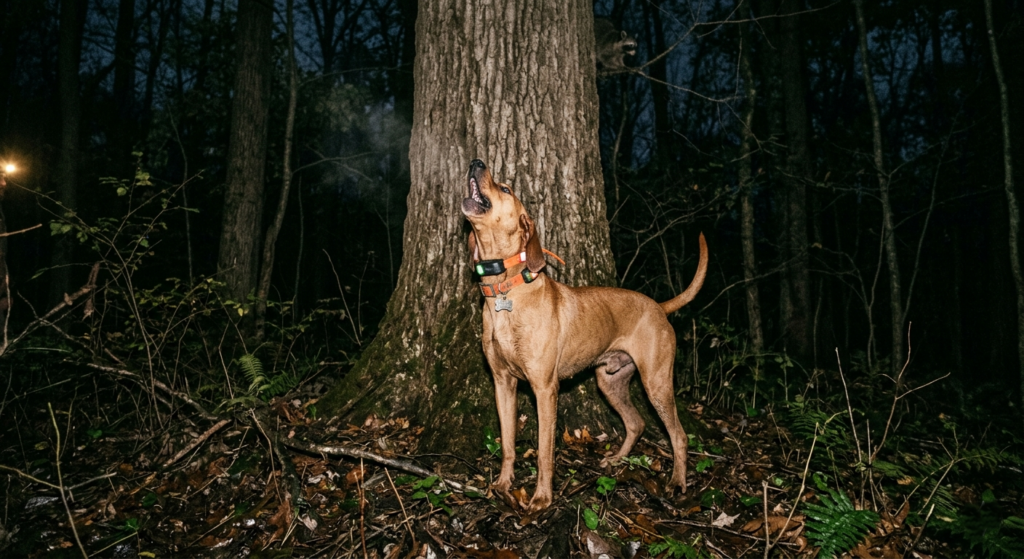
The dog treed. You heard it. You marked the direction, noted the GPS, and started walking. By the time you pushed through the last stand of timber and got to the tree, the dog was gone. Already 200 yards off, moving again. You shined the tree. Nothing. You assumed it was a slick tree and cast on.
Most handlers call this a tree commitment problem. They say the dog lacks the drive to hold. They start looking for fixes at the tree. The real problem started 300 yards back when you were still walking in.
This is one of the most common patterns in coonhound training, and one of the least talked about. The dog is not broken. The handler’s approach routine is.
What’s Actually Happening
A coonhound that trees learns the pattern of what treeing means from every hunt it runs. Not just what happens at the tree, but everything that happens in the sequence surrounding it. That includes the noise it hears on the walk-in. The light that sweeps the canopy from 80 yards out. The voice calling out praise before the handler even arrives. The sound of boots crashing through dry leaves getting louder every minute.
Research on working detection dogs has documented what handlers in the field have long understood from experience: dogs read handler behavior and adjust their own performance based on the cues they receive. A peer-reviewed study published by the National Institutes of Health found that handler beliefs and behaviors directly affect the outcome of scent detection work. Dogs are tuned in to the human in a way that overrides even strong olfactory signals. A coonhound in the dark, 400 yards from the truck, is picking up on every piece of information its handler is broadcasting on the walk-in.
Over many hunts, the dog pairs your approach with the end of the work. You show up, the hunt ends. You show up, the dog gets touched and praised and released. Eventually, the dog starts anticipating. It hears you coming and breaks off the tree before you get there because that is what it has been conditioned to expect.
Why It Happens
There are several specific handler behaviors that build this pattern over time. None of them feel like mistakes in the moment. That is what makes them hard to catch.
Noise on the walk-in. Timber is quiet at night. Sound travels. A handler walking through dry hardwood leaves in November is audible from a long distance. The dog hears the crunch before it can see the light. If that crunch has always preceded the end of the hunt, the crunch becomes a signal.
Light in the canopy before arrival. Swinging a headlamp or flashlight up into the tree canopy while still on the approach is one of the most common habits handlers develop without realizing it. It feels like checking on the dog. From the dog’s perspective, the light sweeping the canopy is a disruption. It breaks focus at exactly the moment the dog needs to be working.
Verbal contact from distance. Calling out “good boy” or “whoaaaa” from 150 yards out feels like encouragement. It functions as a recall. The dog has been conditioned to associate that sound with the handler’s proximity and the approaching end of the work. Over time it shortens the hold.
Urgency in the approach. When handlers get excited about a hard-treeing dog, they speed up. Running or fast-walking toward a tree creates a different energy than a controlled approach. Dogs read movement patterns. A handler moving fast toward them has often meant something is about to change.
No established arrival routine. Most handlers have never thought about their walk-in at all. They just go. There is no consistent, deliberate routine for how to arrive, what to do first, and when to engage the dog. Without a routine, every arrival is unpredictable noise and stimulation.
For a deeper look at what drives tree-commitment failures at the structural level, this breakdown of why coonhounds won’t stay treed covers the dog’s developmental side of the equation.
How to Fix It
Do This:
Walk in at a normal, unhurried pace. No urgency. No speed changes. Arrive at the tree the same way you would arrive at any other spot in the timber.
Keep your light directed at the ground until you are within 10 yards of the tree. No canopy sweeping on the approach. When you are standing at the base, then you can work the light.
Stay completely silent on the walk-in. No calling out. No praise at a distance. No verbal contact with the dog until you are physically present at the tree.
When you arrive, stop. Stand still for at least 60 seconds. Let the dog keep working the tree. Do not touch it. Do not praise it. Do not acknowledge it. Let it do the job.
Observe the tree first. Watch where the dog’s nose is working. Let the locate develop. When you have confirmed the coon, then you can reward the dog. Not before.
Practice this on training runs when the pressure is low. Deliberate approach routines need to be built in before hunting season when the habits are already formed.
Don’t Do This:
Do not sweep the canopy with your light on the walk-in. Do not call out praise or encouragement from a distance. Do not run or move with urgency toward the tree. Do not touch or praise the dog the moment you arrive. Do not treat your arrival as the signal that the work is done.
What Most Handlers Get Wrong
The majority of handlers treat arrival at the tree as a conclusion. They get there, find the dog, pet it, say good boy, shine the tree for thirty seconds, maybe clip on a lead. From the handler’s perspective, that is a successful hunt moment. From the dog’s perspective, it has just been trained again that arriving at a tree leads to interruption and termination of work.
The other consistent mistake is praising on the walk-in. A handler who calls out encouragement while still in the timber is not building confidence in the dog. That sound has become associated with the approach of the handler, the physical contact that follows, and the end of the work. It is a cue the dog has learned to recognize. When it hears that cue, it starts preparing for the sequence that comes next.
This is also where a lot of handlers misread the dog entirely. They diagnose a tree commitment problem and start working on the dog’s motivation or tree drive. The actual problem is in the approach sequence, not the dog’s desire to work. Young dogs especially get blamed for patterns their handlers have built without realizing it.
Devil’s Advocate
A fair objection here is that a truly finished, confident hound should be able to work through a noisy handler approach. And there is truth in that. A dog with three or four seasons of solid work behind it, with hundreds of confirmed locates, has a deep enough track record to keep working even when the handler is disruptive on the walk-in. The job is baked in by then.
But young dogs do not have that depth. Every hunt is still teaching. Every pattern the handler creates is still being recorded. If the first two seasons build an association between a noisy approach and the end of the work, that association is going to be in the dog when it should be in its prime. You do not get those sessions back.
The other pushback is that some dogs just have weak tree drive no matter what the handler does on the walk-in. That is also true. But there is a simple way to separate a handler-caused pattern from a genuine drive problem. Watch whether the dog holds longer when the handler stays farther back. If a dog that breaks at minute 8 on a normal approach will hold 25 minutes when the handler hangs back and walks in quietly, that is not a drive problem. That is a conditioned response to a learned pattern.
When to Leave It Alone
Not every dog that moves between trees is responding to handler approach. A finished dog working a coon that has shifted in the canopy may drift to a second tree or work a tight circle before relocating. That is normal locating behavior. Do not diagnose a handler psychology problem when the dog is simply doing the job in heavy cover.
If the pattern is random and does not correlate specifically with the handler’s approach, look elsewhere. Bad weather, thermal shifts that scatter scent in tight river bottom timber, or a coon that is moving will all cause a dog to work more than one tree in a night. None of that is the handler’s fault, and none of it is improved by changing the walk-in routine.
The walk-in approach matters specifically when the dog’s behavior changes in response to the handler’s presence. If the dog holds steady when the handler is far away and breaks when the handler gets close, that is the diagnostic. Fix the approach. Everything else, let it be.
Quick Fix Checklist
- Walk in at a normal, unhurried pace every time — no urgency, no running
- Keep your light off the canopy until you are standing at the base of the tree
- Stay completely silent on the walk-in — no calling out, no praise from a distance
- Stop for 60 seconds when you arrive and let the dog keep working before you engage
- Do not touch or praise the dog at the moment of arrival
- Confirm the locate first — praise after the work, not during it
- Note whether the dog holds longer when your approach is quiet and controlled
- Practice your walk-in during training runs before the pattern is set for the season
The dog has been reading you from the first night you put it in the timber. If the approach has been noisy, unpredictable, and full of verbal contact at distance, the dog has built a picture of how the hunt goes. It did not form bad habits. It learned the pattern you gave it.
Quiet down on the walk-in. Keep the light low. Give the dog room to keep working when you arrive. That is not a technique or a fix. It is a basic adjustment in how you show up. The dog will notice it faster than you think.
The tree is not where tree commitment gets built or broken. It gets built or broken on every walk-in, one hunt at a time.