If you have started shopping for your first coonhound, you have noticed the prices are all over the place. One ad wants $300. The next wants $1,000. It is fair to ask what the difference is.
A lot of it is what happened before the pup left the breeder’s yard. Was it wormed on schedule? Did it get colostrum? Was it kept warm and clean? None of that shows up on a pedigree, and nearly all of it costs time and money.
This guide walks through what a careful breeder does from breeding day to go-home day, what it adds up to, and what to ask before you write the check. It doubles as a checklist if you are raising your first litter. And once a pup is on the ground, the real work of coonhound training starts.
What Coonhound Puppies Cost Right Now
Registered pups from hunting lines generally run $500 to $1,000, more for proven crosses, frozen semen breedings, or litters paid into a futurity. Unregistered pups sell for less, and $200 to $300 litters get posted every week.
A cheap pup is not automatically bad, and an expensive one is not automatically good. Price should reflect two things: how the litter was bred and how it was raised. Buyers ask plenty about the first. Almost nobody asks about the second.
Before the Pups Hit the Ground
Good litters start with a female in good shape. Breeders who keep a dog hunted or on a treadmill before and early in pregnancy see fewer dead pups, long labors, and C-sections than those who let a dog sit in the pen for months. A fit, well-wormed dam is the cheapest insurance in the whole process.
About two weeks into pregnancy, most breeders increase feed, and many add a little ground beef or beef heart. The dam gets dewormed again in the last week or so, commonly with Safe-Guard (fenbendazole), which is labeled for pregnant dogs. Some vets prefer a longer course late in pregnancy, so ask yours about timing.
In the last seven to ten days, many breeders start Oxy Mama from Revival Animal Health to support milk production. The soft meat-stick version goes down easier for a picky eater than the hard chew, though it has to stay refrigerated. Some also keep fenugreek powder around for a dam light on milk.
What a dam should not get before labor is extra calcium. Loading it during pregnancy makes a dangerous calcium crash after whelping more likely, not less.
Careful breeders also X-ray in the last week or so to get a pup count. Counts can miss by two or three because pups overlap, but a rough number tells you whether the dam is finished or still has a pup stuck, and a stuck pup is how you lose a dam and a litter.
They take temperature, too. Normal runs about 101 to 102.5 degrees. Starting a few days before the due date, around 63 days from breeding, take it twice a day and write it down. When it drops to around 99 or lower, pups usually come within 24 hours. A cheap digital thermometer works; buy a new one each litter.
A week or two out, the pen gets pressure washed and disinfected top to bottom, often with Kennel Sol from Revival. Move the dam in several days ahead so it settles into the box.
Whelping Day and the First 72 Hours
Once contractions start, many breeders give a whelping calcium paste, such as Oral Cal from Revival or Elite Nutrition’s version, then another dose after each pup, following the label for the dam’s weight. Calcium helps drive contractions and replaces what milk pulls out. After the last pup, breeders switch to calcium chews like Doc Roy’s Healthy Bones until weaning. Dams eat them eagerly at first and turn them down once their body stops needing them.
Colostrum matters more than anything else that day. It carries the antibodies that protect pups until vaccines take over, and a pup’s gut stops absorbing them within about 24 hours. Every pup needs a teat early. Count heads often and watch for one stuck on the edge of the pile.
Slow pups get extra help. Puppy ASAP, a colostrum and probiotic paste, is a common drawer item for a pup that starts weak. If the dam had a C-section or a pup is fading, call your vet early; some can supply plasma, which only helps in the first day or two. Antibiotics are a vet’s call, not a routine.
The Whelping Box Setup That Keeps Pups Alive
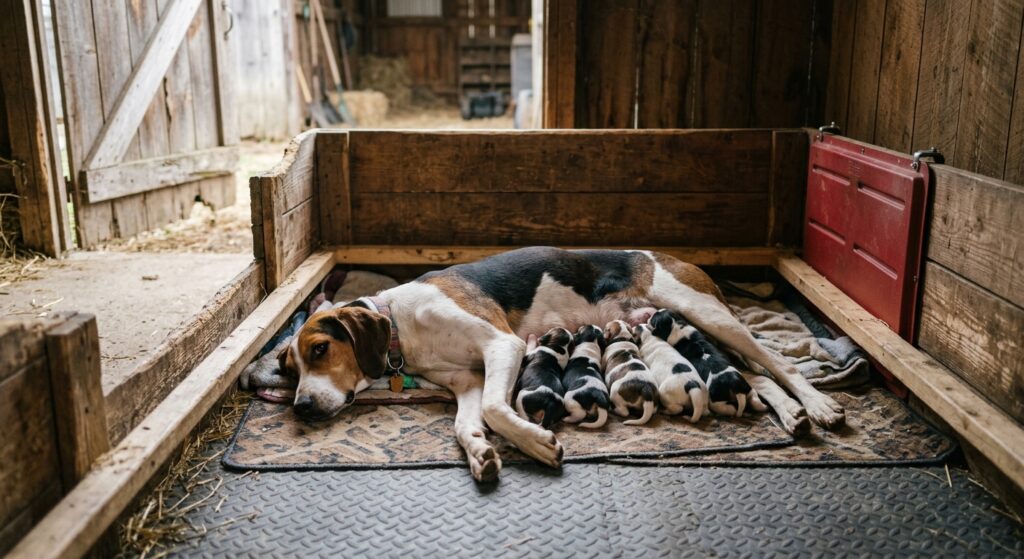
Three things matter most. First is a puppy rail, a 2×4 on edge or PVC pipe run around the inside of the box about four to five inches off the floor. It gives a pup somewhere to go when the dam lies against the wall. Crushing kills a lot of newborns, which is the main problem with whelping in a kiddie pool: slick sides and no rail.
Second is bedding. Loose household carpet, towels, and blankets get dug into a nest and wrapped around pups, and pups smother and strangle in them. Rubber-backed entry mats screwed down at the corners hold up to digging. Stack a few and pull the top one when it gets soiled.
Third is heat. Newborn pups cannot hold their own body temperature for the first few weeks. Merck Veterinary Manual’s guidance on newborn puppy care puts the whelping area in the mid to upper 80s the first week, around 80 through weeks two and three, and near room temperature by week four. Pups always need a cooler spot to crawl to. A livestock heat mat like the Kane mat, mounted to one side, lets them move on and off. Heat lamps work but dry pups out, and a bulb busted by a wagging tail puts hot glass in the box. A thermostat-controlled Hound Heater is worth a look for outdoor kennels. Homemade bulb heaters are a fire risk around wood and bedding.
Pups piled up are cold. Pups spread to the corners are hot. In a summer heat wave, breeders pull the heat pad, run fans, prop the box open, and set frozen water bottles in with older pups. Cool-weather litters are easier.
Weeks Two Through Eight
Starting around one to two weeks, a good breeder trims every pup’s nail tips weekly until weaning. Those needle nails cut up the dam’s belly until it stops lying still for nursing. Baby nail clippers work best, front feet first.
Worming starts at two weeks and repeats at least every two weeks through weaning. Nemex (pyrantel) is the common early choice, and many breeders switch to Safe-Guard around four weeks for broader coverage. Set the schedule with your vet, since parasite pressure varies by region.
Weaning starts around three weeks with kibble blended into an applesauce-thick gruel with warmed goat’s milk or lamb milk replacer, left chunkier as teeth come in. Lamb milk loosens stools in some litters. Buy a real blender; cheap ones burn up.
Around six weeks, many breeders give a coccidia preventative such as ponazuril through their vet, plus the first parvo shot, either NeoPar or a 5-way. Pups still around at eight weeks get another round. Careful breeders order vaccines shipped cold from a supplier like Revival, not off a warm feed store shelf.
Buyers need to hear this: a pup leaving at eight weeks is not fully protected. Boosters typically continue every three to four weeks until around 16 weeks. Get every date and product in writing.
Then comes registration. UKC papers plus PKC Super Stakes fees can run several hundred dollars across a litter of seven.
The Disease Risk Most People Never Think About
This story plays out every year. A breeder has healthy, fat pups following people around the yard. A new dog gets hauled in and put at the far end of the same kennel. Within a week the pups are sick, and despite fluids at the vet, they are gone.
Parvo and coccidia ride in on dogs, boots, and haulers. Quarantine any new dog about two weeks in a pen well away from pups, handle it last, and change clothes or spray boots before going near the litter. Every dog on the place, yard dogs included, gets wormed and vaccinated.
As a buyer, ask where the litter is kept and whether dogs come and go. A careful breeder will have a real answer.
Adding Up the Real Cost
Before any stud fee, a breeder doing all of the above on a litter of seven or eight can spend roughly $300 a pup: three or four extra bags of a food like Purina Pro Plan Sport, supplements, wormers, vaccines, the X-ray, registration, and heat. That does not count the hours. Somebody checks that box five or more times a day for two months.
Progesterone testing, frozen semen, a stud fee, or one emergency C-section can double that. A litter of eight can easily have $2,000 or more tied up before a pup sells.
Coonhound litters commonly run six to ten pups, and eleven is not rare from a big Walker or English dam. A big litter spreads fixed costs, but it also means more feed and more crushing risk.
So at $500 to $750, a breeder who did it right is not getting rich. At $1,000 from a proven cross, the pup is still one of the cheaper parts of coon hunting once you count lights, collars, fuel, and ten years of feed. That does not make every $1,000 pup worth it. It means a fair price and a good raising usually go together.
What to Ask Before You Buy
Pups should be fat, slick-coated, clear-eyed, and busy, with trimmed nails and a clean, dry box. A good breeder has a written record of every wormer and shot and will not mind you asking how many pups were born versus how many are left.
Ask how deposits work. Reputable breeders take a deposit to hold a spot, set pick order by when deposits arrive, and refund it if the litter comes up short. If you are serious, send it. A handshake hold is how buyers lose out to the next person.
Raising is only half the picture, though. What the parents do in the woods matters more. Our breakdown of what actually matters when buying a coonhound covers bloodlines, temperament, and why you should see the parents hunt.
The Bottom Line
A good pup comes out of a fit dam, a clean box, a puppy rail, steady heat, early colostrum, weekly nail trims, and a worming and shot schedule somebody actually kept. That costs real money and hours, and a fair price usually reflects it.
Raising a litter is not for everybody. If nobody is home to check pups five times a day, buying a well-raised pup is cheaper and easier.
Once your pup is home, the next stretch is about patience more than products. Read how to start a young hound the right way before you ever turn it loose at night.