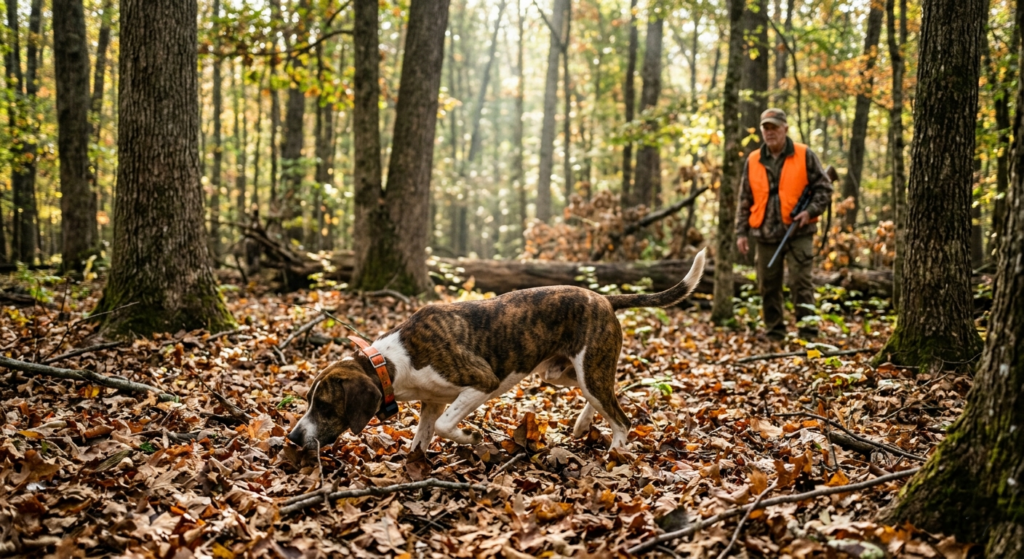
A young dog tearing through early season timber, hot on every squirrel it flushes, barking treed every few minutes — that looks like progress. The handler is pumped. The dog looks sharp. Trees are falling. Everybody goes home happy.
But that kind of early season heat can hide a problem that doesn’t show up until the leaves are gone and squirrels start slipping trees, using dens, and relocating twice before you get close. That’s when the dog that looked so good in October suddenly looks lost.
This isn’t about talent. It’s about what the dog learned to do when a track ended.
What’s Actually Happening
Early leaf cover makes squirrels easy to see and hear. A young dog picks up a track, pushes a squirrel, watches it go up a tree, and barks. Success. Except the dog didn’t really finish the track. It followed what it could see and hear until the squirrel stopped moving.
That’s the hole. The dog is learning to tree where it last saw or heard something, not where the scent trail actually ends. It doesn’t develop patience at the tree because the squirrel is visible. It doesn’t learn to check surrounding trees, look for den exits, or work out a secondary move. For more on how dogs process and rely on scent to do this kind of work, how dogs use smell to perceive their environment explains why nose-led work is a fundamentally different skill than eye-and-ear treeing.
Over time the dog starts associating quick, visual trees with success. It learns that speed matters. That assumption holds in thick leaves. It falls apart completely when conditions change.
This connects directly to a pattern covered in guessing or actually tracking a squirrel — a dog can look convincing while doing the wrong thing, and early season cover is exactly where that gap gets built without the handler noticing.
Why It Happens
Too much early work in heavy leaf cover is the main driver. Squirrels are visible, action is constant, and every hunt feels productive. That environment rewards guessing because guessing works. The dog doesn’t need a finished nose to pile up trees in October timber.
The handler accelerates the problem by praising fast trees. Shooting squirrels off weak trees reinforces the idea that getting there quick is what matters. Dog trees in thirty seconds with no track work to speak of, handler shoots the squirrel, dog learns that’s the game.
Running only high-density areas makes it worse. A dog that never has to work a cold track, never has to puzzle out a loss, never has to move off the first tree and relocate — that dog doesn’t know how to solve problems. It only knows how to react to obvious ones.
The other factor is intervention. A handler who jumps in the moment the dog hesitates is training the dog not to think. Letting the dog struggle — for a reasonable stretch — is how it builds the mental habit of working things out. The same failure pattern that drives dogs to quits tracks in thick leaf cover later in the season often starts here, when the dog never learned to push through confusion in easier conditions.
How to Fix It
Step one is slowing the whole process down. Hunt thinner squirrel country where tracks take effort. A dog that has to work to find and finish a squirrel is a dog that is learning something real. If the timber has squirrels everywhere and every chase ends in two minutes, you’re running laps, not training.
Step two is stopping the reward on weak trees. If the dog fires on a tree with no meaningful track behind it — went to ground from a flush, barked at a shimmy in the branches, treed off visual contact — don’t shoot. Lead off. Keep hunting without any reaction. No scolding, no drama. Just nothing. Let the reward disappear.
Step three is letting losses play out. When a squirrel slips and the dog loses it, stay quiet. Give the dog time. Let it leave the first tree, check the next one, work out where the squirrel went. This is where nose-work gets built. A handler who calls the dog back or moves it on is cutting that process short every single time.
Step four is hunting in tougher conditions. Cold mornings before the ground warms up. After rain when scent holds better but disperses differently. These conditions punish visual treeing and reward honest nose work. A dog that can tree consistently in tough scent conditions has learned to finish tracks, not just react to movement.
Step five is limiting easy kills. This one is hard because it feels wrong. You want to build the dog’s confidence, and shooting squirrels does that. But killing a squirrel off a weak tree is the same as giving a student the answers. Knock out squirrels when the dog works the full track. Make finishing matter. The dog figures out what earns the reward.
What Most Handlers Get Wrong
The biggest mistake is reading early excitement as development. A young dog running hot in October timber isn’t necessarily learning to tree squirrels. It might be learning to react to squirrels. Those are different things, and one of them falls apart in November.
Over-hunting leafy conditions because it’s fun and produces action is how this problem grows. The handler has a blast, the dog runs hard, everybody feels good, and the actual hole in the dog’s training gets covered up until conditions change and expose it.
Talking too much at the tree is another one. A handler who walks up barking encouragement, talking the dog into staying, moving around the tree, pointing — that’s a handler doing the dog’s job. Let the dog work the tree on its own. Your job is to show up after the dog has committed and verified.
Treating every tree like it must have a squirrel is also a mistake. If the dog tells you there’s a squirrel and you believe it every time regardless of how the dog got there, you have no standard. The dog learns that you’ll follow it anywhere. That’s not a useful lesson.
Devil’s Advocate
Some handlers will push back on this and say early confidence matters more than early precision. Get the dog fired up, get it running hard, worry about accuracy later. There’s something to that argument.
A dog that never gets to tree squirrels early on can get discouraged. A dog that gets cold-tracked through thin timber every hunt before it’s mentally ready can lose interest before the foundation gets built. Some early action and some easy success isn’t a problem. It’s probably necessary.
The issue isn’t giving a young dog easy squirrels. The issue is giving it nothing but easy squirrels for months and never introducing any conditions that require it to work differently. The difference between building confidence and building a bad habit is usually the variety of conditions and the handler’s standard for what earns a reward.
If your dog is improving week over week, checking itself, relocating squirrels, and showing better patience at the tree even in leafy conditions, you’re probably fine. Don’t over-correct a dog that’s already trending right.
Quick Fix Checklist
- Hunt thinner squirrel country at least one day per week during early season.
- Stop shooting squirrels off trees the dog reached without a real track.
- Stay quiet when the dog loses a squirrel. Give it time to work out the loss.
- Add at least one cold-morning or post-rain hunt per week to build nose reliance.
- Stop intervening when the dog hesitates. Hesitation is the dog thinking.
- Only kill squirrels the dog tracked from the ground to the tree.
- Walk away from weak trees without any reaction, positive or negative.
Closing
Early leaf-only success builds a dog that looks good and can’t finish a track when conditions get real. Most handlers don’t see it coming because the problem hides behind action.
The broader framework for how to train a tree dog keeps coming back to the same principle: the environment the dog learns in shapes what the dog learns to do. Build the habit in easy timber and the dog will need easy timber to perform. Build the habit in varied, honest conditions and you get a dog that can adapt.