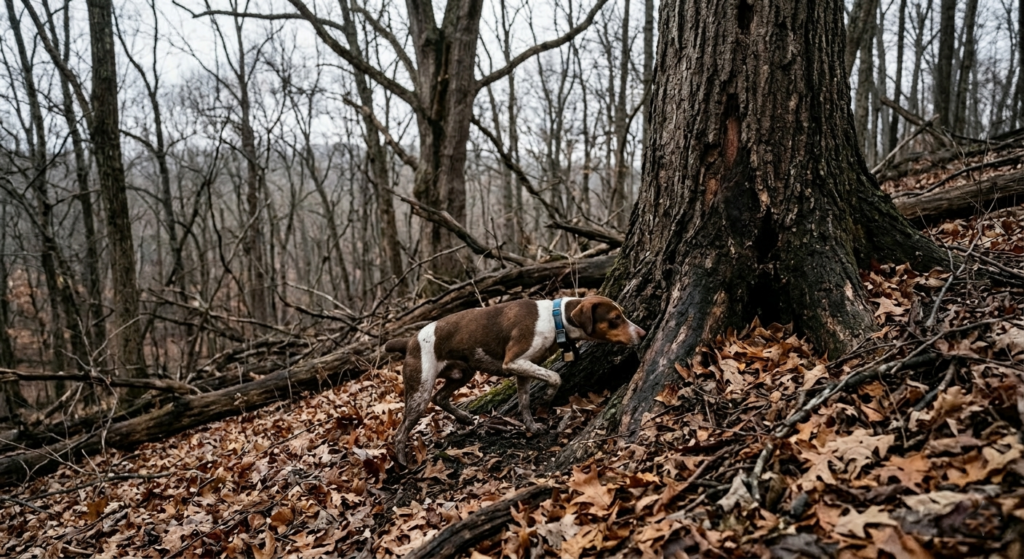
Any dog can look useful when squirrels are moving fast and making mistakes. Throw a dog in the woods on a warm October morning after a light rain and you will see a lot of bark. That does not tell you much.
The slow days are where you find out what you actually have. Cold fronts, bluebird skies after a weather change, dry woods with no wind, midday hours when everything has laid up and gone quiet. Those are the days that separate dogs with real ability from dogs that have been running on easy conditions.
A lot of hunters never figure this out because they judge the dog on the best days and make excuses on the worst ones. They remember the morning the dog treed seven times and forget the three hunts where it produced nothing. That is not evaluation. That is wishful thinking.
If you are serious about squirrel dog training, you need a method for judging your dog that holds up across different conditions, not just the ones where any decent dog looks fine.
What a Slow Day Actually Looks Like
Slow days are not just about low squirrel numbers. They are about conditions that reduce movement and eliminate obvious sign.
After a cold front moves through, squirrels pull tight to dens and feed areas. A bluebird sky with dropping pressure will shut movement down fast. Dry woods crunch underfoot, which keeps squirrels still and high. Heavy hunting pressure on public ground makes them call-shy and tight to cover. Midday in summer is its own version of the same problem.
On these days, the woods go quiet. There is no chasing, no cutting, no squirrels moving limb to limb. Your dog has to locate animals that are not advertising their position.
This is where accuracy and patience matter. A dog that depends on obvious movement, hot scent, or easy confirmation gets exposed fast. A dog that can slow down, work old sign, and make good decisions without constant squirrel cooperation becomes far more valuable than its easy-day numbers suggested.
Knowing what good squirrel habitat looks like is part of this. Mast-producing oaks, den trees, creek bottoms, and hardwood transitions are the places a smart dog checks when squirrels are not broadcasting their location. Understanding mast, den trees, and squirrel habitat helps you evaluate whether your dog is hunting with intention or just covering ground.
Why Some Dogs Fall Apart on Tough Days
Most slow-day failures come from the same places.
The biggest one is handlers misjudging what they have because of easy-day performance. A dog with a big range, loud bark, and high energy looks impressive when squirrels are cooperating. Put that same dog in dry, cold woods with no movement and the style evaporates. What is left is a dog that cannot finish anything without help from the conditions.
Some dogs just depend on hot scent. They are not working a problem. They are following obvious trail and catching up to visible squirrels. When the scent goes cold and squirrels go still, they have no framework for what to do next. They start covering ground to look busy instead of making smart moves.
Accuracy breaks down when dogs start guessing. They slick tree on every likely-looking den. They check the same feed areas repeatedly without result. They make noise without conviction. None of that helps you kill squirrels.
Some dogs also lack the patience to work thin movement. When the woods go dead quiet, they speed up instead of slowing down. They rush tracks, overrun scent, and leave trees before they have confirmed anything. That is not drive. That is a dog that has not learned how to handle difficulty. It is worth reading about quitting a track too early because the same impatience that causes a young dog to give up on a running squirrel shows up differently on slow days, just as a dog that bails on marginal trees instead of working them out.
Handler mistakes feed all of this. Praising empty trees, shooting squirrels the dog did not earn, walking the dog into obvious spots, letting it survive on high-movement mornings without any real evaluation. All of that creates a dog that looks better than it is until the conditions expose the gap.
How to Read the Dog When Conditions Are Poor
Start with results over a run of hunts, not one outing. One bad day tells you almost nothing. Three or four low-movement hunts in a row start to show a pattern.
Watch what the dog does when nothing is happening. Does it keep hunting with intention or start wandering? Does it check mast edges, den trees, creek transitions, and hardwood points, or does it just move to stay moving? A dog that hunts purposefully on dead mornings is doing something right regardless of whether it is making noise.
Judge tree accuracy hard on slow days. Volume does not matter. A dog that makes three honest trees on a tough day is worth more than a dog that pounds ten empty ones. An honest tree on a slow day means the squirrel was there, fresh sign was present, or the setup made sense given the terrain and conditions. An empty tree with no sign and no logical reason is just noise.
Watch how the dog handles cold, weak scent. Good dogs slow down and work it. They commit to a track even when it is thin and follow it deliberately. Weak dogs either blow through old scent without registering it or start guessing at likely locations. Track style on bad days matters more than raw speed.
Pay attention to how much handler help the dog needs. Effective dogs on tough days do not need to be walked into spots, talked along, or coached past difficulty. They hunt independently. That does not mean they never check in. It means they are doing useful work between check-ins rather than waiting to be pointed somewhere.
What Most Handlers Get Wrong
They confuse action with production. A dog that covered three miles, barked at four trees, and came back with burrs all over it looks like it did something. Whether it helped you kill squirrels is a different question.
They expect the same hunt style on hard days as on high-movement mornings. That is not realistic. A good dog adjusts. It slows down, works tighter, makes more deliberate checks. If your dog is covering the same ground at the same pace on a dead midday as it did on a wet October morning, something is off.
They panic when a patient dog appears slow. A methodical dog checking real feed areas and den trees on a quiet morning is not a dog that has lost its edge. It may be the most useful dog in the woods that day. The problem is that patient dogs do not look impressive until they tree something, and handlers who are used to busy dogs misread calm as disinterest.
They give young dogs no credit for adjusting. A young dog still learning to work thin conditions is doing something different from a dog that has developed empty habits. The young dog is figuring out a problem it has not faced much. That deserves time, not correction.
They inflate trees where they find the squirrel after a long search. The dog put them in the right zip code and they poked around until they found it. That is not the same as the dog making an accurate, honest tree on its own. Crediting that work as if it were a finished performance leads handlers to keep dogs in the field past the point where honest evaluation would have told them to adjust their expectations.
Devil’s Advocate
Here is the pushback worth sitting with: not every slow-day failure means the dog is weak.
Squirrel behavior is unpredictable. Pressure fronts, temperature swings, and dry conditions affect game differently in different terrain. A dog hunting ground with very few squirrels is going to produce less regardless of its ability. If the squirrels are not there, the dog cannot tree what does not exist.
Young dogs also need time to learn how to handle low-movement conditions. That is a learned skill to a degree. A dog that falls apart at two years old on a cold front may develop real competence on those same conditions by year three if you do not overreact and create pressure that teaches it to guess instead of work.
Some dogs also just have a longer warm-up on hard mornings. They are not immediately fired up, they work into it, and then they find something in the second hour that a more excited dog ran past in the first thirty minutes. Do not write off a dog that takes time to settle on slow days if it ultimately produces.
The honest version of this is that slow days are a test, not a verdict. They reveal tendencies, not final grades. Use them as information, not as a hammer.
Quick Fix Checklist
- Log hunts with simple notes: weather conditions, squirrel movement, trees made, squirrels confirmed, squirrels killed
- Run the dog on several low-movement days before drawing conclusions
- Stop rewarding empty trees with attention or excitement
- Stop shooting squirrels out of trees the dog did not earn honestly
- Watch what the dog does when nothing is happening, not just when it is treeing
- Judge tree accuracy over volume on tough days
- Observe how the dog handles cold, weak scent before deciding it lacks patience
- Give young dogs time to develop slow-day skills before applying pressure
- Separate handler-caused failures from dog-caused failures before correcting anything
- Check whether you are walking the dog into obvious spots instead of letting it hunt
The Difference Between a Useful Dog and an Impressive One
This is where a lot of hunters land wrong. They want a dog that is exciting to watch. Big range, loud mouth, fast-moving mornings where everything comes together and the tailgate stories write themselves. There is nothing wrong with appreciating that.
But an exciting dog and a useful dog are not always the same thing. On the best days, they can look identical. On slow days, they separate fast.
A useful dog makes decisions that produce game consistently across varying conditions. It does not need the woods to cooperate. It does not need hot scent and visible squirrels to do its job. Those are the finished dog qualities that take time to develop and even longer to recognize in the field, because they are quiet qualities that do not announce themselves the way flash and speed do.
Most hunters do not have enough slow-day data on their dogs to know which category they are dealing with. They assume exciting equals useful because they have not hunted the dog hard enough under pressure to see otherwise.
Slow days are the test that fixes that gap. Run your dog in those conditions deliberately, keep honest notes, and you will get a real picture of what you have.
The best squirrel dogs you will ever own may not be the most dramatic ones on easy mornings. They will be the ones that keep putting you on squirrels when the woods go quiet and other dogs are just making noise.
Accuracy, patience, and honesty under difficult conditions are not flashy traits. They do not make for great tailgate talk. But they are what separates a dog that performs when it is easy from a dog that performs when it matters.
Evaluate accordingly.