How to Attract Squirrels to Your Property (Short- and Long-Term Habitat Strategies)
I’ve had years when squirrels were plentiful, and you didn’t need a deep and lonely dog to chase a few in the morning or evening. Then there have been years that deep and lonely wasn’t enough, and as any dog hunter can tell you, that makes training a pup much more difficult, as well. What causes those up and down years? Well, it can be a few different reasons. The most common, in my experience, has to do with poor mast production, but it can also be predator or hunting pressure. What some may or may not realize is that squirrels migrate to keep up with the demand for food. There are some methods that you can use to mitigate the need for squirrels to migrate. Though no guarantees can be made, you just make sure that they have what they need to alleviate the necessity to move. As all who give advice on the internet say, the methods I’m going to discuss are the ways I do it. It’s not the only way, just what has worked for me.
Short Term Strategies
Supplemental Feeding
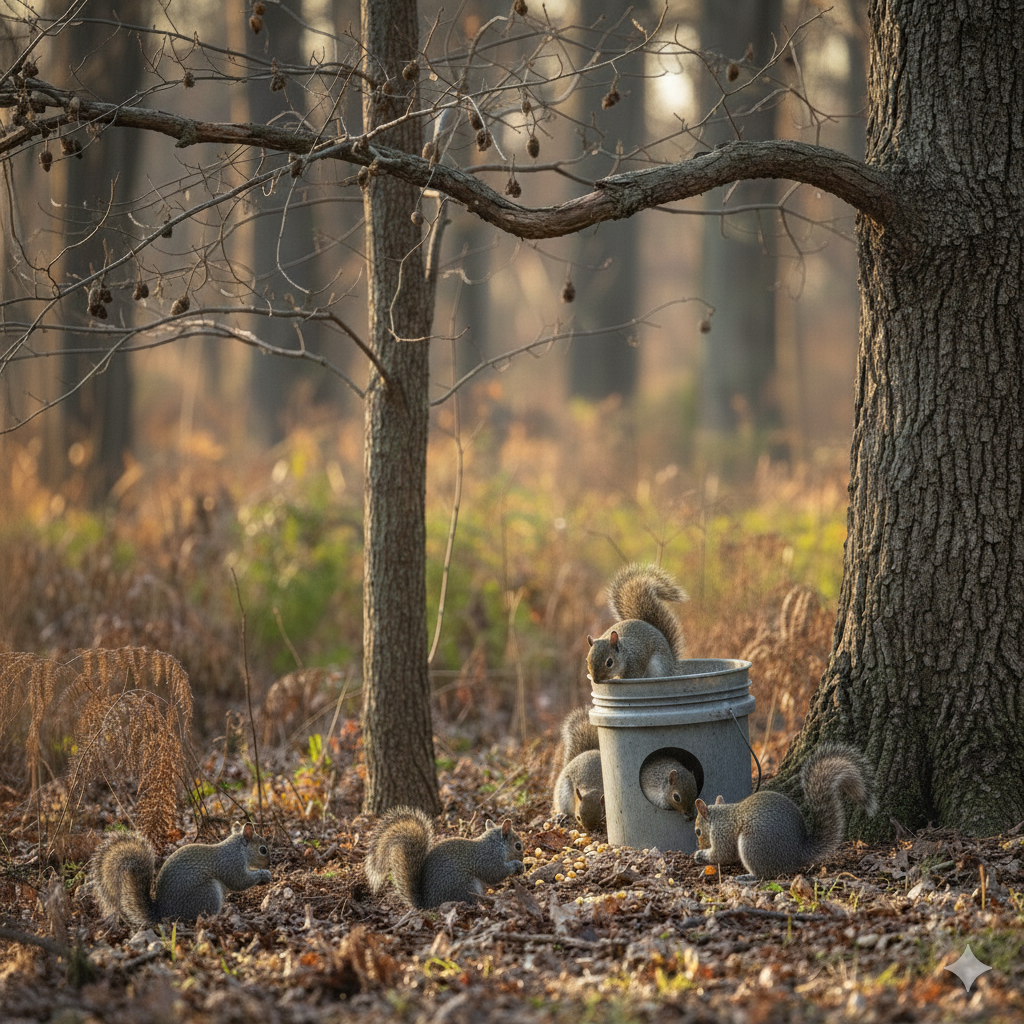
Studies have shown that “squirrel feeders” will increase the population in an area where a population currently exists. Especially when the food source is predictable and consistent. Gray squirrels consume more supplemental food compared to other wildlife, according to a study by ScienceDirect. So, what do we use to contain the food and allow, primarily, squirrels access to it? What should we use as the food source? Well, I can tell you what worked for me for the last 20 years.
- Black Oil Sunflower Seeds are a high-energy and high-calorie food. Squirrels process it easily and provide energy when natural food isn’t available.
- Corn (whole or cracked) will attract squirrels, but lacks a lot as a nutritional source. It’s mostly carbs and is low in fat, so it’s primarily an energy source and nothing else.
What I like to do is mix the sunflower seed and corn at about 3:1, 3 parts sunflower seeds to 1 part corn. I have game cameras on my feeders, and I will watch them dig through the corn to get to the sunflower seeds. I use this mixture in my traps as well, and it’s the most effective bait I’ve found.
What is a Feeder
A feeder is a container that is used to hold the food for the squirrels. I don’t like pouring the feed on the ground for a couple of reasons. 1. Other wildlife will come and consume their share, and it can get expensive feeding everything, like deer and coons. They can wipe out a pile of feed in a single night. 2. The feed will get wet. It might not matter to the animal, but I like to keep it dry. Nothing will attract a coon like sour corn. I know, because I use sour corn in my coon feeders.
Making a Feeder
There are many ways to make a feeder and different materials to make it out of. I’ve made them out of wood and PVC pipe, but the only way I make them now is out of a 5-gallon bucket. I found it’s the best method for keeping the feed dry, and most important, controlling what is able to access the food. Let me explain.
Take a 5 or 3-gallon bucket with a lid, either will work. Most people have them laying around, or you can get them from Wal-Mart, Lowe’s Home Depot, and Harbor Freight for around $5 with the lid. Measure down from the top of the bucket 4 inches and drill or cut a 2 ½ inch hole. Then, directly across from that hole, drill or cut another 2 ½ inch hole. This will allow a squirrel to climb into the bucket while deterring unwanted animals. That’s really it, it’s not complicated. You can paint it if you like, but it’s not necessary.
Feeder Location
When picking a spot to place the feeder, keep a few things in mind. Look for squirrel activity. Are there potential den areas or nests? Are there natural food sources nearby, producing or otherwise? Should I tie them to a tree or stake them out away from trees? I will give you the short answer for now. Locate them near den trees near where natural food would normally be. If you’re planning to use the feeders to help train pups, stake them away from trees so that squirrels must get on the ground to access the feeder. If you’re using the feeders during warmer months, and poisonous snakes can be an issue, move the feeders around. Snakes like to hang around them and ambush squirrels. This would be an issue for your dogs if you hunt year-round during the summer.
Install Nesting Boxes
If your property is mostly younger timber, you can supplement natural dens with artificial nest boxes. It’s a long-term investment that works. I’ve seen properties where nest boxes made a noticeable difference in squirrel numbers within a few years.
Making a Nesting Box
Use a 5-gallon bucket, not a 3-gallon bucket, with a lid. This time measure 4 inches from the top and drill a 2 ½ inch hole. Put hay or wheat straw, or you can let the squirrels make their own bedding. Hang the bucket about 10 to 15 feet off the ground in a tree with the drilled hole of the bucket as close to the tree as possible. Use some screws to attach the bucket to the tree. You’re done.
If you’re looking for a short-term solution for increasing the abundance of squirrels on your hunting property, make sure they have food and a water source nearby, and you’ll give them no reason to move on to the next property.
Long-Term Strategies
Alright, so the feeders will help you in the short run, but if you’re planning to hunt the same ground for the next 10, 20, 30 years, you’re gonna want to do more than just keep buckets full of sunflower seeds. You want to actually build a habitat that holds squirrels naturally. This is the stuff that takes time, we’re talking years, not weeks, but once it’s in place, you’ve got squirrels for the long haul.
Plant the Right Trees and Take Care of What You’ve Got
Look, squirrels live where the food is. And their favorite food is acorns, hickory nuts, beechnuts, and walnuts. That’s just how it is. If you’ve got a property loaded with oak and hickory, you’re gonna have squirrels. If it’s all pine, you’re probably not.
So here’s what you do. If you’re planting trees or managing timber, go heavy on the hardwoods. Oak, hickory, beech, walnut, maple, those are your money trees for squirrels. Pine is fine for timber value, but it doesn’t do much for keeping squirrels around.
Got a spot that’s mostly scrub or young pine? Start sticking some hardwood seedlings in the ground. Yeah, it’ll be 15 or 20 years before they’re dropping acorns, but that’s the whole point. You’re setting things up for the future.
And keep the weeds and vines off those trees while they’re growing. The faster they get big, the faster they’re feeding squirrels.
Don’t Cut Everything Down
This one’s pretty simple. Squirrels need old trees. Not just for food, but for places to live. Those big hollow trees? That’s where they’re raising babies. No hollow trees, no baby squirrels. It’s that simple.
If you’re cutting timber, don’t just clear-cut the whole thing. Take some trees, leave some trees. The ones you leave will grow bigger crowns and drop more acorns. Plus, you keep your squirrel habitat intact while you’re making money off the timber.
And don’t be in a rush to cut every mature tree on the place. Yeah, those big old oaks might be worth something at the sawmill, but they’re worth a lot more to your squirrel population. Leave enough big timber standing that the squirrels have somewhere to live and plenty of food dropping every fall.
Save Those Hollow Trees
Here’s something most folks don’t think about: you can have all the acorns in the world, but if there’s no place for squirrels to have their young, you’re not gonna grow your population.
Squirrels need den trees, big old trees with cavities in them. Those usually don’t show up until a tree’s 40 or 50 years old. And squirrels will use a good den over and over again for years.
So when you’re out cutting firewood or managing timber, if you see a tree with a hole in it, leave it alone. Mark it with some paint if you need to. Just don’t cut it down. Those cavity trees are gold for squirrels.
If your property is mostly young timber and you don’t have many hollow trees yet, you can put up nest boxes. Yeah, it sounds funny, but it works. I’ve seen it make a real difference on properties where the timber just wasn’t old enough yet.
Keep Your Woods Connected
Squirrels don’t like running across big open fields. They’re sitting ducks for hawks out there, and they know it. So if your property is all chopped up with fields and roads and clearings, squirrels have a hard time moving around.
If you’ve got two patches of woods with a field between them, think about planting a tree line or hedgerow to connect them. Doesn’t have to be wide, just enough that a squirrel can get from one spot to the other without being totally exposed.
And if you’ve got big open areas, see if you can break them up a little with some edge cover. Squirrels like that brushy transition between field and forest anyway. Gives them extra cover and food.
Mix It Up
Have you ever noticed how some years the acorns are everywhere, and some years there’s hardly any? Different trees drop at different times and in different years. If your whole property is nothing but white oak, and the white oaks have an off year, you’re screwed.
But if you’ve got white oak, red oak, hickory, beech, walnut, a whole mix of stuff, then even if one type has a bad year, something else is dropping. Squirrels have food, and they stick around.
So when you’re planting or managing, don’t put all your eggs in one basket. Mix it up. Get different species, different ages. That way you’ve got something producing every year.
And when you’re cutting timber, don’t take all the mature stuff at once. Leave some, and leave some younger trees to grow into the next generation. That keeps you with a mix of ages, which means consistent food year after year.
Bottom Line
So that’s it, short-term and long-term. Both ways work, and honestly, you’ll probably end up doing some of both.
The feeders are your quick fix. They’ll hold squirrels on your place when the acorns are scarce, and they’re a lifesaver when you’re trying to train young dogs, and there just aren’t many squirrels around naturally. They’re cheap, they’re easy, and they work.
The habitat stuff takes longer, but it’s what really pays off down the road. Plant good trees, protect the old ones, keep some hollow trees standing, and don’t cut everything at once. Do that, and 10 or 20 years from now, you’ll have squirrels all over the place without having to fill a single feeder.
The best setup? Do both. Run some feeders to give you squirrels now, and work on the habitat to set yourself up for the future. That way, you’ve got it covered whether the mast crop is good or bad, and you’re building something that lasts.
At the end of the day, squirrels aren’t complicated. They need food, they need a place to live, and they need den trees to raise their young. Give them those three things, and they’ll stick around. Make it hard to find those things, and they’ll move on to somebody else’s property.
Like I said at the beginning, this is just what’s worked for me over the last 20 years. It’s not the only way to do it, but it’s proven. The science backs it up, and I’ve seen it work on my own ground.
Give some of this a try and see how it goes. And if you’ve got your own tricks that work, I’d love to hear about them.
Starting a young coonhound? Get the free “First 30 Nights” guide before you make mistakes you can’t undo
Even the best-trained squirrel dog needs opportunity. Habitat matters just as much as training.