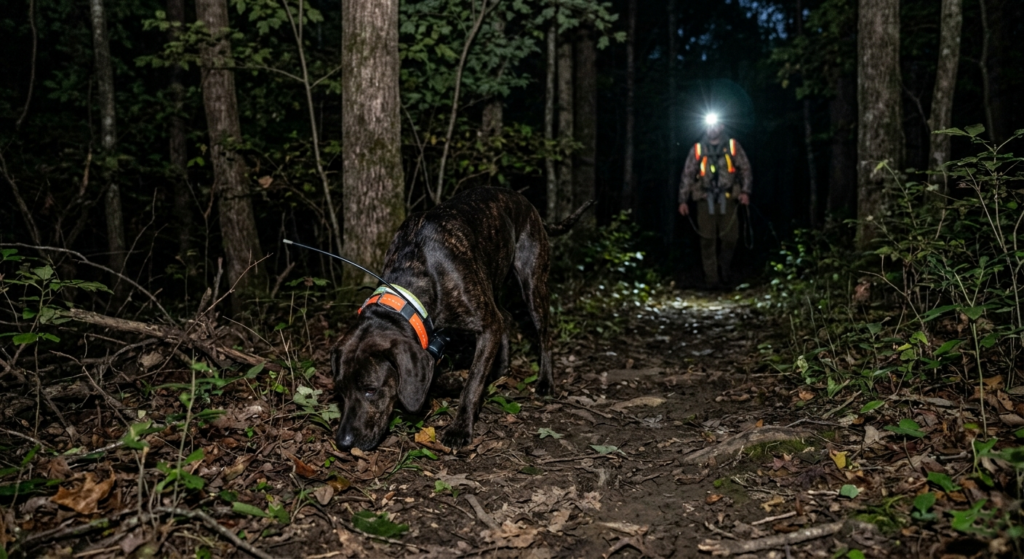
Most handlers do not struggle because the dog has no ability. They struggle because they keep grading progress off emotion, one big night, or what somebody else’s pup is doing.
If you want to get honest about how to judge progress in a young coonhound, you need a framework that works across weeks, not one that changes every time the dog has a good turnout.
Progress in a young hound is not measured by calendar age alone. It is not measured by one flashy hunt. It is measured by patterns over time, by stages rather than birthdays, and by steady forward movement that holds up across different nights and different conditions.
If you want to help a young dog, you better learn to read where it really is. Not where you wish it was.
What Is Actually Happening
Progress in a young coonhound is uneven. It does not arrive in a straight line. A young dog often improves in one area before another shows up. It may hunt out better before tree accuracy improves. It may open more honestly before it learns to work independently. It may show more drive before it shows any consistency.
A young hound can look impressive one night and immature the next. Neither night tells the whole story.
Honest progress looks like this: more repeatable behavior over time. Fewer foolish mistakes. Quicker recovery after confusion. Better effort without the handler pushing it along.
The right question is not “Did it look good tonight?” The right question is “What is this dog doing more consistently now than it was doing a month ago?”
Development should be judged by patterns across several weeks. One turnout is a data point. A month of turnouts is a picture.
Why It Happens
Handlers confuse milestones with age.
People want a fixed timeline. By X months the pup should do this. By Y months it should do that. That thinking leads to bad evaluations because dogs mature at different speeds, mentally and physically. Exposure, opportunity, track conditions, and natural ability all affect timing. The calendar does not.
One flashy night fools people.
A young hound on a hot track with easy coon movement and the right older dog running alongside can look like a finished dog. One good night only matters if the dog starts repeating pieces of it. If it does not repeat, that night was luck and conditions, not development. The article on why young tree dogs regress after a few good hunts lays this out plainly: young dogs develop unevenly, and one peak performance is not a pattern.
Handlers expect finished-dog traits too early.
Total independence too soon. Perfect tree accuracy before the dog has sorted out its own style. Deep hunting every drop. No foolishness at all. Early promise looks rough and incomplete. That is normal. Expecting polish before the foundation is set is a reliable way to either push a dog too hard or give up on one that was worth waiting for.
Emotion gets in the grading.
Ego, comparison, impatience, kennel blindness. Handlers either overpraise because they want the dog to be something special or underrate because they are stacking it against a polished older hound. Neither gives you an accurate read.
They do not track patterns.
Without mentally tracking repeated behavior, handlers react to whatever happened last. Useful categories to watch over time: hunt, track, locate, tree, accuracy, handle, confidence. When you watch those areas across multiple hunts, you stop reacting and start reading.
How to Fix It
Step 1: Judge by stage, not just age.
Divide progress into practical stages rather than strict months. Think in terms of what the dog is doing, not how old it is.
Exposure stage: going to the woods willingly, showing curiosity, handling pressure without shutting down. Figuring-it-out stage: opening in the right places, trailing with more purpose, showing interest at the tree. Starting-to-repeat stage: putting pieces together more often, less dependence on luck or conditions. Building-consistency stage: doing the same useful work across different nights and different terrain.
Understanding these stages is part of what a broader coonhound training framework is built around. Readiness drives the timeline. Age is just a number.
Step 2: Watch for repeatable gains.
Look for things the dog is doing more often now than it was doing before. Leaves cleaner off the lead. Stays in the country better. Works colder scent longer before quitting. Trees with more commitment. Checks less and decides faster. Repeatable gains matter more than spectacular moments.
Step 3: Separate normal immaturity from real problems.
Normal immaturity: inconsistency, distraction, uneven confidence, rough tree style, occasional backtracking. These are part of figuring it out.
Real problems: a quitting habit, chronic dependence, a slick tree pattern that keeps repeating, avoidance behavior, trash problems getting stronger instead of weaker. These deserve attention. The difference between the two is whether a mistake is still happening because the dog is learning, or because it is becoming a habit.
The independent streak in coonhounds is well documented. Maturity and consistency do not arrive all at once. Factor that in when you are deciding what is a problem and what is still developing.
Step 4: Grade the dog across several hunts.
Evaluate over a block of hunts, not one night. Judge trends across different conditions: easy coon movement and thin coon, good weather and poor scenting, hunting alone and hunting with company. Honest progress holds up better across changing conditions. If the dog only looks good under perfect circumstances, it is not as far along as the good nights suggest.
Step 5: Ask what the dog needs less help with now.
Progress often shows up as reduced handler involvement. Less leading. Less encouragement. Less helping at the tree. One of the clearest signs a dog is improving is that you are doing less work to keep it going. If the dog still needs another hound to get started and has for months, that is worth examining. There is a real difference between a young dog that is still finding its independence and one that is making a young coonhound dependent on an older dog into a habit it is not breaking out of.
Step 6: Keep expectations tied to the next step, not the finished picture.
Stay honest by asking what the next right piece is, not why the dog is not finished yet. The pup that hunts willingly but has not settled on the tree is in a different place than the one that trees hard but is still loose on accuracy. Know where your dog actually is. Work from there.
What Most Handlers Get Wrong
Grading one big night like it proves everything.
One good performance does not erase weeks of weak patterns. The flip side is true too. One bad night does not erase real progress. Neither single night is the story.
Comparing the dog to somebody else’s pup.
Different genetics, different opportunity, different hunting conditions, different handling. The comparison tells you nothing useful. The only question that matters is whether this dog is improving relative to itself.
Expecting calendar-age milestones to be exact.
“X months old” tells you very little. Actual exposure and actual maturity tell you much more.
Calling every regression a major setback.
Normal setbacks happen. A rough patch after a jump forward. A confidence wobble after pressure. Temporary sloppiness during growth. These are part of development. The regressions that matter are the ones where bad habits are getting stronger, quitting is becoming the response, or dependence is growing instead of shrinking.
Letting hope outrun evidence.
Kennel blindness in plain terms: wanting the dog to be ahead so bad that every small thing gets graded as proof. This is the most common way handlers lie to themselves. If you cannot describe what the dog is doing more consistently now than it was doing a month ago, you are grading hope, not evidence.
When to Leave It Alone
Not every rough edge needs fixing right now. A young dog that is progressing but still uneven does not need constant intervention. A dog showing initiative, even with rough style, is figuring things out. Leave it room to do that.
Timing matters more than intensity. Too much correction too early can muddy a dog that is still sorting things out.
The practical line is this: leave alone what is immature but improving. Step in on what is becoming a habit.
Patience means watching a pattern mature. Blindness means ignoring a bad habit getting stronger. Know which one you are doing.
Quick Fix Checklist
Stop doing these:
Grading the dog off one hunt, good or bad
Comparing development to another handler’s pup
Expecting calendar-age milestones to hold exactly
Calling normal immaturity a major problem
Grading hope instead of repeated evidence
Start doing these:
Judge by development stage, not months
Track what the dog is doing more consistently over time
Separate normal rough edges from habits that are getting stronger
Evaluate across a block of hunts and different conditions
Measure progress by what the dog needs less help with
Devil’s Advocate
Some handlers will say all this pattern-watching and stage-tracking is overthinking. Just run the dog. Let it sort out. Stop analyzing and start hunting.
There is something to that. Young dogs do need woods time above everything else. No amount of evaluation replaces honest hunting exposure.
But there is a difference between running a dog and reading a dog. You can put miles on a young hound every weekend and still miss what is actually developing, or not developing, if you are not paying attention to the right things. Plenty of dogs get run plenty and never improve because nobody noticed the habit forming underneath the activity.
The goal is not to turn every hunt into a performance review. The goal is to notice what the dog is doing more of, what it is doing less of, and whether the overall direction is forward. That does not take long. It just takes honesty.
Closing
Judging progress honestly means looking for repeatable improvement. Not excuses. Not highlight reels.
Milestones matter more than birthdays. Patterns matter more than one hunt. Some regressions are normal. Some are warning signs. Handlers lie to themselves when they grade hope instead of evidence.
A young coonhound does not need a cheerleader or a critic nearly as much as it needs an honest handler who can tell the difference between growing up and going backward.