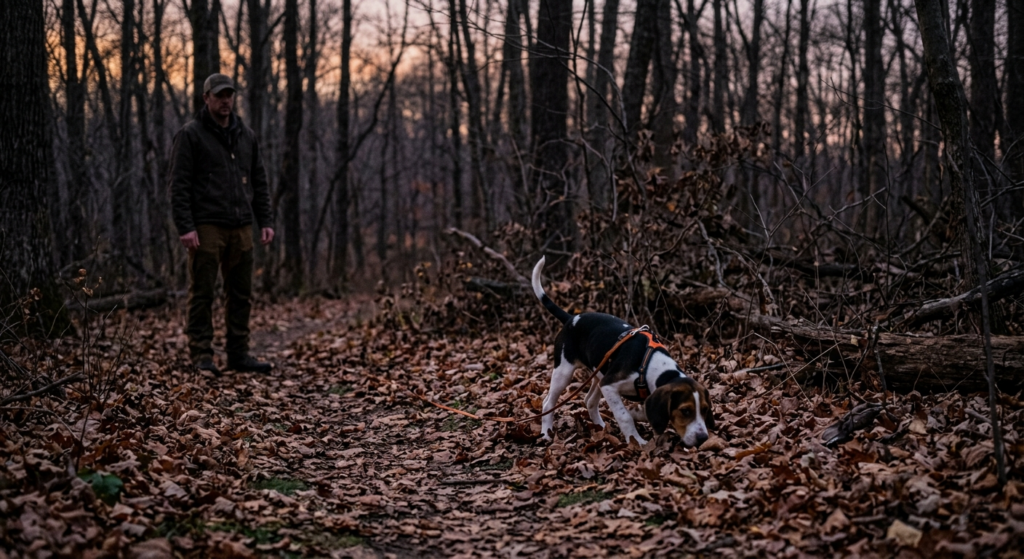
A drag is not a training program. It is a door. You use it to show a young coonhound what scent is, what following it feels like, and what reward waits at the end. That is the whole job.
The problem is most handlers do not stop there. They keep running drags long after the lesson is learned. They make them longer, older, and more complicated because they think more difficulty means more progress. It does not.
What it actually builds is a pup that creeps. A pup that overworks every check. A pup that has learned to be careful instead of confident. That matters more than most handlers think, because good coonhound training starts with building confidence and independence, not creating routines a pup leans on.
This article is about how to use drags correctly, when to walk away from them, and what to watch for when they start doing more damage than good.
What a Drag Is Actually Teaching
When you drag a coon hide across the ground and turn a pup loose on the start, you are teaching three things.
First, scent association. The pup learns that a specific smell means something worth following. That is foundational.
Second, nose-down behavior. The pup learns to keep its head down and work ground scent rather than air-scenting or running random.
Third, reward at the end. The pup learns the formula: follow the smell, get the payoff.
That is it. That is the whole lesson. Drags are controlled setups, not real coon work. There is no track aging naturally with weather and terrain. There is no animal behaving unpredictably. There is no true hunting happening.
Some handlers mistake a pup that stays glued to the scent line for a pup that is learning to hunt. What they are really watching is a pup learning to follow a predetermined path. Those are not the same thing.
When a young dog learns to build a pup’s confidence through tracking, the goal is forward momentum and problem-solving. A drag that is too long, too old, or run too often does the opposite. It teaches the pup to puzzle instead of push.
Why Handlers Make Drags Worse
Drags too long too early
Long drags wear out a young pup mentally before it has built enough desire to sustain the effort. The pup starts bogging down not because it is thorough but because it ran out of gas. That slow, careful movement gets reinforced every session and eventually becomes the pup’s default style.
Keep first drags short. Short enough that the pup reaches the reward before its nose loses interest or its legs get tired.
Scent that is too old
Older scent forces a beginner to solve a problem it does not yet have the tools for. The pup slows down, questions itself, and hesitates. Hesitation early can become a habit fast. Start with fresh scent so the pup gets clean, strong smell to follow and wins the lesson quickly.
Running too many drags
This is probably the most common mistake. Handlers get comfortable with drags because they are easy to set up and easy to watch. So they keep running them. The pup gets pattern-trained to handler-made setups and starts waiting for that exact type of scenario instead of developing real hunting instincts.
Drags are an introduction. Use them like one.
Walking the pup through it
When a handler walks right behind the pup on every drag, hovering and guiding, the pup learns to lean on that presence. Take away the handler and suddenly the pup has no confidence at the checks because it has never had to figure one out alone.
Turn the pup loose and step back. Let it work. It will make small mistakes. That is fine. Small mistakes followed by self-correction are how a dog builds real ability.
Reward structure that never changes
If every drag ends the same way, the pup learns a routine. Routines can make dogs mechanical. A hunting dog that is mechanical will fall apart the first time real conditions do not match the training setup.
How to Run a Drag Correctly
None of this is complicated. It just requires restraint on the handler’s part, and restraint is harder than it sounds.
Start short and fresh
First drags should be short enough that the pup finishes them quickly. Use scent that is fresh enough to give the pup a clear, strong trail to follow. Success early is more important than difficulty early. A pup that wins its first few drags wants to go again. A pup that struggles through them learns to approach scent with caution.
Use drags sparingly
Treat a drag like a teaching tool with a specific, limited purpose. A handful of good drag sessions can accomplish what the lesson is supposed to accomplish. After that, additional drags are not building anything new. They are just reinforcing a pattern.
Let the pup work without interference
Start the pup on the drag, step back, and stay quiet. Watch. Only step in when the lesson is genuinely breaking down and the pup has no way to find its way forward. Anything short of that, let the pup sort it out.
Keep the line natural, not tricky
There is no value in making a complicated drag for a beginner. Winding routes and aging tricks are not challenges that build ability in a young dog. They build frustration and hesitation. Save difficulty for when the dog has earned it.
Quit while the pup wants more
End sessions before the pup is mentally worn out. A sharp, eager session that leaves the pup wanting more does more for drive development than a long session that drags on until the pup stops caring.
Transition off drags early
The handler’s job is to watch for the moment the pup understands the basic lesson and then move toward short, real-world opportunities. Not to keep polishing drag work until it feels perfect.
If you keep manufacturing every lesson, you end up with the same kind of dependence covered in starting a young coonhound without building dependence — a dog that needs the handler to set up every scenario before it will commit.
Devil’s Advocate
Some experienced handlers will tell you that drag work done right can build genuine tracking ability and that short, fresh drags are a clean foundation for a pup that will eventually work real coon.
That is not wrong. There are handlers who use drags well, keep them short, keep them infrequent, and move off them fast. Those handlers produce good dogs.
The problem is that most handlers do not do it that way. Most handlers fall into one of two patterns. Either they run drags constantly because it feels productive and the pup looks busy, or they make the drags progressively harder because they want to test the pup’s ability. Both patterns produce slow tracking.
So yes, drags can be a useful tool. The argument here is not against drags. It is against overusing them. If your pup is already showing natural drive, hunting out confidently, and starting to follow real scent on its own, you may not need much drag work at all.
What Most Handlers Get Wrong
They think more drag work automatically means more progress. It does not. It means more repetitions of a controlled exercise.
They confuse careful tracking with capable tracking. A pup that creeps down a drag line is not being thorough. It is being dependent.
They make drags harder to prove the pup is smart. A young pup does not need to be tested. It needs to succeed.
They help too much. At the start, at every check, at the finish. The pup never solves anything on its own.
They keep using drags long after the lesson has been learned because it is the only training exercise they are comfortable with.
They miss the fact that some slow tracking is man-made. The pup did not come out of the box like that. The handler built it.
When to Leave Drag Work Alone
If the pup is hunting out naturally, using its nose on its own, and showing confidence at checks, do not keep falling back on drags just because they feel safe.
If drag sessions are making the pup more careful, less bold, or more handler-focused, back off. The tool is working against you at that point.
If the pup is becoming mechanical or bored with drag setups, reassess entirely. More repetitions of the same exercise will not fix that.
If a pup has no desire and no drive, more drags may not solve the real problem. Some pups need exposure, maturity, and opportunity more than they need another training exercise.
Not every young coonhound needs much drag work at all. And bad early tracking patterns do not always stay on the ground. They show up later in finish problems. If you are seeing things like a young hound that trees but will not stay, look back at how early training was handled. The roots of that problem often start earlier than handlers expect.
Quick Fix Checklist
- Keep drags short and fresh until the pup understands the basic lesson
- Step back and let the pup work without guiding it through every check
- Limit drag sessions to a handful, then transition toward real opportunities
- End each session while the pup still wants more
- Watch track style closely — if the pup starts creeping, shorten the drags or reduce frequency
- If the pup is already hunting naturally, skip most of the drag work
- Assess drive honestly — if there is no desire, drags are not the fix
The Bottom Line
A drag is a door opener. Use it to introduce scent, build a little confidence, and show the pup the formula. Then get out of the way.
The dogs that track with drive and independence are not the ones that ran the most drags. They are the ones whose handlers knew when to stop setting things up and let the dog figure out the rest.
Build the foundation, then trust it.