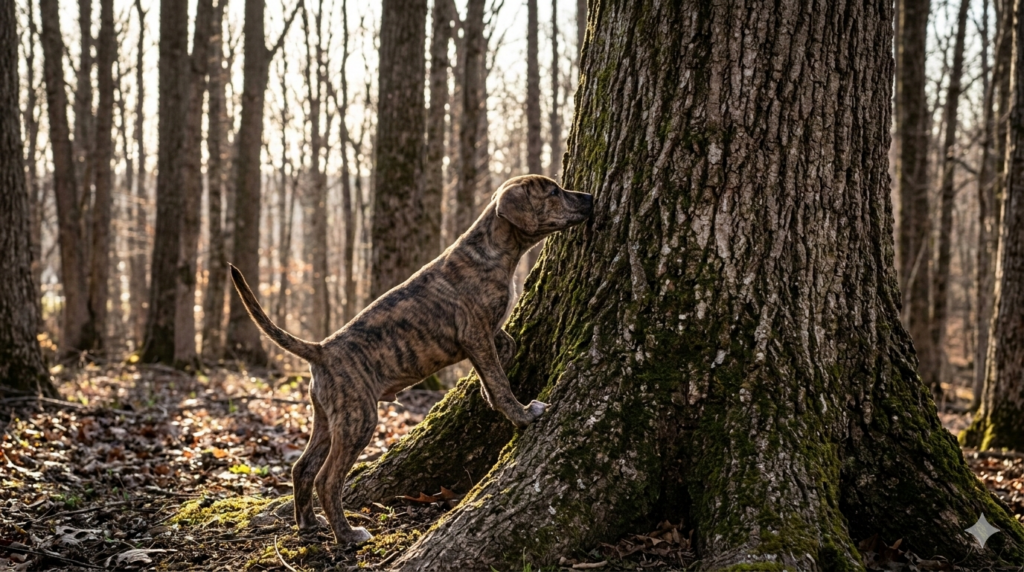
Most young squirrel dogs do not fail because of bad breeding. They fail because somebody pushed them too hard, too soon, and turned curiosity into confusion. That is a handler problem. It always has been.
The early woods trips matter more than most hunters realize. Not because the dog needs to find squirrels right away, but because those first weeks in the timber are building something deeper than a hunting skill. They are building the dog’s relationship with the woods itself.
Get that right, and everything else has a foundation to grow on. Get it wrong, and you spend the next two years trying to fix a dog that learned the wrong lessons before it ever really started.
Curiosity Is the First Real Sign
Before a young dog tracks, before it trees, before it develops any kind of hunting pattern, it gets curious. That is the tell.
You will see it on early trips. The pup pokes into a brush pile. It stops and works the base of a tree for a minute before moving on. It circles back to a spot it already passed. None of that looks like squirrel hunting yet. It looks like a dog with a nose and a wondering mind.
That is exactly what you want.
Curiosity is the engine that drives everything downstream. A dog that is genuinely curious about its environment will eventually start connecting scent to squirrels, squirrels to trees, and trees to the act of speaking. That sequence builds itself over time if the handler stays out of the way.
What you do not want is a pup that wanders without interest. Not sniffing. Not investigating. Just moving. That dog is not curious, it is bored or disconnected. The woods have not grabbed it yet. Those dogs sometimes come around, but the timeline stretches out considerably.
Watch the early trips for genuine investigation. That is your baseline.
What Early Trips to the Woods Actually Look Like
Here is what most first-time squirrel dog handlers expect: the pup follows its nose, finds a track, works it to a tree, barks. That is a finished dog’s behavior. It takes time to build.
What early trips actually look like is random. The pup explores without a clear pattern. It covers ground in wide arcs, stops at interesting smells, follows a track for thirty yards and then loses interest. It might tree a bird. It might bark at a stump. It might spend five minutes at a log that has not seen a squirrel in two weeks.
That is not a problem. That is a young dog learning what the woods smell like.
Every early trip deposits information. The pup is building a scent library, learning what is interesting and what is not, starting to associate certain smells with certain behaviors. The hunting pattern comes later. Right now, the dog is just reading the book.
Handlers who do not understand this start correcting too early. They pull the pup away from unproductive spots. They try to redirect attention toward squirrel sign. They walk faster, trying to get the dog into better areas. All of that disrupts the natural learning process and teaches the dog to look to the handler for direction instead of trusting its own nose.
Let the dog explore. That is the job on early trips.
Confidence in the Woods Comes Before Hunting in the Woods
A squirrel dog that is not comfortable in the woods cannot hunt the woods. This sounds obvious, but a surprising number of handlers skip this step without knowing they are skipping it.
Comfort means the dog is not worried about the terrain, the sounds, the distance from the handler, or the general unfamiliarity of being in timber. A pup that stays close, checks back constantly, or shuts down in thick cover is not ready to hunt. It is still getting used to being there.
This is worth cross-referencing with what experienced handlers have written about why your young squirrel dog won’t hunt deep. A lot of range problems trace back to confidence that never fully developed in those first few months of exposure.
Short, positive trips fix this. Take the pup out for twenty to thirty minutes in good weather. Let it move freely. Do not push into unfamiliar terrain every single time. Use areas where the dog has been before. Familiarity builds confidence faster than novelty does.
Once the dog is moving freely, covering ground with its head down, and not checking back every few minutes, the confidence piece is in place. Now you can start putting it in front of more squirrel activity.
The Two Mistakes That Wreck Most Young Dogs
Most early failures in squirrel dog development come from one of two places. Knowing them does not require years of experience. It just requires paying attention.
Expecting too much too soon. The handler takes the pup to the woods and expects squirrel hunting behavior in the first month. When the pup is just exploring with no pattern, the handler decides something is wrong and starts intervening. That intervention teaches the dog to stop trusting itself. Down the road, that dog hesitates when it should commit.
Staying in the woods too long. The handler figures more time in the woods means faster development. What actually happens is the pup fatigues mentally and physically, the trips become a drag, and the dog loses enthusiasm for the whole thing. Young dogs have a threshold. Once they hit it, the trip stops being useful.
End every early session while the pup is still moving and still curious. That last ten minutes of genuine hunting energy is more valuable than an extra hour of tired wandering. You want the dog to load up in the truck wanting more, not relieved the trip is over.
Those two corrections alone will put most young squirrel dogs on a better track.
Building the Foundation for Tracking and Treeing
Tracking and treeing are the performance skills. Curiosity and confidence are the foundation skills. Handlers who try to build performance before the foundation is solid end up with dogs that are brittle.
A dog that is confident in the woods and genuinely curious about squirrel scent will begin to develop a hunting pattern on its own. It starts distinguishing between cold tracks and fresh ones. It learns what a running squirrel smells like versus an old crossing. That distinction is what produces a dog that tracks with purpose rather than just following scent randomly.
Understanding that distinction matters a lot when you start evaluating what the dog is doing in the woods. Knowing how to tell if your squirrel dog is tracking or guessing becomes relevant right around the time the pup starts showing its first real squirrel interest. You want to read the behavior correctly so you reinforce the right thing.
Do not rush the treeing. Some young dogs tree early and clean. Others take longer. The dogs that take longer are often the ones that come around with the most commitment once they do. The tree is not the starting point. It is the result of everything that came before it.
For a full breakdown of how these early skills connect to long-term development, the squirrel dog training pillar covers the full progression from pup to finished dog.
Devil’s Advocate
Some hunters will say letting a young dog range freely without guidance creates bad habits. That the pup will start running rabbits, busting birds, or developing a sloppy pattern that takes years to correct.
That concern is not entirely without merit.
But the answer is not to lock down a young dog before it ever gets a chance to develop. The answer is management. Choose hunting ground with low rabbit pressure in the early trips. Keep sessions short enough that the pup does not range into temptation before it has any squirrel drive to compete with it. Introduce squirrel scent deliberately when the timing is right.
A dog that was allowed to develop naturally and then guided away from bad habits is a more confident dog than one that was corrected before it ever really started. The goal is to shape the curiosity, not suppress it.
Quick Fix Checklist
- Keep early woods trips to 20-30 minutes
- End each trip while the pup is still curious and moving
- Use familiar terrain to build comfort before adding new ground
- Watch for genuine investigation, not just movement
- Do not redirect the pup away from unproductive spots too early
- Do not expect a hunting pattern in the first few weeks
- Let the dog explore without pressure before introducing squirrel focus
- Choose low-distraction ground for early trips
Start Right, Stay Patient
The dogs that become reliable squirrel hunters almost always had handlers who understood one thing early: the pup’s job in the first few months is not to hunt squirrels. It is to fall in love with the woods.
Curiosity built into genuine comfort, comfort built into a natural hunting pattern, hunting pattern sharpened into tracking and treeing ability. That is the sequence. It cannot be hurried without cost.
Give the dog time to become what it is bred to be.