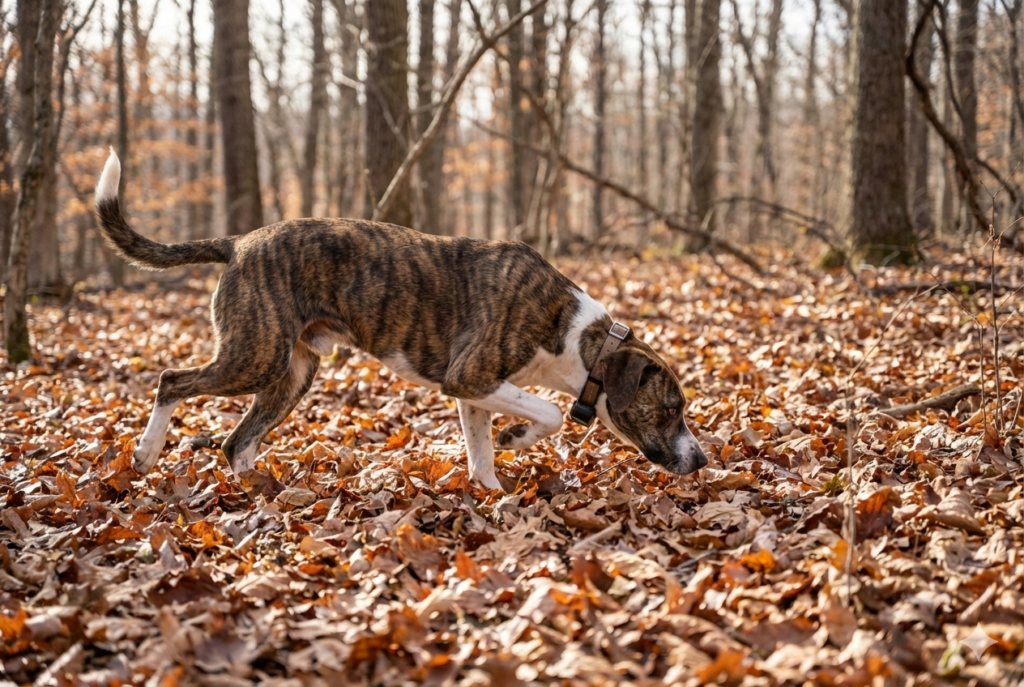
There’s a kind of dog that looks busy all day.
He ranges. He moves. He covers miles. From a distance, it feels like effort.
But if you watch long enough, you start noticing something.
He keeps ending up in the same places.
He loops back through the timber he already hunted. He checks the ridges twice. He drifts back toward the truck, then swings wide again. It looks like motion. It isn’t progress.
That’s squirrel dog backtracking. And if you don’t address it early, it becomes a habit that’s hard to break.
What Is Actually Happening
Backtracking isn’t just circling a tree. It isn’t checking a loss on a track.
It’s when a squirrel dog keeps circling back to revisit ground that’s already been hunted thoroughly, not because scent pulled him there, but because comfort did.
It often shows up as wide loops that end where they started, drifting back toward the handler, rechecking the same ridges or creek bottoms, or hunting in circles instead of pushing forward.
On the surface, it can look like thoroughness. In reality, it’s inefficient hunting. A dog revisiting the same area twice isn’t covering new ground. He’s burning time.
A good squirrel dog moves forward with purpose. He clears ground and progresses into new timber instead of orbiting the same area.
Why It Happens
Backtracking usually isn’t stubbornness. It’s uncertainty. Here are the most common reasons it develops.
Lack of Confidence in New Ground
Young squirrel dogs afraid to hunt new woods are more common than most handlers realize. If a dog doesn’t fully trust his nose yet, he may drift back toward familiar territory instead of committing to fresh timber. It feels safer. But safe doesn’t produce squirrels. Confidence is built by solving new problems, not revisiting old ones.
Over-Hunting the Same Property
If you hunt the same woods repeatedly, your dog begins to memorize patterns. He knows where the squirrels were yesterday. He learns travel routes. Instead of hunting scent in the moment, he starts hunting memory. That’s when you see a squirrel dog hunting the same woods over and over, swinging back toward known spots rather than pushing forward.
Too Much Early Freedom
Dogs that were allowed to range out wide without structure sometimes never learned what forward progression means. They learned to move. They didn’t learn to hunt. If a young squirrel dog was praised for covering ground rather than producing game, backtracking becomes just another form of busy movement.
Pack Dependence
When hunting with other dogs, some dogs drift back toward the group when uncertain. That subtle dependence can turn into a pattern of circling instead of committing. Solo hunting often exposes this quickly.
Handler Dependence
A squirrel dog that keeps hunting behind you or keeps looping back toward your position hasn’t fully developed an independent hunting drive. He’s looking for confirmation instead of trusting his nose. That’s a training gap, not a defect.
How to Fix It
Fixing this doesn’t require heavy correction. It requires clarity and structure.
- Hunt Fresh Ground
New timber forces a dog to rely on its nose instead of memory. If you want to know how to get a squirrel dog to hunt new ground, start simple. Vary entry points. Approach from different angles. Change direction of travel. Break the pattern. A dog that can’t fall back on memory has to hunt forward.
- Shorten Hunts
Long, wandering hunts often create lazy movement. Shorter sessions encourage purposeful hunting. Clear a section. Move forward. Finish. Quality progression matters more than hours logged.
- Reward Forward Movement
When your dog pushes into new timber and hunts independently forward, reinforce that. Calm praise. Continued forward movement. Keep momentum. Don’t stall in areas already cleared unless scent demands it. Improving squirrel dog hunting efficiency starts with this one habit.
- Interrupt Repetitive Loops
If you consistently see your dog circling back into dead ground, don’t ignore it. Move yourself forward physically. Change direction. Guide the hunt without constant micromanagement. You’re not controlling every step. You’re preventing comfort from replacing purpose.
- Hunt Solo Strategically
Solo hunting exposes patterns clearly. Without other dogs influencing movement, you can see whether your dog pushes forward or circles back. If backtracking shows up repeatedly alone, that’s where you focus your work.
What Most Handlers Get Wrong
Most handlers see a dog that won’t push out and immediately assume a lack of drive.
That’s usually the wrong diagnosis.
A squirrel dog not progressing forward is almost always a confidence issue, not a drive issue. You fix those differently. Pressure fixes drive problems. Pressure makes confidence problems worse.
The other common mistake is hunting the same timber until it’s dead. A dog learning to hunt inefficiently on burned-out ground is learning bad habits. Fresh timber, varied routes, and new challenges build the kind of dog that hunts independently.
Building confidence in a young squirrel dog means giving him problems he can solve, in places he hasn’t already memorized.
When to Leave It Alone
Not every loop back is backtracking.
If a dog returns to an area because scent is pulling him there, that’s different. Let him work it. Don’t confuse purposeful checking with comfort-seeking.
Young dogs also need time. If a pup is six to twelve months old and still circling, give the process time before labeling it a problem. Some dogs mature into forward hunters without intervention.
Watch the pattern. Is he following scent or following habit? That distinction tells you when to step in and when to stay out of it.
For the full framework on building foundation habits, see our Squirrel Dog Training pillar page.
Final Thoughts
Squirrel dog backtracking isn’t a sign your dog lacks drive.
It’s usually a sign he lacks clarity or confidence.
Fix the foundation. Build forward progression. Break repetitive patterns early. Hunt fresh ground. Reward purposeful movement.
A squirrel dog should hunt ahead with purpose, not sideways in comfort.
Forward movement builds efficiency. Efficiency builds results. And results build the kind of squirrel dog you trust when you turn him loose alone.