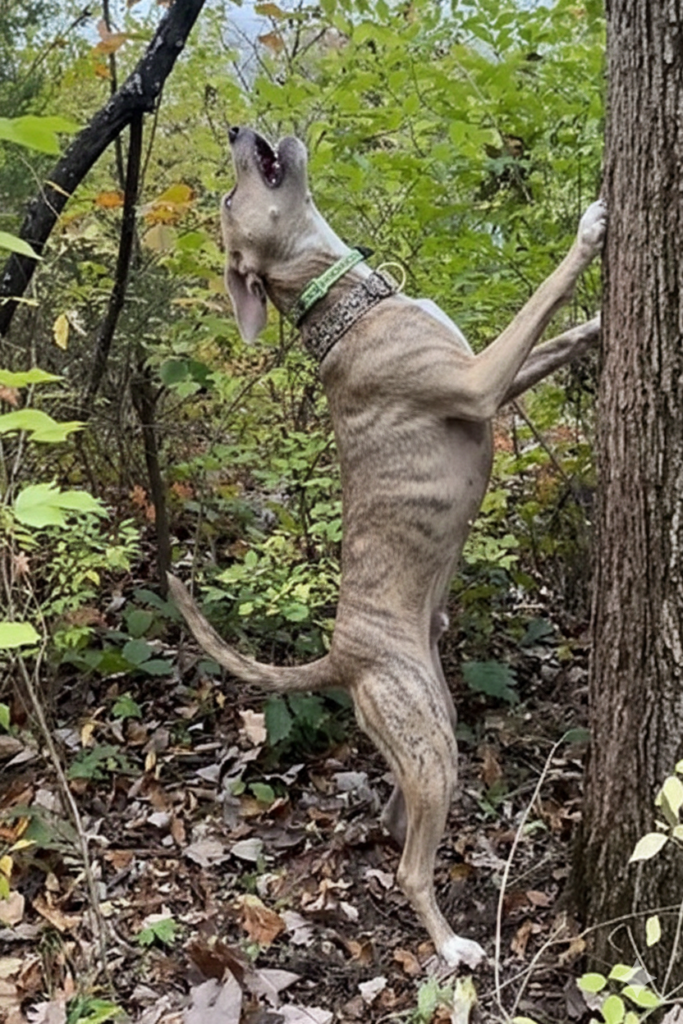
You turn him loose, and he hunts decent. Opens up a little. Drifts into a tree.
You walk in expecting to find him locked down and loud.
Instead, he is circling. Nose up. Nose down. Two barks, then nothing. He checks one side, checks the other, drifts off ten yards, and comes back. Acts like there is a squirrel up there. But he will not plant his feet and say so.
This is one of the most common problems I see with young squirrel dogs. It is also one of the most misread.
Most handlers watch that circling behavior and go straight to a bad conclusion. They say he is slick treeing. Or gutless. Or just not a tree dog.
Sometimes that is true. Most of the time it is something else entirely.
Before you start correcting something you do not fully understand, here is what is actually happening when a squirrel dog circles a tree and will not commit.
What’s Actually Happening
Circling is not quitting. It is uncertainty.
Not dramatic confusion. Not rebellion. Just a dog that has enough scent to know something happened at that tree, but not enough confidence to lock down and own it.
Daylight squirrel hunting exposes this fast. There is no long track to sort through. No dark cover to buy time. You are standing there watching your dog process scent in real time, and if he is not sure, it shows.
A dog that circles is usually doing one of a few things. He is trying to figure out which tree the squirrel actually ended up in. He is checking for a hole or den opening. He is sorting out scent that has drifted with the wind or thermals. Or he is making sure he is right before he commits.
That last one matters more than people think.
Young dogs who have been corrected at a tree, even once, will start hedging. They will circle a little longer. Double-check. Second-guess themselves.
That is not always a flaw. Sometimes that is a dog learning to be accurate.
Why It Happens
There are four main reasons a squirrel dog circles without committing.
1. Scent Conditions Are Working Against Him
Squirrels rarely climb straight up the tree they are sitting in. They hit it, bounce, cross limbs, and jump to an adjacent trunk. Wind pushes scent. Morning thermals lift it off the tree entirely. Evening cooling drops it in a way that makes the source hard to pin.
Your dog circling may have nothing to do with confidence or training. He may be working on a genuine puzzle. That is not a problem to fix. That is a dog doing his job.
2. You Already Corrected Him for Guessing
If you have hammered him at trees before, especially early in his development, he has learned that being wrong has a cost.
The result is a dog that slows himself down. Checks and rechecks. Will not commit until he is certain.
The timing of correction matters more than the intensity. A dog corrected too early or too often at trees will swing too far toward caution, and caution at a tree looks a lot like hesitation to a handler who does not know what they are looking at.
Most handlers build this problem themselves without realizing it.
3. He Has Not Learned What Commitment at the Tree Means
Some dogs trail well, open honest, and locate squirrels consistently, but have never been taught that once the track ends, the job changes.
Locating and treeing are two different behaviors. A dog that was allowed to free-range too much early on, without structure around the tree, may not understand that once he gets there, his job is to plant and bark, not check and drift.
Structure builds that understanding. But only if you actually teach it.
4. The Squirrel Is Gone
People hate hearing this one, but it is the truth.
Sometimes the squirrel is not there. Den tree, heavy leaf cover, a bail before you walked in. A dog that circles briefly and then drifts off is sometimes just reporting an honest result.
He is not failing you. He is telling you the truth.
How to Fix It
Start by figuring out if there is actually something to fix.
Step one: Keep your mouth shut and watch.
Walk in quietly. Let him work. If he circles once or twice and then settles in and trees hard, you do not have a problem. If he circles for two full minutes and drifts off without committing, that is a pattern worth paying attention to.
Pattern beats emotion every time. Do not react to one hunt.
Step two: Look at the tree before you make a judgment.
Check the vines. The adjacent trunks. Limb bridges. Any holes. If you find the squirrel, praise him calmly and let him bank that confidence. If you do not find it, do not assume he is wrong. Daylight dogs miss fewer squirrels than handlers give them credit for.
Step three: If real hesitation is the issue, tighten the structure.
Hunt him alone instead of in a pack. Avoid any correction at trees until you are certain of the mistake. Reward correct trees clearly and early in the season. Limit his exposure to den trees while he is still figuring things out.
Some trainers use a caged squirrel to build tree drive. It can help if you use it sparingly. Overdoing it creates artificial habits that fall apart in the field.
Step four: Do not correct uncertainty.
This is the most important one.
If your dog is unsure and you put pressure on him, you get one of two outcomes. He starts guessing to avoid the pressure, or he stops treeing altogether. Neither one is what you want.
Correction is for confirmed mistakes. Not for a dog that is still working it out.
What Most Handlers Get Wrong
They want a finished dog before they have built one.
They want him to hit the tree and lock down loud like a competition hound, and when he does not do that at eight months, they start looking for the problem.
In daylight squirrel hunting, accuracy is worth more than volume. A dog that is right matters more than a dog that is loud.
Most of the circling and hesitation problems I see trace back to the same things. Expecting finished behavior from an unfinished dog. Correcting before the dog understands what he did wrong. Comparing him to someone else’s dog from a different line with different development. Hunting him in bad scent conditions and blaming him for the results.
Every dog runs on a different clock. Some will tree naturally at six months. Others take two full seasons before it clicks. The handlers that ruin the most potential are the ones who treat every dog the same.
When to Leave It Alone
If your dog finds squirrels consistently, shows improvement from one month to the next, eventually commits after a brief circle, and is still in the early part of his development, you may not have a problem at all.
Some of the most accurate squirrel dogs I have seen do a short check before settling in. They are confirming, not guessing. That is a different thing entirely from a dog that drifts off and quits.
If you are seeing steady progress, leave it alone and let him develop.
If you are seeing regression, avoidance, or a dog that drifts off trees more and more often, then it is time to tighten the structure and look at how you have been handling trees.
The Bigger Picture
Tree hesitation is a symptom. The cause is almost always something that happened earlier in training.
Timing, structure, and how you handled the first few trees matter more than most people realize. If you want to understand how squirrel dogs develop from ranging pups into accurate daylight hunters, the full breakdown is in the squirrel dog training guide here: /squirrel-dog-training/
Most tree problems start long before the first tree mistake shows up.
When your squirrel dog circles a tree and will not commit, slow down before you react.
Watch what he is telling you. Uncertainty is not the same as disobedience. Hesitation is not the same as weakness.
Sometimes he is wrong. Often, he is thinking. And a dog that thinks before he trees is usually closer to right than the one that guesses loudly and gets it wrong.
Volume matters less than accuracy.
Build his confidence. Protect the timing of your corrections. Only correct when you are certain of the mistake.
Do that consistently, and most circling problems take care of themselves with experience.
Take a look at the Squirrel Dog Training guide for more training information.
Starting a young coonhound? Get the free “First 30 Nights” guide before you make mistakes you can’t undo