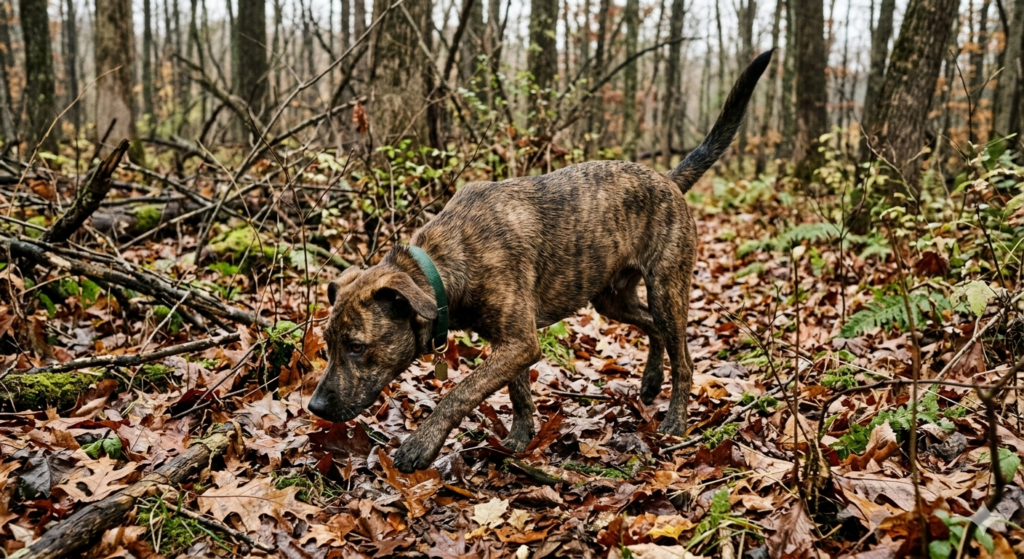
A young dog runs hard, puts its nose down for twenty yards, then lifts its head and blows straight to a tree. It barks. You walk in. No squirrel. You mark it as a miss and move on.
That happens to everybody. The question is whether you are reading what just happened or just calling it bad luck.
There is a real difference between a dog tracking a squirrel to a tree and a dog making a guess. Both can look confident. Both can end with barking. But only one of them is building something useful. The other is building a habit that will cost you later.
Learning to tell the difference is one of the most important things a handler can develop. Most people never do.
What Real Tracking Looks Like in the Woods
A dog working real squirrel scent moves with purpose but it does not move fast. Scent on the ground is thin. A squirrel that walked through leaves an hour ago left a scent trail that breaks apart, gets blown sideways, and pools in low spots. A dog working that trail is solving a puzzle, not sprinting to an answer.
Watch the nose. A dog genuinely tracking keeps its nose low and active. It checks, adjusts, and checks again. You will see it slow down in spots where the scent is weak. You will see it circle small areas where the trail bends or crosses itself. That circling looks like confusion. It is not. That is the dog doing the work.
The body follows the nose. When a dog is working true scent, the direction it is moving is being dictated by what it smells, not by what it sees. A dog locking onto a squirrel in a tree from sixty yards and running straight at the tree is not tracking. It is using its eyes or its ears. That is a different behavior.
Real ground tracking on a cold morning in damp leaves looks slow and uncertain from the outside. The dog looks like it is not sure. It is sure. It is just being careful with information that is barely there. That is what you want to see. That is the dog learning to trust its nose over everything else.
What Guessing Looks Like
A guessing dog moves fast and covers ground. It hits a smell somewhere, maybe a few feet of real trail, and then it makes a decision based on incomplete information. It picks a direction, commits to it, and trees.
A guessing dog is not stupid. In fact, guessing is what a bold young dog does when it has enough drive but not enough patience. The dog knows something is there. It just has not learned yet that the nose has to lead all the way to the tree, not just to a general area.
You can spot a guesser by watching what happens after the first hit of scent. Does the nose stay down? Does the dog work the trail forward? Or does it lift its head, assess, and make a run for the nearest tree?
Watch what the dog does when it hits a fork. A squirrel trail crosses itself constantly. The dog that slows down at a fork and works through it is tracking. The dog that picks the fork closest to a tree and runs is guessing.
This same pattern shows up in dogs that refuse to push into heavy cover. If that is something you are seeing alongside the guessing behavior, it is worth reading about why a young squirrel dog won’t hunt deep because the two problems often come from the same root cause.
Guessing dogs often tree accurately in easy conditions. When the scent is fresh, the trail is direct, and the cover is open, they get it right. That is the dangerous part. A guessing dog that trees correctly half the time in its first season will convince a handler it is a finished dog by its second. The handler stops watching. The habit gets cemented. When conditions get harder, cold scent, wind, thick cover, the guessing dog falls apart and the handler has no idea why. The dog that was actually tracking in hard conditions all along keeps performing. That is the dog built to last.
The Handler Mistake That Makes This Worse
Most handlers do not watch the dog work. They watch the tree. They are already looking up before the dog gets there. They are counting on the outcome to tell them whether the run was good.
Outcome is the worst teacher you have in squirrel dog training. A dog can guess right and a handler will reinforce sloppy work. A dog can track beautifully and a squirrel that jumped to another tree before the dog arrived makes the run look like a failure.
You have to watch the process, not the result. That means staying behind the dog, staying quiet, and keeping your eyes on how the dog is moving, not on whether it trees something.
The other mistake is pulling young dogs off runs too early. A young dog that loses a trail and circles for three minutes looks like it is wasting time. Handlers step in, redirect, and rob the dog of the chance to work through the problem on its own. That circling and recovering is exactly how a dog builds the patience and nose discipline that separates a tracking dog from a guessing dog.
If your dog performs well in open ground but unravels once it hits real timber, that is a related problem worth understanding. The breakdown between yard work and woods work is covered in detail in this post on why your young squirrel dog looks good in the yard but confused in timber.
For a broader look at how young squirrel dogs develop in the field, the resources at squirrel dog training cover the full picture of what to expect from puppies through their first full seasons.
Scent Conditions Shape Everything
A young dog hunting on a warm, dry afternoon in October is hunting in hard conditions for scent work. The ground is dry, thermals pull scent up fast, and whatever trail the squirrel left is already breaking apart.
That same dog on a damp November morning, thirty-eight degrees, dead calm, wet leaves on the ground, is working in near-ideal conditions. Moisture holds scent low. Cold air keeps it close to the ground. The trail stays where the squirrel left it.
If you only hunt a young dog in poor scent conditions and call it a slow developer, you are not giving it a fair read. Hunt it in good conditions first. A dog that improves dramatically when scent is good has real nose ability that has not yet matured into hard-condition tracking. That is something to build on.
A dog that guesses the same way in good conditions and bad conditions is a different problem. That dog has learned to rely on pattern recognition and tree proximity instead of scent. It has learned the wrong lesson and it is going to take a lot of careful, deliberate hunting to undo it.
Devil’s Advocate: Some Young Dogs Just Need Reps
There is a version of this conversation where a handler reads this and starts overanalyzing a dog that is genuinely just young. Not every fast tree is a guess. Not every confident run is a problem.
Some young dogs that look like guessers in their first season look like trackers by their third. The nose matures. The patience develops. The dog figures out on its own that guessing costs it more than it gains. Some dogs need failure to learn that lesson and there is no shortcut around it.
The point of watching scent work closely is not to diagnose every run as a problem. It is to give yourself an honest read on where the dog actually is so you are not hunting it above its ability or praising behavior that is going to cause problems later.
Know what you are looking at. Then let the dog work.
Quick Fix Checklist: Reading Your Dog in the Field
- Watch the nose, not the tree. Keep your eyes on the dog from the first hit of scent all the way to the bark.
- Note where the dog first hits scent and where it trees. A straight-line run from scent hit to tree in open cover is often a visual or auditory locate, not a nose track.
- Let the dog circle and work. Do not step in before three minutes of honest effort at a sticking point.
- Hunt in good scent conditions intentionally. Early mornings after overnight rain in cool weather. Use those runs to build your baseline read on the dog.
- Log what you see, not just whether the dog treed. A journal of behavior patterns over twenty runs tells you more than outcomes alone.
- Watch how the dog handles trail forks. That moment tells you more about nose discipline than any other single behavior.
- Do not correct guessing directly. Hunt the dog in conditions that reward tracking and make guessing fail. Let the woods do the teaching.
- Stay patient. Nose discipline develops on the dog’s timeline. Pressure from the handler does not speed it up. It usually slows it down.
Closing
A dog that trees confidently and wrong is not necessarily a bad dog. It may just be a dog that has not yet learned that confidence without accuracy does not get rewarded.
That is a lesson the woods will teach, if the handler stays out of the way long enough to let it land. The problem is most handlers are not watching closely enough to know which lesson the dog is actually getting. They see a miss and blame luck. They see a tree and call it talent. Neither reading is doing the dog any good.
Watch the nose. Read the body. Let the dog work. Everything else will follow.