The coon hunter has one advantage the squirrel dog handler does not get. When a coonhound goes quiet in dark timber, you have to imagine what is happening. Your brain fills the silence with whatever it wants. That distance gives a handler space, and it forces patience.
Squirrel dog work strips that away.
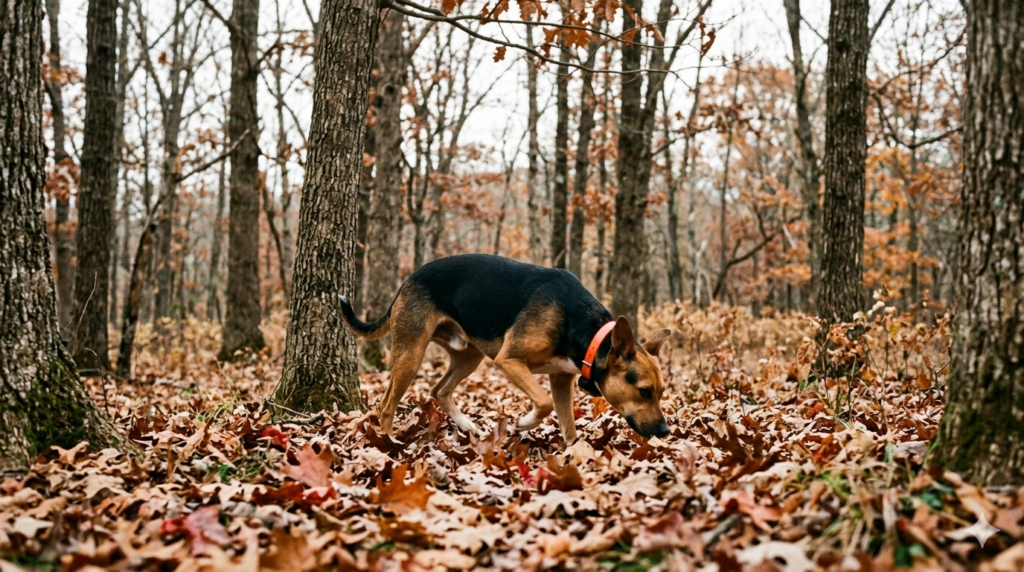
In daylight hardwoods, you see everything. You see the dog swing past a tree and keep going. You see it stop in the middle of a flat and just stand there. You see it push to the ridge and circle back with nothing. There is no gap between what the dog is doing and what you are witnessing. Every hesitation, every mistake, every moment the dog looks unsure plays out in front of you in real time.
That transparency is one of the genuine pleasures of squirrel dog work. It is also the exact thing that makes handlers worse at their job.
The squirrel dog training problems that are hardest to fix are not the ones that come from a dog with bad habits or weak drive. They come from handlers who cannot stay still while they watch their dog struggle.
What’s Actually Happening
A squirrel dog that stalls, misses a track, or false trees is not failing. It is working. Sorting scent in open hardwood timber is a problem-solving task, and young dogs solve it slowly at first, then faster as they build experience. What looks like failure from the ridge is often a dog doing exactly what it should — checking, adjusting, trying again.
The handler who watches that process long enough to let it play out is the handler who ends up with a finished dog. The handler who walks toward the stall, points at the tree, or moves the dog to a new area after two minutes of watching is the handler who just interrupted the most valuable part of the training session.
Dogs read movement. A squirrel dog working a cold track knows where you are. The moment you start closing the gap between yourself and the dog, it reads that as information. You are telling it that the problem is somewhere near you, or that the current effort is not worth continuing. The dog has no way to know that you are walking toward it out of frustration. It only knows that when it struggles, the handler arrives. That pattern, repeated enough times, becomes the dog’s operating assumption.
Why It Happens
The first reason is that squirrel dog work is a visual sport, and human beings are wired to respond to what they can see. A coonhound going quiet in timber on a cold night does not give the handler a clear picture of the dog struggling. A squirrel dog standing still in an oak flat with its head low and its body posture off reads as a visible problem. The same urge to fix things that coonhound handlers feel in the silence, squirrel dog handlers feel when they watch their dog slow down.
The second reason is comparison. Finished dogs look effortless. They swing through timber, locate game, and tree with conviction. A young dog working through the same territory looks messy by comparison — lots of circling, false starts, track losses that the handler can see and watch and worry about. The gap between what the handler sees and what the handler expected creates a pressure that almost always leads to action.
Third is the social factor. Squirrel hunting is often done with other people. There is someone else at the truck watching the dog work. That audience makes visible failure feel personal. The dog struggling in front of someone else is not just a training problem. Handlers in that situation act faster than handlers who are alone.
Fourth is the terrain itself. Open hardwood timber with good visibility means the handler can see the dog at range. That visibility creates the illusion that the handler has enough information to help. You can see the dog. You can see the tree. You can see the squirrel moving in the canopy. The dog missed it. You could fix this easily. That reasoning is sound in a vacuum and harmful in a training context. Every time you fix what the dog should have found on its own, you remove a piece of the job from it.
How to Fix It
Do This
Pick a position and stay there. Not until you get uncomfortable. Not until the dog has been stopped for a couple of minutes. Stay there long enough that the dog has genuinely had time to try. If you can track your movement by looking at where you started and noticing that you have closed the gap to the dog, you have already intervened. Start over.
Let false trees stand. When a dog trees and there is nothing there, the natural handler response is to call it off and move on. But a false tree is one of the most useful learning events in a young dog’s development. The dog treed on something. The reward did not come. That pattern is corrective on its own without anything from you, if you let it play out. Walk to the tree. Look up. Say nothing. Move off on your own schedule. Let the dog make the connection that the bark and the confirmation did not match.
Hunt slower than you want to. If you feel like the dog should be covering ground faster, that is almost always about you and not about the dog. A slow young dog working scent carefully is doing more useful work than a fast young dog that is missing everything because it is moving too quickly. Match your pace to the dog, not the other way around.
Read body posture, not stillness. A stalled dog and a working dog can look similar from fifty yards. The working dog has its head up and is taking in information. Its body weight shifts as it adjusts to scent. It circles with purpose. The stalled dog has dropped its head, lost body posture, and checks back toward the handler. Those are different situations. One calls for patience. The other calls for a clean restart, not a rescue.
Don’t Do This
Do not walk toward movement you spotted before the dog did. If you saw the squirrel first, the dog did not find it. If you steer the dog toward it, you have taken the locate away from it and replaced it with your eyesight. That teaches the dog to wait for handler direction on locates, which is the last thing you want from a dog that needs to hunt on its own.
Do not end hunts because you are frustrated watching the dog struggle. Hard days in the timber are the ones that build the most useful skill. A dog that finds three squirrels in thirty minutes has not learned nearly as much as a dog that pushed through two hours of thin timber and came out with one tree it found on its own. End hunts when the dog is tired or when there is a natural stopping point. Do not end them because watching failure is making you uncomfortable.
Do not reward a dog for coming back to you when it should be hunting. That check-back habit is almost always handler-made. If the dog gets any attention, any acknowledgment, any word when it walks back to you in the middle of a hunt, it will keep doing it. Silence and stillness are the correct response. Give the dog nothing to come back to.
What Most Handlers Get Wrong
The most common mistake is treating visible failure as information about the dog rather than information about the moment. A dog standing still in an oak flat is not showing you that it lacks drive. It is showing you that the scent picture it is working from is incomplete and it is trying to complete it. That is the correct behavior. The handler who reads that stillness as a dog problem and acts on it has misread what they are seeing.
Research on working dog behavior confirms what experienced handlers already know from the field. A peer-reviewed study published through the National Institutes of Health examined how handler behavior affects dog performance in search tasks and found that dogs significantly increase the frequency of looking back at their handlers when conditions become uncertain. The behavior is not accidental — dogs are actively reading handler response as part of their search strategy. A handler who moves when the dog struggles is teaching the dog that moving toward the handler is the appropriate response for uncertain moments.
The other common mistake is comparing what you are watching to how a finished dog looks. A finished dog’s speed and confidence took seasons to build. What you are watching in your young dog right now is not a finished product. For a detailed breakdown of how this pattern leads handlers to blame their dogs for problems the handler built, the article on why young dogs get blamed for handler mistakes too early covers exactly how visible failure gets misread as permanent deficiency.
Devil’s Advocate
Not every moment of visible struggle should be watched without response. That position taken to its extreme produces a handler who stands at the truck while the dog spends ninety minutes working the same trash line because stepping in feels like cheating.
There is a difference between a dog working through difficulty and a dog that is stuck in a loop it cannot exit on its own. A young dog that is consistently reinforcing a bad pattern — guessing at trees, leaving before the locate is honest, circling without purpose for extended stretches — is building habits that get harder to fix with every repetition. At some point the handler has to interrupt that.
The question to ask before acting is whether the dog has had time to try. Not whether the dog has succeeded. Whether it has genuinely attempted the problem with enough time to work through it. That threshold is longer than most handlers allow. It is rarely two or three minutes. It is often fifteen or twenty, depending on scent conditions and what the dog is working through.
Hunt design also matters here. If you keep putting a young dog into terrain and conditions that overwhelm it, you are not building ability — you are building avoidance. A dog that consistently fails in poor conditions without any opportunity for success starts to shut down rather than try. Starting in better squirrel density with more favorable conditions is not rescuing the dog from difficulty. It is appropriate setup for the stage of development.
When to Leave It Alone
Leave it alone when the dog is circling with clear purpose. Forward motion in a loop that is getting tighter and moving toward a tree is a dog completing a locate, not a dog that is lost. That circle is productive work. Breaking into it because you can see it happening is one of the most common ways handlers interrupt the best parts of the hunt.
Leave it alone when the dog checks back once and then goes back to hunting. A single check-back from a young dog in unfamiliar timber is not a dependency problem. It is a quick calibration. If the dog goes back to work immediately after, it is using the check-back as a tool, not as a crutch.
Leave it alone when conditions explain the difficulty. A dry fall morning with a west wind pulling scent off the ridges is hard work for a young dog. If the dog is working hard and coming up empty, that may be conditions and not the dog. A dog that stalls when hunting alone in tough conditions may simply need more exposure to easier ground before tackling the difficult stuff. The same dog in a damp bottom with good squirrel density often shows you a completely different picture.
Leave it alone when you are reacting to how the hunt looks and not how the dog is actually performing. Slow, steady, methodical work in hardwood timber does not look dramatic. But a dog that is covering ground with purpose, working scent when it finds it, and staying engaged without leaning on you for direction is doing the job correctly. That is not a problem to fix.
Quick Fix Checklist
- Stop moving toward the dog the moment it shows difficulty. Stay where you are.
- Let false trees complete before calling the dog off. Say nothing at the tree.
- Do not reward check-backs with any acknowledgment. Give the dog nothing to return to.
- Read body posture before reading stillness. Working and stalled are not the same thing.
- Do not steer the dog toward movement or game you spotted before it did.
- End hunts on effort and timing, not on emotional response to watching failure.
- Match terrain and conditions to the dog’s current stage before deciding there is a problem.
A squirrel dog that works in front of you and struggles where you can see it is not a problem. It is a dog doing its job in the most transparent training environment that exists.
The clarity that makes squirrel dog work enjoyable is the same clarity that makes handlers worse if they respond to every visible moment of difficulty. Most of the time the right move is to stand still and let the dog figure it out. The dog is not asking you to help. It is asking you to stay out of the way long enough for the work to mean something.
Get comfortable watching failure. The ability to do that is a bigger part of training than most handlers will ever admit.