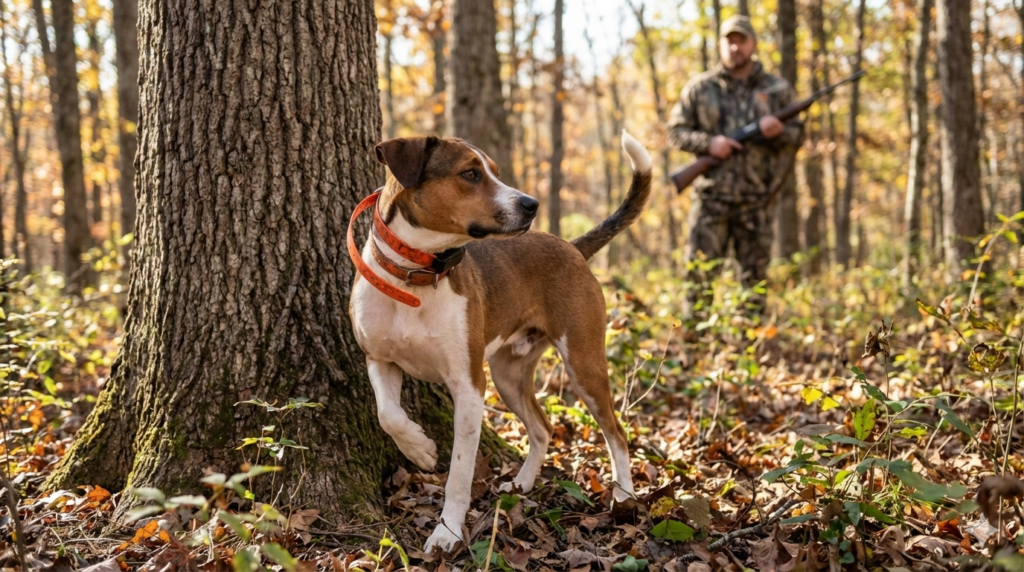
There’s a particular kind of frustration that only squirrel dog handlers understand.
Your dog strikes. He works the track clean. He comes treed hard and steady. You start walking in confident, already scanning limbs in your head.
Halfway there, he goes quiet.
You pick up the pace.
By the time you reach the tree, he’s drifting off through the woods like nothing happened.
If you’re new to squirrel dog training, this can feel like betrayal. Was he guessing? Did he lie? Is he just not serious about treeing?
When a young squirrel dog leaves the tree, it’s rarely stubbornness. It’s usually confusion, pressure, or immaturity.
What Does It Mean When a Squirrel Dog Leaves the Tree?
Not all “leaving the tree” looks the same. Before you correct anything, you need to understand which behavior you’re actually seeing:
- Barks hard for a minute, then fades off
- Checks the tree briefly and moves on
- Drifts when he hears you coming
- Leaves when another dog pulls away
Each of these behaviors has a different root cause. Different behaviors. Different causes. Don’t treat them the same.
Why Young Squirrel Dogs Leave the Tree
1. Lack of Confidence
A young dog that isn’t completely sure the squirrel went up may start second-guessing itself. When doubt creeps in, movement follows. Confidence at the tree comes from solid track work and repetition, not pressure. If a dog struggles to verify scent at the base, that can carry straight into leaving behavior.
2. Too Much Pressure
Some dogs leave because they’re afraid of being wrong. If a young squirrel dog has been corrected harshly on empty trees, he may abandon a tree the moment he feels uncertain. Pressure without understanding creates hesitation, and hesitation creates movement. This is the same pattern that ruins more squirrel dogs than lack of talent ever will.
3. Hunting With Too Much Competition
When hunted with other dogs, a young squirrel dog may leave to follow movement. He hears another dog open and assumes he made a mistake. Without independence, he’ll choose action over commitment every time. Alone hunting builds steadiness.
4. Reward Timing Problems
If a dog never clearly connects staying treed with success, he has no reason to stay. Young dogs need consistency. If sometimes you rush in, sometimes you call him off, sometimes he gets rewarded, and sometimes nothing happens, he can’t form a pattern. Dogs stay where staying pays. That’s how you keep a squirrel dog treed consistently, by making the right behavior predictable and rewarding.
5. Weak Track Foundation
Dogs that lack track confidence often leave trees. If the track wasn’t worked cleanly, the tree won’t feel solid. Tree staying behavior begins long before the dog locks down at the base. That foundation is built during early squirrel dog training, not at the tree.
Should You Correct a Dog for Leaving the Tree?
Only if he clearly knows better.
Correct only if the dog:
- Has proven accuracy
- Understands the expectation
- Repeats the behavior intentionally
But if he’s young, unsure, or inconsistent, heavy pressure will make the problem worse. You don’t fix insecurity with force. You fix it with clarity and repetition.
Overcorrecting a squirrel dog at the tree is one of the most common training mistakes young handlers make. The dog that fears being wrong will choose to leave rather than commit, and that habit can take a full season to undo.
How to Teach a Squirrel Dog to Stay Treed
Staying treed is a skill. It’s developed through structure, not corrections. Here’s how to build it:
1. Hunt the Dog Alone
Independence builds confidence. Without competition, he learns that his decision at the tree is final. There’s no other dog to second-guess himself against.
2. Slow Your Approach
If you rush in loudly or emotionally, you create anxiety at the tree. Walk in steady. No yelling. No drama. Let him settle into the bark. Dogs that are still anxious about your arrival will often drift before you get there.
3. Reward Correct Trees Clearly
When the squirrel is there, make it obvious. Calm praise. Consistent routine. Clear connection between staying and success. Dogs repeat what pays, so make sure staying at the tree is the behavior that pays.
4. Avoid Emotional Corrections
Frustration at the tree teaches uncertainty. If the tree is empty, quietly move on. Consistency builds steadiness. Emotion builds doubt. A young squirrel dog losing interest at the tree is often responding to inconsistent handler behavior, not his own lack of drive.
5. Build Accuracy First
Dogs that check trees properly are more likely to stay. Accuracy creates confidence. Confidence creates commitment. If your squirrel dog struggles to verify trees, fix that first, especially if he won’t check trees properly, and staying will often improve naturally.
At What Age Should a Squirrel Dog Stay Treed Reliably?
Most young squirrel dogs become noticeably steadier during their first full season. Some mature earlier. Some later.
Expect development, not perfection. Steadiness grows with exposure and opportunity. A dog that’s still inconsistent at 18 months isn’t broken; he’s still building the track confidence that’ll make his trees feel worth committing to.
Will a Young Squirrel Dog Grow Out of Leaving Trees?
Sometimes. But only with structure.
A dog will improve if:
- He isn’t rewarded for drifting
- He gains track confidence
- He’s hunted consistently
- Pressure is applied appropriately
Without structure, leaving behavior can become a habit. With structure, most young dogs improve steadily. The keyword is consistency. A dog hunted twice a month won’t develop the same tree confidence as one getting out every week.
Why Does My Young Squirrel Dog Leave the Tree Before I Get There?
This is one of the most common frustrations handlers report, and it usually comes down to one of two things: the dog heard you coming and got anxious, or he lost confidence in his own tree before you arrived. Slow your approach. Keep your tone neutral. And make sure the dog has had enough positive experiences at verified trees to believe that staying is worth it.
Frequently Asked Questions
Why does my squirrel dog tree and then leave?
Usually, because he isn’t fully confident the squirrel is there, or he feels pressure at the tree. Young dogs often abandon trees when unsure rather than commit to being wrong, especially if they’ve been corrected harshly on empty trees in the past.
How long should a squirrel dog stay treed?
Long enough for you to arrive and confirm the tree. As maturity increases, steadiness should improve naturally with consistent hunting. A finished dog should hold until you release him.
Should I tie my squirrel dog back at the tree?
Tying back can help reinforce staying when the squirrel is present. But tying a dog at empty trees repeatedly can create confusion. Timing matters; use it as a reward structure, not a correction tool.
Can too much correction cause a dog to leave the tree?
Yes. Overcorrection often creates hesitation and insecurity. Dogs that fear being wrong may choose to leave rather than commit. If your squirrel dog won’t hold pressure at the tree, check your correction history before adding more.
What does it mean when my squirrel dog drifts off the tree?
Drifting, rather than flat-out leaving, usually signals uncertainty mixed with distraction. He believed the tree enough to bark, but not enough to commit. That’s a track confidence issue more than a steadiness issue. Work the track foundation, and drifting typically cleans up.
The Bigger Picture
If your squirrel dog leaves the tree, don’t assume the worst. Most young dogs go through this phase.
The goal isn’t to create a loud dog. It’s to create a dependable one.
- Accuracy builds confidence.
- Confidence builds steadiness.
- Steadiness builds a finished squirrel dog.
And if you’re building that dog from the ground up, start with the full squirrel dog training guide.