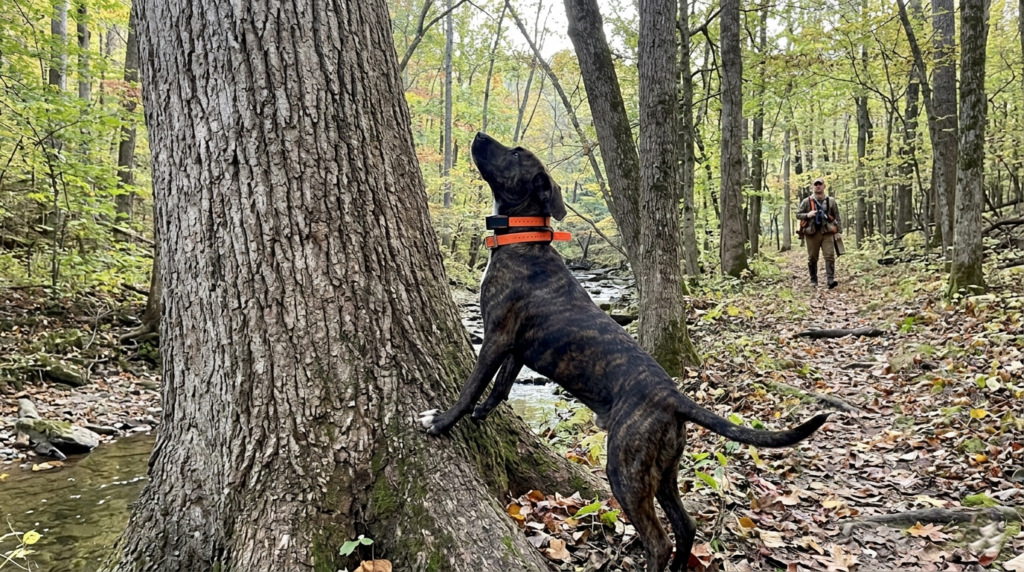
A young squirrel dog that burns out of the cast like something is chasing it looks exciting. It is not. That dog is moving fast on emotion, not hunting on nose. It is covering ground without working it, and most of the time it is leaving squirrels behind it that it never checked.
The first fifty yards is where hunting style gets built. Not the first season. The first fifty yards, every single hunt, from the time the dog starts going to the woods. What a young dog learns to do in that opening stretch becomes what it does everywhere.
This is not a talent problem. Hard-going dogs are not wrong. Uncontrolled speed without any search pattern is wrong. The dog that blows through close timber before it has ever learned to hunt it is a handler problem, and it is fixable earlier than most people try to fix it.
The goal here is not to make a dog hunt at your feet. The goal is to build a dog that checks what is in front of it before it moves on. That habit is worth more in a squirrel dog than raw range will ever be.
What Is Actually Happening Out There
The dog is not really hunting yet. It is moving. There is a difference.
Young dogs in the early months are running on excitement. They are taking in the woods, chasing wind pockets, following old ground scent, and covering as much country as possible because everything is new and interesting. That is normal. The problem starts when the handler lets that excitement become the hunting style.
What you see in the woods looks like this. The dog leaves the cast point hard and gets out of pocket within the first few minutes. It skips the edge trees, the den trees, and the mast trees along the first stretch of timber. It circles wide before it settles down. And at the end of the hunt, the amount of ground covered rarely matches the number of squirrels found.
Some of that is just youth. But some of it is the dog learning that getting gone is what hunting means. Squirrels spend a significant portion of their time in native hardwood trees such as oaks and hickories — the same close timber the dog is blowing past in the first cast. The game is often right there. The dog just has not learned to look for it yet.
Some of that is just youth. But some of it is the dog learning that getting gone is what hunting means. Squirrels spend a significant portion of their time in native hardwood trees such as oaks and hickories — the same close timber the dog is blowing past in the first cast. The game is often right there. The dog just has not learned to look for it yet.
The first fifty yards tells you what you have built so far. If the dog has no pattern close, it will not develop one deep. Range without method just moves the problem farther from the truck.
Why It Happens
Too much excitement and not enough structure from the start. Young dogs get cut loose wound up, and repeated free-casting without any guidance teaches speed before method. The dog learns that leaving fast is what the hunt is.
Handler praise is a big part of this. A lot of hunters brag when a pup gets gone quick, even when it is not finding game. The dog picks up on that. It learns that blowing out earns approval, and it keeps doing it.
Starting in the wrong places makes it worse. Big open timber encourages a young dog to drift and run. When there is not much squirrel sign in the close cover, the dog ranges farther before it finds anything. That pattern locks in before the handler realizes it is happening.
Running behind finished dogs too early is another one. A young dog behind a big-hunting, wide-ranging experienced dog often learns to chase movement instead of developing its own search pattern. It gets dragged through the woods at someone else’s pace instead of learning to pick a piece of timber apart.
And then there is random success. One or two lucky trees found while hunting too deep can lock in a sloppy style faster than steady correction will ever fix it. The dog does not know the find was an accident. It just knows it worked.
How to Fix It
Start in tighter, squirrel-rich places. Creek edges, oak flats, small woodlots with visible sign. You are trying to stack the odds so the dog can find game close. Every find in close timber teaches the dog that the first fifty yards is worth working.
Walk slower and hunt with purpose from the start. Do not rush from one spot to the next. Let the dog learn that the hunt begins where you are standing, not two hundred yards ahead. Your pace sets the tempo.
Cast near likely trees. Den trees, mast trees, travel lanes, edges. Turn the dog loose where finding game early is actually possible. Build repetition around finding squirrels before the dog ever gets far out.
Hunt the dog alone. Solo time forces independence. It makes the dog responsible for what it finds instead of following someone else’s nose. It also shows you whether the overrunning is a real pattern or just pack excitement from running with other dogs.
When the dog starts blowing out, change direction. Ease along quietly. Keep the dog working with you instead of letting every drop become a dead sprint away from the timber. On some dogs a soft recall and recast is enough to break the launch habit.
Reward method, not just results. When the dog checks trees right, works cover carefully, and hunts with its head down and nose working, mark that. Do not only get loud when it gets deep and falls treed. The article on fixing skipped tree checks in young dogs covers this from a different angle and is worth reading alongside what you are doing with close-cover work.
Make hunts short and useful. A young dog learns more from a few controlled finds than from a two-hour hunt full of wasted running. Quit on good work when you can.
Let range come after pattern. Once the dog has learned to search the close woods right, natural range can stretch out without becoming sloppy. The goal is not a dog that hunts at your boots. The goal is a dog that checks what is in front of it before it moves on.
What Most Handlers Get Wrong
They confuse hard hunting with good hunting. A dog covering a lot of ground looks impressive. A dog finding squirrels in the ground it covers is useful. Those are not always the same dog.
They praise depth before the dog has learned accuracy. They start bragging on how far a pup gets gone before it has ever demonstrated it can find and work game in the cover it runs through.
They hunt pups in too much country too early. Wide-open timber with thin squirrel sign teaches a young dog to range instead of search. That lesson is hard to undo later.
They run young dogs behind finished dogs and assume the pup is learning more than it really is. The young dog is usually just chasing movement and getting a bad education about what pace is supposed to look like.
They keep moving when the dog needs to slow down and learn. Every time the handler rushes to the next spot, it tells the dog that covering ground is more valuable than working what is already there.
They overcorrect and take the edge off a dog that really just needs direction. There is a difference between a hard-going dog that needs structure and a dog that needs its drive knocked down. Overcorrecting the wrong thing costs more than letting the problem run a little longer.
And they wait too long to address it. The thinking is usually that the dog will grow out of it. Sometimes that is true. But a pattern that runs unchecked for a full season or two is going to be harder to reshape than if you had started working on it in the first few months. The piece on why young squirrel dogs get worse when hunted too hard makes this point clearly. Too much hunting too soon does not sharpen a young dog. It usually just builds sloppy habits faster.
Devil’s Advocate
Some people are going to read this and say a squirrel dog is supposed to range. That you cannot make a good squirrel dog by keeping it close. And they are not entirely wrong.
A boot-licker is not the goal. A dog that checks every tree at your elbow and never gets out is not a useful squirrel dog either. Drive, range, and independence are traits you want in a squirrel dog.
But there is a difference between a dog that has learned to hunt the close woods first and then ranges out intelligently, and a dog that has never learned to hunt close at all. The first dog is useful at any range. The second dog is only productive when the squirrels happen to be where it already is.
Range without method is not range. It is just distance. The handler who brags that a dog gets five hundred yards gone is not always bragging about what they think they are.
Teach the close woods first. The range will come. It always does.
Quick Fix Checklist
- Hunt smaller timber with visible squirrel sign until the dog is finding game close consistently
- Slow your own pace down and let the hunt start where you are standing
- Cast near likely trees, not just into open timber
- Pull the dog solo and watch whether the overrunning is real or just pack energy
- Change direction when the dog blows out instead of letting every drop become a race
- Mark and reward careful tree checking and methodical searching, not just deep trees
- Keep hunts short and end on good work when possible
- Do not correct raw drive, correct repeated reckless patterns the dog clearly understands
- Let range stretch naturally once the close-cover pattern is honest and repeatable
Build the Pattern First
The first fifty yards is where style gets decided. What a young dog learns to do in that opening stretch of timber becomes what it does everywhere, in every piece of woods, for the rest of its hunting life.
Most of what goes wrong in a young squirrel dog’s search pattern is handler-shaped. The woods you choose, the pace you keep, and what you reward all matter more than most people realize. If you are still putting together the foundation, the broader principles behind squirrel dog training fundamentals are worth spending time with before you get too deep into fixing specific habits.
A squirrel dog does not need less desire. It needs structure, repetition, and the chance to learn that the close timber matters. Teach that first, and range becomes an asset instead of a problem.
Teach the dog to hunt what is in front of it. Everything else follows from there.