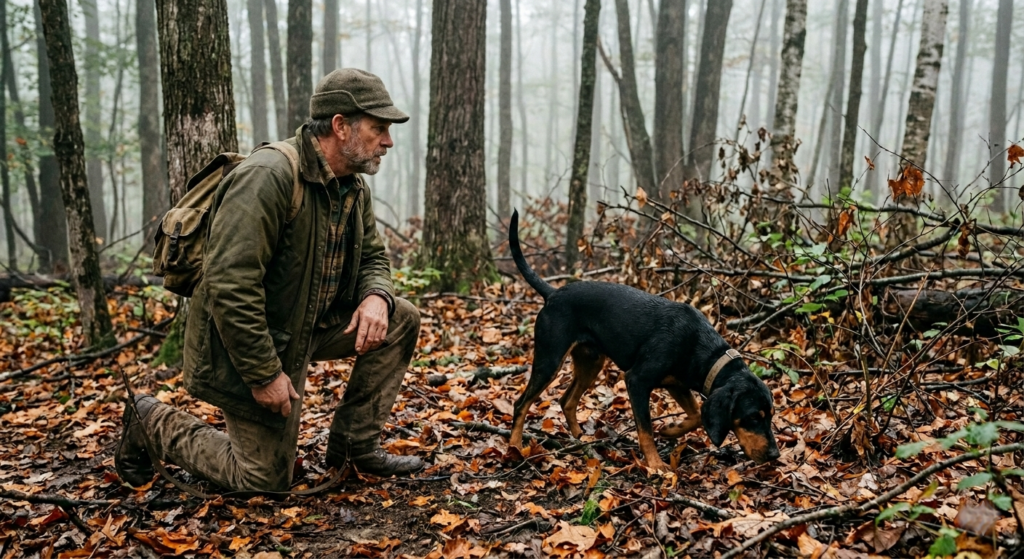
A young coonhound that blows past cold scent isn’t broken. But if you let it keep doing it, it will be.
Cold track work is where good dogs separate from average ones. And most handlers never figure out that they’re the reason their dog can’t slow down.
Why Young Dogs Blow Past Cold Scent
Cold tracks are hard. The scent is hours old, spread thin, and broken up by wind, dew, and ground temperature changes. A young dog that’s been rewarded for speed and excitement doesn’t have the patience built in yet to nose down and pick through that.
They’re not being stubborn. They’re doing exactly what worked before.
When a pup has run mostly fresh tracks, it learns to trust speed. Hot scent rewards fast movement. So when you drop that same dog on a twelve-hour-old track on a dry October night with a northwest wind pulling scent off the ground, it runs its pattern and comes up empty. Then it does it again. Then it starts guessing.
That’s when the bad habits start stacking up.
The Real Problem Is Usually You
Most handlers put young dogs on cold tracks before they’ve earned it. They want to see what the dog can do. They get impatient. They run the dog in conditions that set it up to fail, then wonder why it doesn’t work scent right.
You cannot build cold track patience by accident. It has to be trained intentionally, in the right conditions, at the right time in the dog’s development.
If you’ve been running your young hound hard and fast on fresh tracks all summer, and now you’re frustrated it can’t settle on cold scent come fall, that’s on you. The dog learned what you taught it.
This is the same problem covered in Wide Too Early: How Young Coonhounds Learn Bad Habits That Stick. Speed and range problems almost always trace back to the same place: handlers moving too fast through the training progression.
Do This / Don’t Do This
Do start cold track work on drag lines before you ever put the dog on wild game cold tracks. You control the age of the scent. You control the terrain. You control the outcome.
Don’t start with eight or ten hour old tracks. Work up to it. Start with two-hour-old drags, then four, then six. Let the dog build confidence at each level before you push further.
Do run cold tracks in conditions that hold scent. Damp ground, light wind, moderate temps. Don’t put a young dog on a cold scent on a dry windy night and call it a training session.
Don’t intervene every time the dog loses the track. Let it work. Circling, checking, backtracking — these are the behaviors you want. If you jump in too fast, you rob the dog of the problem-solving experience it needs.
Do end sessions on a success. If the dog is struggling badly, shorten the track or freshen the conditions slightly. You want the dog finishing with confidence, not frustration.
Don’t run cold tracks back to back in the same session on a young dog. One good track worked thoroughly is worth more than three failed ones. Knowing when to stay quiet matters just as much — Calling Your Dog Too Early and Ruining Tracks breaks down exactly where that line is.
Devil’s Advocate
Some old-timers will tell you to just let the dog figure it out on its own in the woods. Run it enough, and it’ll learn.
There’s some truth in that for certain bloodlines with strong natural ability. Some dogs do sort it out.
But that approach also produces a lot of dogs that develop workarounds instead of real cold track skill. They learn to range wider, hoping to cut ahead of the track. They learn to wait for the handler to help. They learn to give up faster when the scent gets thin.
Wild hunting will sharpen a dog that already has the foundation. It won’t build the foundation for you.
Quick Fix Checklist
- Start cold track training with drag lines, not wild game tracks.
- Age your drags in two-hour increments. Don’t jump straight to cold.
- Run cold tracks in good scenting conditions: damp ground, low wind, mild temps.
- Let the dog circle and work without interference.
- Keep early cold track sessions short. Quality over quantity.
- End every session on a completed track when possible.
- Don’t stack failures. One good session beats three bad ones.
- Pull back the difficulty if the dog is shutting down. Build back up slower.
For more on building a complete foundation with your hound, visit our full coonhound training resource.
Gear Note
If you’re dragging scent lines for cold track training, a basic drag kit with a solid synthetic scent pad and a long check cord is all you need. Don’t overthink it. The value is in the process, not the equipment.