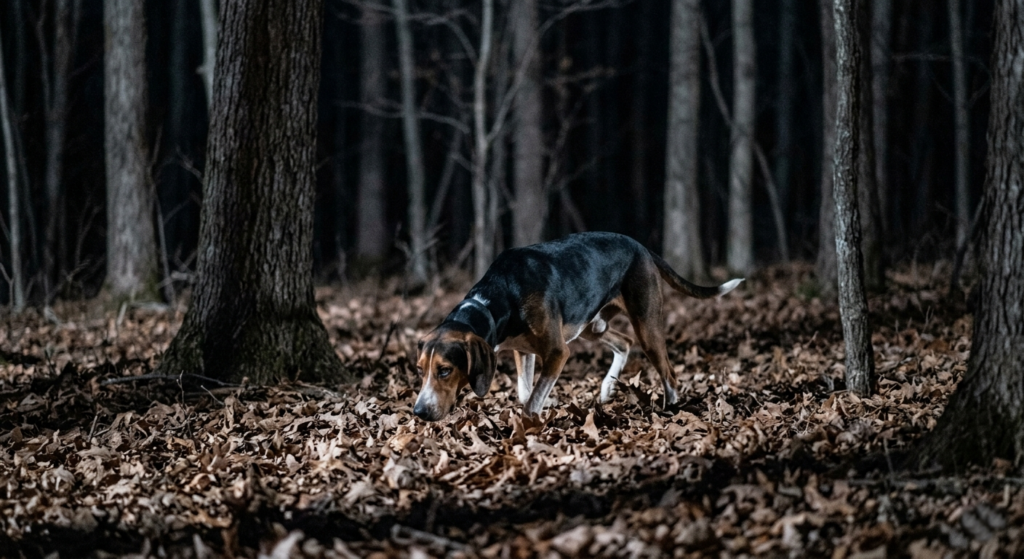
You did not set out to make a dependent dog. Nobody does. You got a good pup, you put time in, and somewhere along the way you started helping. Just a little at first. You called it back when the track went cold. You steered it toward cover you could smell from where you were standing. You cut the hunt short when things went quiet because quiet felt like nothing was happening. You called it in when it ranged farther than you were comfortable with.
Every one of those decisions felt responsible in the moment. Every one of them was a cost.
The intervention habit is one of the most common problems in coonhound training, and it is almost never recognized as a problem because it looks like good handling. Attentive. Involved. Present. But a handler who is always present at the moment of difficulty is a handler who has been teaching the dog to expect presence at the moment of difficulty. After enough repetitions, that expectation becomes the foundation the dog stands on.
What’s Actually Happening
When a handler keeps stepping in, the dog stops solving. Not because it cannot. Because it does not have to.
A coonhound that gets redirected every time a track goes cold learns that cold tracks end with the handler doing something. It starts watching. It starts waiting. It checks back. It slows down on its own initiative and holds up in the timber, waiting for the answer to arrive on two legs. The dog is not broken or soft or lacking. It has simply learned to read the situation correctly. You are the answer. It has figured that out, and it is playing the game accordingly.
This is not a training problem the way slicking trees is a training problem. The dog has not developed a bad habit by accident. It has learned a rational strategy. Check the handler when things get hard, because that is where solutions have always come from. You taught it that. You taught it well.
The coonhound’s job is to solve problems independently in the dark. A night dog that still defers to the handler when things get difficult is not a finished dog. It is a dog with a gap in its foundation, and that gap was put there one well-meaning intervention at a time.
Why It Happens
The most common driver is not impatience. It is anxiety.
A handler who cannot stand silence in the timber is a handler who will fill that silence with action every single time. When the hound goes quiet, the mental spiral starts fast. It is losing the track. It is running trash. It got hurt. It gave up. That silence is terrifying to a handler who has not learned to read it yet. So they move, or they call, or they do something, because doing something feels like it is still going somewhere, and standing still in a dark woods with a quiet dog feels like failure.
The second cause is comparison. You watched a finished dog work a track last fall and it never hesitated once. Now your young hound is puzzling over the same kind of ground, stopping, circling, checking back. Compared to the finished dog it looks like nothing. That comparison is doing real damage to your ability to read your own dog accurately. A young hound sorting a cold track in the dark on a dry night with a west wind is doing something extremely difficult. It does not look like much from the road. That does not mean nothing is happening.
Third: you brought someone with you, or you told someone this dog was ready, and now there is something to prove. The dog picks up on that pressure before the truck door opens. Dogs that operate in high-expectation environments change their behavior to manage the environment, not the track.
Fourth cause is early training that felt productive at the time. If you spent the first several months directing the young dog toward every opportunity, running it in front of experience, steering it toward easy wins, you built a dog that expects direction. That habit of looking to you is not a character flaw. It is what you installed.
Fifth: the GPS collar. The screen tells you what the dog is doing every second of the hunt. Handlers who watch the screen too closely start managing by the dot. They see the dog circling in one area for several minutes and they interpret it as a problem before the dog has had the chance to work it out. That dot is a problem-solving dog doing its job. Every time you start moving based on what the screen shows, you are collapsing the space between the problem and the solution. The dog never gets to close that space on its own.
How to Fix It
Do This
Put the dog in the woods and stay still. Not for five minutes. Long enough for it to genuinely feel alone out there. The moment you start moving toward the area the dog is working, you have announced yourself and changed everything. Park the truck. Kill the light. Stand in one place.
Let the track go cold on purpose if you have to. Find area with aged scent and work the dog there with no help. A dog that is never required to work a cold track never builds the ability to work one. That skill is not something you can explain to a dog. It has to be earned through requirement.
Stop treating the GPS screen as a story you need to fix. Check it for safety. Do not use it to direct the hunt. A hound learning to operate in the dark does not need a handler running scenario management from the road edge.
Shorten the leash on your own anxiety. That is not a metaphor. If standing still while your dog is silent in heavy timber is something you genuinely cannot do, that is the first problem to solve. The dog cannot get better until you do.
Don’t Do This
Do not call the dog back and redirect it toward a track you found. If you found it from the road, you found it by accident. You did not find it with your nose. Your job is not to pre-solve the scent puzzle and hand the answer over. Let the dog find it the right way, on its own terms, on its own timeline.
Do not end hunts because the dog is having a hard night. Hard nights are where the real development happens. A dog that only hunts when things are easy only learns how to perform when things are easy. A dog that grinds through three hours of tough, cold, windy timber and comes out the other side with nothing to show for it except experience has built something you cannot manufacture any other way.
Do not reward a dog for checking in when it should be hunting. Every time it walks back to you and gets a kind word, a scratch, any positive acknowledgment, you are paying it to quit. It will do more of what pays.
What Most Handlers Get Wrong
Most handlers who struggle with this problem do not recognize themselves as the cause. They frame it as a dog problem. The dog is slow. It lacks drive. It checks back too much. It will not hunt alone. If you have said any of those things while also walking toward the dog when the woods go quiet, look carefully at that connection.
Research on working dogs confirms what experienced handlers already understand from the woods: handler behavior reaches dogs far more effectively than handlers realize. A peer-reviewed paper published in Frontiers in Veterinary Science specifically found that in working roles requiring independent action, dogs are easily and unintentionally influenced by handler presence and cues in ways that undermine the independence the handler is trying to build. You do not have to issue commands or blow a whistle. Arriving at the right moment is enough to teach the dog that arriving is part of the system.
When a young hound seems to have a drive problem during solo hunts, the intervention habit is almost always involved. Read through this honest breakdown of what a young hound that appears to lack drive is actually doing: Young Hound Lacks Drive or Just Learning Alone? Then ask yourself how many of those patterns your own handling has contributed to.
The other thing most handlers get wrong is the timeline of damage. One intervention does not cost you much. The twentieth one has built a dog that has never had to finish a problem on its own. By the time the pattern is obvious enough to diagnose, it has been there for a full season or more. Start paying attention early.
Devil’s Advocate
A handler who never steps in is not a better handler. That one needs to be said plainly.
There are situations that require action. A young dog working the same trash line for the fourth time in a row. A dog that has been running with no contact in rough country for ninety minutes. A dog showing clear signs of shutdown, not just quiet work, but tail down, disengaged, walking back toward the truck on its own. These situations call for a handler who is paying attention and willing to act.
The argument here is not hands-off. The argument is about timing. The space between a dog struggling and a dog needing help is where everything is built. Collapsing that space because the silence makes you uncomfortable is the habit that costs you. The question to ask before you move is not “Is the dog having a hard time?” The answer to that will almost always be yes. The question is “Has the dog had time to try to solve this on its own?”
Hunt design also matters. If you are consistently putting a young hound into terrain that overwhelms it, you are not building problem-solving ability. You are producing repeated failure. Starting on smaller, simpler ground with better scent conditions and less demanding terrain is not babying the dog. It is matching the challenge to the stage of development. That is different from rescuing the dog from every difficult moment.
When to Leave It Alone
Leave it alone when the dog is silent but moving. Silence does not equal stalled. A hound working a cold track on a dry October night with a northwest wind pushing through open hardwood timber may not make a sound for thirty minutes. It may not make a sound for an hour. The GPS dot moving steadily and purposefully through that timber is a dog doing the most honest, valuable work it will ever do. That is not the moment to arrive.
Leave it alone when it makes the same mistake it made last week. Some lessons have to be learned more than once. A dog that keeps coming back to a bad tree, checking it, and then leaving on its own is self-correcting. The lesson is not finished. If you intervene mid-lesson, the dog loses the payoff of figuring it out and keeps the habit of checking. Let the correction land naturally.
Leave it alone when you are frustrated. If the decision about whether to step in is being driven by your own impatience or embarrassment or timeline, it should not be made. That is not information about the dog. That is information about you.
If your hound shows the specific pattern of working hard in company but losing purpose when it is alone, the intervention habit is almost always the root cause. That pattern does not fix itself and it does not improve by adding more experience to a dog that still expects help. This breakdown of why young coonhounds check back after too much company covers exactly how that cycle starts and what a genuine repair looks like from the beginning.
Quick Fix Checklist
- Stop moving toward the dog when the woods go quiet. Stay still and let it work.
- Put the GPS collar away for at least one hunt per week and run the dog without the screen.
- Review the last five times you called the dog back or redirected it. Ask how many were actually necessary.
- Hunt solo before hunting in company. A dog that cannot operate alone will not improve in a pack.
- Let the dog make the same mistake twice before acting. The second time tells you if it is a pattern.
- Stop rewarding check-ins during an active hunt. Ignore them unless something is wrong.
- End hunts based on the dog’s attitude and energy, not your expectations for the night.
The Handler Who Gets Out of the Way
The handler who cannot stay out of the dog’s way will always have a dog that needs them in the way. That is the real cost of the intervention habit, not one bad hunt or one slow week, but a dog that never fully learns to operate on its own terms in the dark.
A finished coonhound is a dog you trust completely. You drop it on a cold night in timber you cannot see through and you know it is working, even when it is silent, even when the GPS dot stops moving for a while, even when you cannot explain exactly what is happening out there. You trust it because it has earned that trust by being required to operate without you at the moment of difficulty, over and over, until that ability became the foundation instead of the exception.
Get out of the truck. Turn out the light. Stay put. Let the timber do its work.