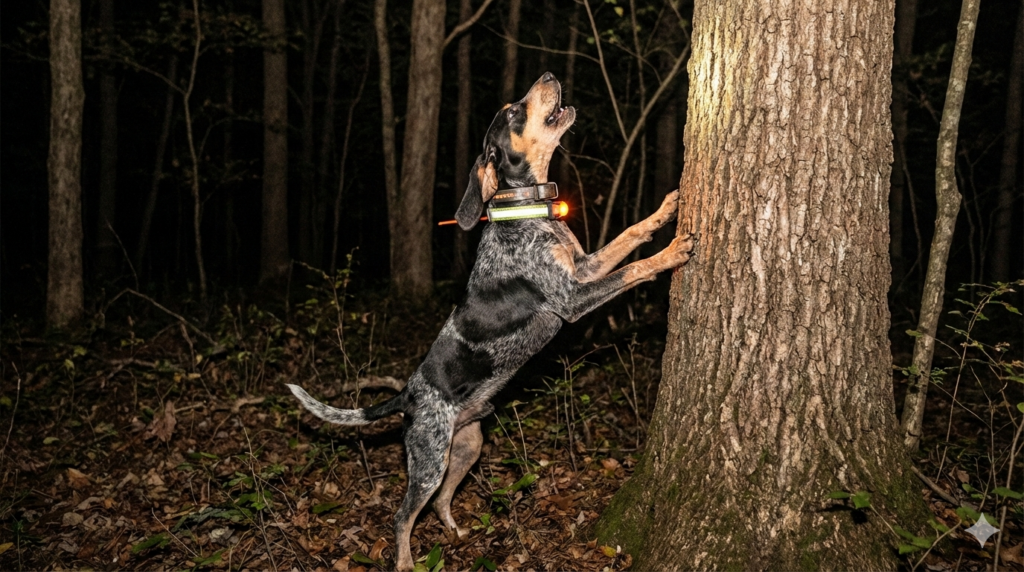
There’s a moment most coonhound handlers remember.
A young coonhound strikes, moves a track with excitement, and comes treed hard. He sounds right. He feels right. You walk in expecting to see eyes.
You shine the tree.
Nothing.
The dog stays treed. Confident. Certain.
Unless it’s a den or there are trees touching, that’s a slick tree, and when a young coonhound slick trees early, frustration sets in fast.
It’s easy to label a young dog after a few slick trees. Easy to assume dishonesty or lack of sense. But most young coonhounds don’t slick tree because they’re bad dogs.
They slick tree because speed outran understanding.
Early slick treeing is usually a developmental issue, not a character flaw.
Why Young Coonhounds Slick Tree
Slick trees rarely come from one cause. They’re usually a combination of immaturity, environment, and handler timing. Here are the most common reasons young hounds start missing early.
Excitement Outruns Track Understanding
Young dogs want the reward. They love the locate. They love settling into a tree. They love the attention that comes when you arrive.
But early on, many hounds haven’t fully learned how a track ends. They may hit a strong scent, locate quickly, and commit before finishing the track properly. The intention isn’t to cheat. It’s to succeed.
Without enough track experience, they don’t yet understand the difference between scent that leads to a tree and scent that simply lingers there. That distinction comes with repetition.
Overexposure to Pack Hunting
Hunting with seasoned dogs has benefits. But if a young hound spends too much time in a pack early, he can learn the wrong lesson. He may tree because others tree, learn to celebrate the tree before mastering the track, or rely on group momentum instead of individual scent work.
Pull that dog out alone, and weaknesses show up fast.
A young coonhound needs solo time to understand how a track develops, how it breaks down, and how it finishes. Without that foundation, slick trees become more common.
Rewarding Speed Over Accuracy
This one is subtle. Handlers get excited about quick strikes and fast trees. And there’s nothing wrong with appreciating hustle.
But if a young hound consistently gets praise for being first rather than being right, he learns what matters.
Dogs repeat what pays.
If speed is celebrated and slick trees carry no consequence, the dog starts prioritizing fast results over correct ones. Over time, that pattern hardens.
Weak Track Commitment
Some young hounds simply haven’t developed enough commitment to stay with a difficult track. When scent gets thin, instead of grinding it out, they may grab the strongest nearby scent and tree short.
This is common in early development. Track confidence takes time. Without it, trees can become guesses instead of conclusions.
The Difference Between a Slick Tree and a Learning Tree
Not every empty tree is the same.
A young dog that worked a track honestly, checked himself during loss, slowed down near the end, and located with conviction is very different from a dog that blew through the country, opened fast, parked under the first strong scent, and never truly finished the track.
One is learning. The other is forming a habit.
Your job is to tell the difference.
If you treat every slick tree as intentional wrongdoing, you risk applying pressure before understanding exists. But if you ignore repeated guessing, you allow bad habits to grow.
That balance is where experience shows.
When to Correct a Young Coonhound on a Slick Tree
Correction has a place in coonhound training. But timing matters.
Early on, when a young dog is still learning how tracks develop, most slick trees should be treated as information, not rebellion. Observe. Ask yourself: Did he truly finish the track? Did he show signs of understanding? Has this become a pattern?
If the dog has demonstrated clear ability in the past and begins repeating sloppy trees, that’s different. At that stage, he understands the job. Now standards can rise, but only when you’re certain the dog understands the job.
But correction before understanding often produces hesitation instead of improvement. A hesitant coonhound may start checking back, leaving trees early, or refusing to commit at all.
Accuracy grows best from clarity, not emotion.
How to Fix Early Slick Treeing
Most early slick tree problems can be corrected without heavy pressure.
Hunt Solo More Often
Solo hunts reveal truth. Without other dogs influencing the outcome, you see how your young hound handles track loss, decision-making, and commitment. If weaknesses exist, they become clear. And clarity gives you direction.
Slow Hunts Down
You don’t need marathon nights. Shorter, focused hunts help a dog concentrate on finishing tracks properly instead of racing through country. Quality beats quantity in early development.
Reward Finished Tracks
When a young dog works a track correctly and finishes accurately, let that success matter. Calm, consistent reinforcement of correct behavior builds a pattern. Over time, the dog begins to value accuracy because it consistently leads to reward.
Raise Standards Gradually
As understanding improves, expectations can rise. If sloppy trees continue after a dog has proven he knows better, then correction has meaning. But don’t rush that stage. Standards should increase with maturity, not before it.
If you want the full framework for building a coonhound that stays accurate, confident, and independent, start here: Coonhound Training: Walking One Dog at a Time
Final Thoughts
Most young coonhounds slick tree at some point. It’s part of learning how scent behaves, how tracks end, and how pressure feels on the tree.
The mistake isn’t an early slick tree.
The mistake is misreading what it means.
Speed without understanding produces empty trees.
Understanding built patiently produces accuracy.
Build the track first.
The tree will take care of itself, and accuracy will follow.
Why Do Young Coonhounds Slick Tree Early?
Young coonhounds slick tree early because:
They move faster than they can process a track.
They get rewarded for intensity instead of accuracy.
They haven’t learned to check themselves before committing.
They lack enough track experience to sort out difficult scent.
Slick treeing early is usually a symptom of immaturity, not stubbornness.
How Do You Fix Slick Treeing in Young Coonhounds?
Slow the dog down.
Hunt him alone.
Avoid rewarding empty trees.
Build track confidence before demanding tree accuracy.
Time and structure fix what frustration cannot.
Slick treeing usually starts long before the first empty tree.