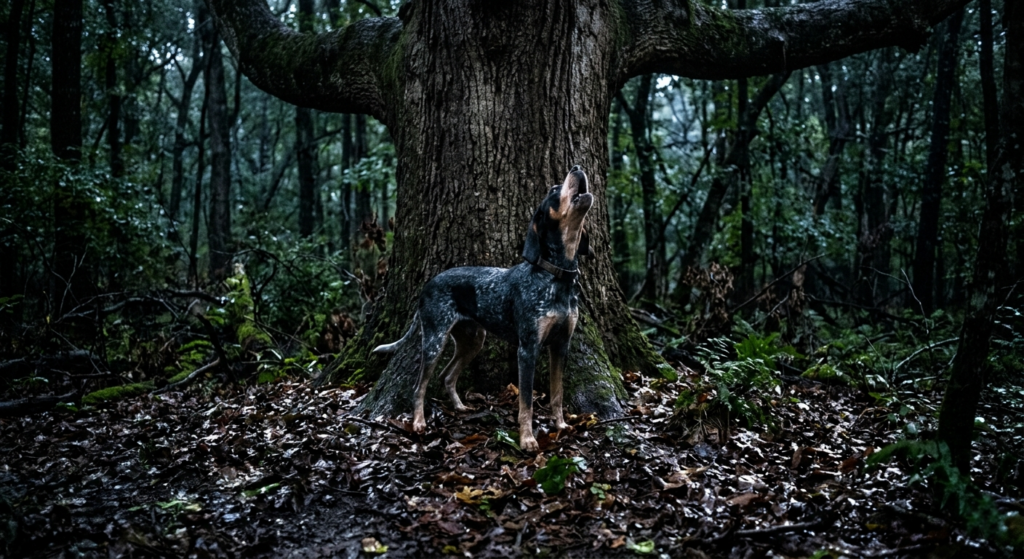
Most people start a young coonhound the same way. They’ve got a good older dog. They figure the pup will learn from watching. So they drop them both, the old dog runs off, the pup follows, and by the end of the night something treed. They call it a good hunt.
Some of those pups turn out fine. A lot of them don’t.
What gets built in those early nights is a habit. If the pup learns that the job is to follow the older dog and show up at the tree, that’s what it will keep doing. It won’t learn to strike. It won’t learn to work out a cold track. It won’t learn to finish a coon on its own because it never had to.
The goal here isn’t to keep a young dog away from experienced hounds forever. It’s to use older dogs as a deliberate tool instead of a shortcut. The foundation you build in the first season determines what kind of night dog you’ll have at three years old. Get it right early and you won’t spend the back half of the dog’s life trying to undo what you did at the start. For a broader look at the fundamentals that support this kind of development, coonhound training covers the full picture.
What Too Much Dependence Actually Looks Like
It doesn’t always announce itself. Sometimes a handler doesn’t see it clearly until the older dog is gone and the pup has no idea what to do.
The most common signs show up like this. The pup won’t open on a track until the older dog does first. It hunts shallow, checks back constantly, and covers the other dog more than it hunts its own ground. At the tree, it arrives after the older dog is already bawling and adds its voice to something it didn’t start.
Pull the older dog out. Put the pup in the box alone. Turn it loose in the same woods, same conditions. Some of those pups will stand there and look at you. Others will wander without purpose. A few will head for where the old dog usually goes and wait.
That is dependency. Not excitement. Not pack drive. A pup that has learned the older dog does the hard part.
There’s a difference between a young hound that hunts well with company and one that can only hunt because of company. The first is normal. The second is a problem you helped create.
Why This Happens to Good Dogs
The older dog gets used too early and too often. That’s the short answer.
A pup turned loose in the woods before it has developed its own drive and curiosity will fill that gap with something. The easiest something is another dog that already knows what it’s doing. The pup learns to draft. It learns that the system works and it doesn’t have to figure out why.
The wrong older dog makes it worse. A tight-mouthed dog that doesn’t bark freely, a fast-going hound that covers ground before the pup can keep up mentally, a dominant dog that crowds every track. Any of these can turn a pup into a shadow instead of a hunter.
The handler is often part of it too. They mistake a treed coon for a trained dog. They count the night as productive when the pup showed up at the tree and barked. What they didn’t see was that the pup did none of the striking, none of the trailing, none of the real work that makes a useful hound.
Repetition locks it in. If the pup hunts with company every single time, company becomes the expected condition. Solo becomes unfamiliar. Unfamiliar becomes anxiety. Anxiety becomes quitting. The article on start a young hound the right way goes deeper on how those early patterns get wired in and why they stick.
How to Build Real Independence
Start with solo time before anything else. Conditions don’t have to be perfect. The purpose of an early solo hunt isn’t a treed coon. It’s getting the pup used to the idea that it is responsible for hunting. No backup. No older dog to follow. Just the pup, the woods, and whatever it figures out.
Pick easy ground. Good weather. Fair scent conditions. Give the dog a fighting chance to find something to be interested in. Let it hunt forward, make mistakes, work its nose. Don’t hover. Don’t rush back every time it checks up or circles. Give it room to think.
When you do use an older dog, use it intentionally. Once in a while, let the pup see a coon run and tree with a finished hound. That kind of positive exposure has real value. But keep those hunts limited. One or two a month alongside regular solo nights is a very different program than hunting them together every time.
When the pup starts showing genuine independent effort, pay attention to it. You don’t need to overreact, but reinforce those moments. A pup that opens on its own track, works it forward, and locates without help is doing exactly what you want. That’s what you’re building toward.
If you notice the pup waiting on the older dog before it does anything, back up. Cut the paired hunts down. Increase the solo work. The fix isn’t complicated, but it does require the handler to recognize the problem before it gets months deep.
Mistakes That Create a Me-Too Coonhound
The biggest one is counting any treed coon as progress. It isn’t. A pup that arrived at a tree the older dog found and bawled because the other dog was bawling has not learned to tree. It has learned to follow noise.
Hunting with the wrong older dog is a close second. Too rough and the pup learns to stay out of the way. Too possessive at the tree and the pup gets corrected for doing the right thing. Too fast and the pup gives up trying to compete and settles for covering.
Helping too much when the pup hesitates is another one. A young hound that stops and puzzles over a cold track or a check is working. The handler who rushes in, calls it up, and moves to better conditions just taught the pup that struggling is the signal to quit. Let it work.
Expecting independence before the pup has any confidence is also a mistake, but it goes the other direction. Some handlers overcorrect after reading articles like this one and give the dog zero company before it’s ready. A pup that is lost, anxious, and failing repeatedly isn’t building independence. It’s building a negative association with the woods. The pup needs young coonhounds need direction, not just drive to thrive.
The handler trains routine whether they mean to or not. Whatever the pup experiences consistently is what it learns to expect. That works both ways.
Devil’s Advocate
Some people will tell you they’ve run young dogs with older dogs from the start and turned out great hounds. That’s true. Some dogs are wired tight enough that they’ll push through the company and develop fine anyway. Ability is largely bred in, and a dog with strong natural drive and independence will show it regardless of early conditions.
The issue is you won’t know which kind of dog you have until it’s too late to change what you built. If you start right and the dog turns out to have plenty of natural fire, you’ve lost nothing. If you start sloppy and the dog doesn’t have that self-sufficient streak, you’ve got a cover dog that you’ll try to fix for years.
The risk isn’t equal on both sides. Building independence early costs you nothing if the dog was going to be great anyway. Skipping it costs you everything if it wasn’t.
When to Leave It Alone
Not every pup needs intervention just because it enjoyed running with an older dog early on.
Leave it alone when the pup will still go hunting by itself and hunts with real purpose when it does. Leave it alone when it’s starting its own tracks at least some of the time and showing growing confidence from week to week. A pup that’s eight or nine months old and still learning the ropes is not automatically dependent just because it runs better in company.
Young hounds are immature. Development is uneven. Some pups take until fourteen months before they really commit to striking on their own. That’s not failure. That’s timeline.
The real issue is persistent dependence. A pup that cannot function alone after a full season of regular hunting is a different conversation than a young dog that still leans a little while it’s figuring things out. Read the individual dog honestly before you start adjusting a program that might already be working.
The AKC has a useful take on building confidence in young dogs without pushing too hard too fast, and the same principle applies in the woods. Build confidence without forcing the pup is worth reading if you’re unsure where your dog falls.
Quick Fix Checklist
Run through this if your young hound is showing signs of dependence:
Count how many of your last ten hunts included an older dog. If most of them did, that’s your starting point.
Schedule three solo hunts before the next paired hunt. Keep conditions fair and reasonable for the dog’s age.
Watch for whether the pup opens on its own track or waits. That single behavior tells you more than anything else.
If you’re using an older dog, evaluate whether that dog is a good influence. A dog that is too dominant, too fast, or too tight-mouthed is not a training tool. It’s a liability.
When the pup shows any independent effort, acknowledge it. You don’t have to make a big deal out of it. Just let it know that’s the right idea.
If the pup trees with company but won’t tree alone, that’s your answer. More solo time. No shortcuts.
Final Thoughts
An older dog can show a pup that there’s something worth chasing out there. That’s about all you should count on it for.
The actual work, learning to strike, working a track that quits and starts, finishing a coon without help, that has to happen with the young dog alone in the woods doing it for itself. No one else can build that. You can only give the dog room to find it.
Start a young coonhound right and it will reward you with years of honest hunting. Start it as a shadow and you’ll spend those same years wondering what it could have been.