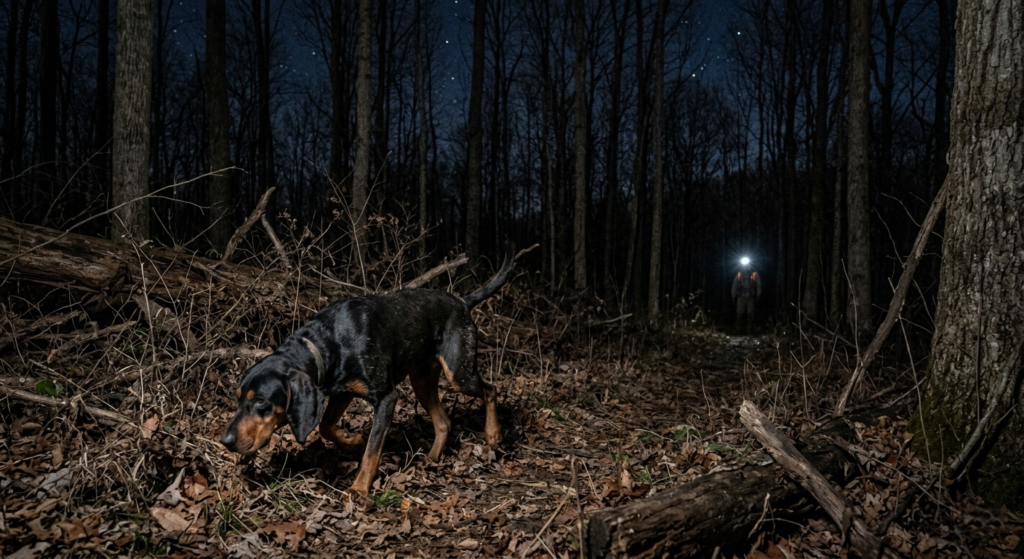
One night a young dog is hunting wide, checking cover, working scent like it knows exactly what it is doing. Two nights later it looks slow, uncertain, maybe halfway back to the truck. A lot of handlers see that inconsistency and start asking the wrong question. They want to know if the dog has enough heart. The real question is whether the dog has enough experience to hunt alone without borrowing confidence from older dogs or from a handler who talks too much.
That gap between what the dog knows and what it can produce consistently is where most young hounds live for a season or two. Handlers who understand that leave their dogs alone and let them grow. Handlers who do not start adding pressure at the exact moment the dog needs patience. Tone sharpens. Corrections come early. The dog starts second-guessing instead of problem solving, and a dog that was on its way to being solid turns into one that hunts with one eye on the woods and one eye on the handler.
Understanding the timing and independence principles behind young dog development is the only way to read this phase correctly. Without that foundation, a handler is guessing, and most of the time they are guessing wrong.
What’s Actually Happening
The dog is transitioning. It spent early months hunting in company, around older dogs that knew where to go and how to work the ground. It was learning, but it was also borrowing. When a seasoned dog commits to a track, a young dog does not have to decide. It follows conviction it did not earn yet.
Pull that young dog out alone and the whole dynamic shifts. Now every decision is its own. Which direction to cast. Whether that cold track is worth working. How long to stay on a tree before moving on. The brain is ahead of the experience. The dog knows what game is. It does not yet know how to consistently produce it without help.
That is not a heart problem. That is a learning curve. Handlers who have worked through it with several young dogs recognize it right away. If you are not sure what you are looking at, it helps to build independence after too much company before you start adding pressure to what may simply be a dog sorting out how to hunt on its own terms.
Some nights the conditions are easy. Fresh scent, cooperative raccoon, light wind. The dog looks like a finished hunter. Other nights the ground is hard, the wind is switching, and the game has not moved in hours. That same dog looks lost. Both nights are real. Neither one is the whole picture.
Why It Happens
Too much early help is the most common cause. The dog got walked into tracks. It hunted with stronger dogs long past the point where it should have been working alone. The result is a dog that has solid instincts but has never been forced to use them without backup.
Handler impatience compounds the problem. There is a version of this dog that would work through the uncertainty on its own given time. What stops it is a handler who expects finished behavior out of a dog still in the middle of learning how to hunt alone. Every hesitation gets read as a character flaw instead of a stage.
Misreading body language makes it worse. A dog that checks back is not quitting. It is checking in, which is different. A dog that starts a track and loses it is not giving up. It is encountering a limit it has not pushed past yet. When handlers confuse hesitation with lack of desire, the correction comes at the wrong moment and for the wrong reason.
Inconsistent exposure slows everything down. A dog that hunts twice a month in different terrain with different conditions never gets enough repetition for learning to stack. It resets instead of progressing. And early correction pressure, whether through a sharp tone, an e-collar check, or calling the dog off when it is struggling, puts fear into a process that requires confidence to work.
How to Fix It
Start by removing unnecessary pressure from every hunt during this phase. No correction tied to hunting effort. No sharp tone when the dog is uncertain. Let it make mistakes without fear. A dog that worries about being wrong while it is trying to figure something out stops trying. That is the last thing you want.
Hunt alone more often. Solo time is where independence gets built. According to SportDOG’s guidance on starting young hounds, pulling a young dog out to hunt by itself when it starts leaning on other dogs is one of the most direct ways to force genuine problem solving and build real confidence. There is no shortcut around it.
Keep hunts short and controlled during the rough stretch. End on something positive. Even a small win, a track worked with effort, a tree checked thoroughly, tells the dog the hunt was worth it. Grinding through confusion until the dog shuts down does the opposite.
Read effort instead of results. Reward the search pattern, the hunt, the try. A dog that works hard on an empty drop and comes back hunting is doing exactly what you want. A dog that trees every night but will not hunt without the handler talking it along is the one with a real problem.
Build consistency through repetition. Same type of terrain when possible, similar conditions, regular schedule. Learning stacks when it has something to stack on. Scattered hunting in unfamiliar country every few weeks gives a young dog nothing to build from.
Hold correction until after understanding. That is the rule and it does not have exceptions during this phase. If the dog does not yet understand the job well enough to do it alone, correction for poor performance is not training. It is just pressure on top of confusion.
What Most Handlers Get Wrong
They expect linear progress. One good night creates an expectation, and when the next night looks rough, the handler treats the dip as a problem instead of a pattern. Young dogs do not improve in a straight line. They develop in waves. A rough stretch after a good run is not regression. It is normal.
They add pressure when performance dips instead of asking why. The dog had a bad night. Before doing anything, a handler should look at conditions, scent, terrain, game movement, and how much rest the dog had. Most bad nights have a reason that has nothing to do with the dog’s drive or character.
They throw an older dog in to fix it. Hunting a struggling young dog with a seasoned hunter might produce a good night. It will not build anything. The young dog goes right back to borrowing. The problem gets masked, not solved.
They talk too much during the hunt. Calling, cheering, steering, all of it interrupts the process the dog needs to work through on its own. A dog that gets managed through every decision never learns to make decisions.
They measure heart by results instead of effort. A dog that hunts hard on a bad night and never trees has more going for it than one that trees on easy conditions and quits when things get difficult. Effort in hard conditions tells you something real. Results on easy nights tell you almost nothing.
Devil’s Advocate
Some handlers will push back on this and say that patience has a limit. That at some point a dog is either going to hunt or it is not, and waiting around past that point wastes a season. That is a fair argument. Not every young dog with inconsistent solo performance is going to become a reliable hunter. Some lack the instinct. Some were never going to be more than average, and the sooner a handler knows that, the sooner they can make a decision.
The problem is that most handlers reach that conclusion far too early and during the wrong phase. Pulling the plug or ramping up pressure at eight, ten, or even fourteen months on a dog that is still in the middle of learning to hunt independently is not an honest evaluation. It is impatience wearing the mask of judgment.
Give the dog enough solo time, enough consistent exposure, and enough runway to actually sort the job out before deciding it cannot do it. You owe the dog that much. If it still cannot produce after a real opportunity has been given under real conditions, then the conversation about fit is a fair one. But most dogs never get that chance.
When to Leave It Alone
If the dog is hunting out, casting, covering ground, and working scent even when it is not producing, leave it alone. That is a dog doing its job. The tree will come when the experience catches up.
If it checks back but then turns around and goes back to hunting without being sent, leave it alone. Checking back is not the same as quitting. A dog that returns to the hunt on its own is managing itself. That is exactly what independence looks like in development.
If tracks are being started but not always finished, leave it alone. Scent is complicated. Ground conditions, age of track, body of game, all of it affects what the dog can do on a given night. Unfinished tracks during the learning phase are expected.
The key is honest evaluation over time. One hunt does not tell you anything definitive. A pattern across several hunts under varied conditions starts to tell the real story. The habit of learning to judge progress by patterns over time rather than grading individual nights is what separates handlers who develop dogs from handlers who stall them.
Weather, terrain, and game movement explain more bad nights than lack of drive does. Before adding pressure after a rough hunt, account for everything outside the dog first. Most of the time, the dog is not the problem.
Quick Fix Checklist
- Pull the dog out solo and stop relying on older dogs to prop up performance
- Drop all correction tied to hunting effort until the dog clearly understands the job
- Keep hunts short and end before the dog shuts down
- Reward effort and search pattern, not just trees
- Hunt in familiar terrain with consistent conditions when possible
- Stop talking during the hunt and let the dog work
- Check conditions before blaming the dog for a bad night
- Track progress over several hunts, not individual outings
- Give the dog enough solo time to actually develop independent hunting habits
- Hold off on any evaluation about drive or character until this phase has run its course
The Bottom Line
Most young dogs do not lack heart. They lack experience carrying a hunt alone without help, and those are two completely different problems.
Pressure before understanding does not build drive. It builds hesitation. A dog that starts watching the handler instead of hunting the woods has been pushed at the wrong time, and getting that back is harder than letting the phase run its course in the first place.
The dogs that are allowed to figure it out, that are given solo time, honest conditions, and a handler quiet enough to let them work, become dependable later. The ones pushed early start looking over their shoulder instead of hunting forward. Patience here is not a soft approach. It is the only approach that actually works.