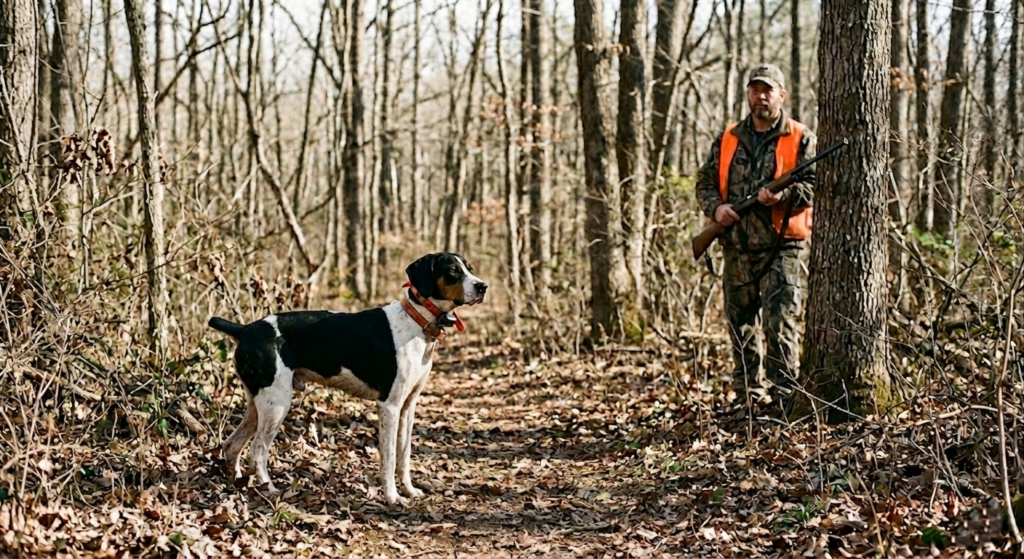
A young squirrel dog that checks back now and then is not a problem. A young squirrel dog that hunts halfway, loops back to your boots, and can’t seem to stay out front without constant reassurance — that is a problem. And most of the time, the handler built it.
The goal is not to eliminate check-ins. A brief swing back to confirm your position, a quick look, and then right back to hunting — that is normal dog behavior and it does not need to be corrected. What you are trying to avoid is the dog that turns checking in into a habit of hanging on you. The line between connection and dependence is thin, and it gets crossed early if you are not paying attention.
If you want to understand the broader picture behind independence, pressure, and letting young dogs develop on their own schedule, the foundation is all laid out in the guide to how to train a tree dog. What follows here is specific to check-in behavior and what drives it in young squirrel dogs.
What a Healthy Check-In Actually Looks Like
A healthy check-in is short. The dog ranges out, works a stretch of timber, swings back to clock your location, and leaves again. It might make brief eye contact. It might just scent-check the air to confirm you are still there. Then it goes. The whole thing takes a few seconds.
What it is not: the dog hunting behind you. The dog making wide loops every few minutes. The dog quitting a search to come find you. The dog that looks lost unless it can smell you close.
Most young dogs check in more often early on because they are still figuring out how much freedom they actually have. That is a normal part of development. The handler’s job is to let that phase run its course without accidentally reinforcing it into a permanent crutch.
Age matters here. A six-month-old dog in a new patch of timber is not expected to hunt like a finished dog. Some dogs are naturally tighter workers by bloodline and will still produce game and tree squirrels consistently while staying closer than another dog might. Closer does not automatically mean weak. The real question is whether the dog is hunting for squirrels or hunting for you.
Why It Happens
Clingy check-in behavior almost always has a cause. Usually more than one.
The most common driver is handler noise. Talking too much in the woods. Whistling. Recalling the dog when there is no real reason to. Every time you pull the dog’s attention back to you for no productive reason, you are teaching it that your voice and location matter more than the hunt. The dog learns to orbit around your sounds instead of working independent of them.
The second driver is handler movement. If you are constantly changing direction, walking too fast, or sneaking off while the dog is hunting, the dog has to babysit your location instead of focusing on squirrels. Walk steady. Stay predictable. Let the dog learn that you are going to be somewhere near where it last saw you.
The third driver is reward timing. Petting and praising the dog every time it swings back teaches it that returning to you is the right move. You are not training a recall. You are training a dependency. Save the praise for good hunting decisions, not just proximity to your boots.
Then there is confidence. A dog that has not built much success in the woods will use the handler as a home base when it gets uncertain. New woods, thin squirrel populations, or too many unfamiliar conditions at once can push even a decent young dog into tight, clingy patterns. The dog is not being stubborn. It is managing anxiety the only way it knows how.
Early habits stick. The patterns a dog builds in its first handful of hunts tend to shape how it approaches the woods for a long time. That is exactly why getting those foundational hunts right matters so much, and it is worth reading through first 10 squirrel dog hunts that matter for early training if you want a clearer picture of how early exposure sets the stage for either independence or dependence.
How to Fix It
Step one is deciding what you actually want. You are not trying to build a dog that never comes back. You want brief check-ins followed by immediate hunt re-entry. Set a realistic expectation for the age and cover you are hunting, and use that as your benchmark.
Step two is stopping the reward pattern. Do not pet or praise the dog every time it swings back to you. Let casual returns feel neutral. The dog should not be getting positive feedback for orbiting you. Save the praise for moments when it makes a good hunting decision — working a likely tree, staying on a line, or coming back to bark at a track.
Step three is hunting the right places. Pick woods that give the dog reasons to stay busy. Creek lines, oak ridges, timber fingers, and edges along hardwood draws tend to produce the kind of squirrel activity that keeps a young dog engaged and moving forward. Native hardwood trees such as oaks and hickories are primary squirrel habitat. Hunt where the squirrels actually are. A dog working dead timber with no game to find is going to drift back to you because there is nothing out there holding its attention.
Step four is slowing your own movement down. Walk steady and in a consistent direction. Do not turn constantly. Do not slip off while the dog is hunting ahead. Let it know that home base stays roughly where it left you. That predictability actually builds more forward confidence than chasing the dog out front.
Step five is letting the dog re-enter the hunt on its own. When it checks in, resist the urge to guide it back out immediately. Give it a moment. Let it choose to leave. That small decision — the dog choosing to go hunt instead of waiting for direction — is where independence starts getting built.
Step six is stretching range gradually. Start in familiar woods where the dog already has some confidence. Build from there before taking it into bigger or more difficult country. Add difficulty one layer at a time.
If the dog is genuinely making a habit of quitting the hunt to shadow your legs, low-level pressure applied at the right moment can interrupt the pattern. But keep it measured and well-timed. Pressure on an unsure young dog tends to make the check-in habit worse, not better. You are targeting dependency, not punishing confusion.
A GPS collar is worth mentioning here not as a fix, but as a management tool. Knowing where the dog is without constantly calling to it lets you leave it alone more. That hands-off approach is often what the dog needs to stop checking back so often.
End your hunts while the dog is still making good decisions. Put it up after a few right choices hunting out front. Do not always run it until it gets mentally tired and starts hanging on you. Ending on a good note matters.
What Most Handlers Get Wrong
The most common mistake is confusing obedience with independence. A dog that stays glued to you is easier to manage in the moment and harder to finish long-term. Tight control does not build a squirrel dog.
The second mistake is overhandling uncertainty. Every time the dog gets unsure and the handler jumps in to direct it, the dog learns that uncertainty should be resolved by looking to the handler instead of working through it. Too much help prevents problem-solving.
Handlers also try to encourage range by walking the dog into deeper timber instead of teaching it to hunt out on its own. You cannot walk a dog into independence. It has to be built through repeated experience making its own decisions.
Some handlers get impatient and start correcting too hard, too early. Pressure on a young dog that is still building confidence makes the check-in habit worse almost every time. The dog is not defying you. It is managing uncertainty. Correct the dependency when it is clearly a habit, not when it is just a phase.
And some hunt bad locations and blame the dog. Thin game and poor timber will make even a capable young dog look clingy. If there is nothing out there to find, the dog has no reason to stay out front. Setup matters.
For a closer look at how early patterning and handler behavior shape forward hunting movement, it is worth going back to teach a squirrel dog the first 50 yards right. A lot of check-in problems are really early-pattern problems that could have been avoided.
Devil’s Advocate
Some handlers will say that a close-working squirrel dog is a handicap and that a dog needs to push out hard to be worth hunting. That argument oversimplifies it.
Range is not a virtue by itself. A squirrel dog that runs wide and trees squirrels is doing its job. A squirrel dog that runs wide, checks in constantly, and trees nothing is not useful. A dog that works closer but stays productive and finds game is doing its job, too. The goal is a dog hunting for squirrels with purpose, regardless of how wide it ranges.
The real issue is never distance. The issue is whether the dog is working the woods or working you. Those are very different things, and one is fixable while the other might just be the dog you have.
Quick Fix Checklist
- Stop talking and whistling in the woods for no reason
- Quit petting the dog every time it swings back to check in
- Walk steady and in a consistent direction
- Hunt timber with real squirrel activity so the dog has reasons to stay out front
- Let the dog choose to re-enter the hunt without guiding it back out
- Use a GPS collar so you can leave the dog alone instead of guessing where it went
- Apply pressure only after a pattern is established, not when the dog is uncertain
- End hunts while the dog is still making good forward decisions
- Build confidence in familiar woods before adding difficulty
- Judge check-in behavior by whether the dog is hunting squirrels or hunting you
Closing
The best young squirrel dogs learn they can hunt away from you without losing connection to you. That trust goes both directions. The dog has to trust the woods enough to stay in it, and the handler has to trust the dog enough to leave it alone.
You build that by giving just enough structure to create confidence, then stepping back. Too much guidance produces a dog that waits for direction. Too much pressure on uncertainty produces a dog that shuts down. Neither one ends up being a finished squirrel dog.
Do less talking. Quit rewarding clingy returns. Hunt smart places and let the dog work. Check-in is fine. Staying with you is not the job.