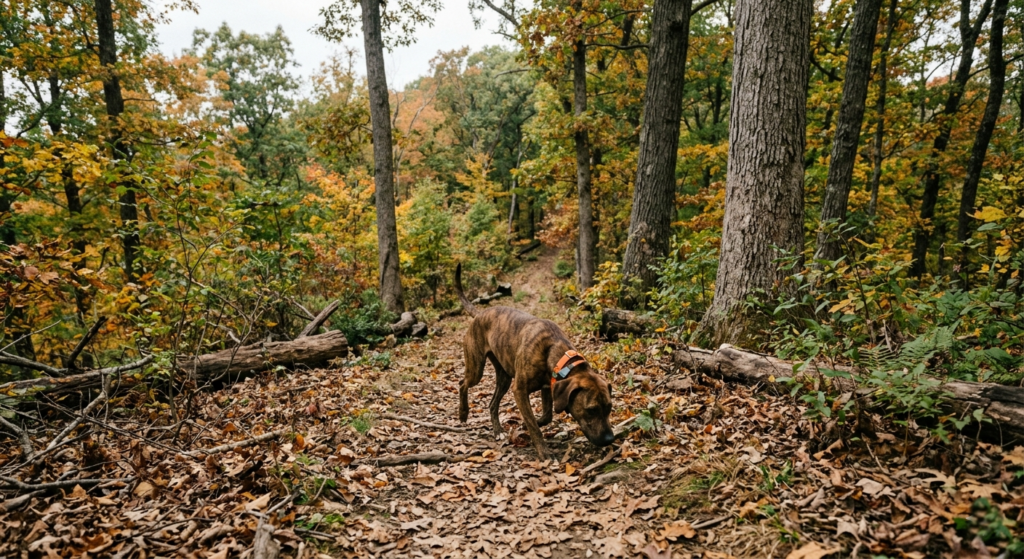
You put this dog in the woods with an older dog and it looks like something. Busy, honest, covering ground. Then you hunt it alone and it turns into a different animal. Slow. Drifting. Checking back every few minutes like it’s waiting on somebody to tell it what to do next.
That gap between paired performance and solo performance confuses a lot of handlers. The ability looks like it’s there. And it probably is. But ability alone doesn’t tell a dog how to create its own hunt when nobody else is doing it first.
This is one of the more common transition problems in young squirrel dog development, and if you want to work through it with a clear framework, the full breakdown lives inside the guide on how to train a tree dog. Most of the time, this is a handler-built problem. And that means it’s fixable.
What’s Actually Happening
When a young dog hunts with a seasoned dog, it’s running on borrowed confidence. The older dog sets the pace. It decides where to go. It opens first when scent gets hot. The young dog follows that lead, plugs into the action, and gets rewarded. It looks like hunting. But what it’s really doing is tagging along.
Pull that older dog out and the young one doesn’t know how to start the engine on its own. In thick squirrel country with game moving everywhere, it might muddle through. But put it in thin woods with long dry spells between sign and it falls apart. That’s because there’s no natural reward driving it forward, and it was never taught to generate its own momentum when conditions get tight.
The dog isn’t quitting. It’s unsure what the job looks like when there’s nobody to follow. That’s an important distinction. Quitting is a character problem. This is a structure problem.
Why It Happens
Most of it comes down to too much time paired with an older dog before solo work begins. Handlers do this with good intentions. The young dog is learning. It’s seeing game. It’s getting reps. But what it’s actually learning is to let the older dog carry the load.
The young dog watches the older dog locate game, commit to a track, and push it to a tree. Then it joins in at the exciting part. Over time, that pattern becomes the hunt. Find the older dog, follow the older dog, celebrate with the older dog. Take that away and nothing in the young dog’s experience tells it what to do next.
Thin woods make it worse because they pull back the curtain. A young dog that has only hunted in heavy squirrel country with a partner can fake independence when game is everywhere. Move it to tough timber with sparse activity and the crutch disappears fast. That’s not a new problem. It’s the same problem that was already there.
Handler timing mistakes play a role too. If you’re praising and rewarding the young dog most when it’s running behind the older dog, you’re accidentally teaching it that proximity to another dog is what earns the reward. You want to be building independent effort, not pack behavior.
How to Fix It
There is no shortcut here. The dog has to learn what solo hunting feels like, and that only happens alone.
Step one is simple and non-negotiable: hunt the dog by itself. Not mostly alone. Not alone except for one quick drop with the older dog to get it fired up. Alone. Independence doesn’t grow in company, and every time you add the older dog back in, you reset the clock.
Step two is to lower the difficulty temporarily. Go back to better squirrel density. Let the dog find success on its own before you ask it to grind through thin timber. This is the same principle behind learning to teach the first 50 yards right — the setup matters. You can’t build confidence by throwing a dog into the hardest conditions right away. Set it up to win first.
Step three is to hunt short. Thirty to forty-five minutes at most. End on effort, not exhaustion. A tired, frustrated dog that hunted poorly for two hours learns nothing useful. A dog that hunted well for forty minutes and quit while things were still good builds the right habits.
Step four is where most handlers get their timing wrong. Reward initiative, not results. When the dog hunts out, praise it. When it opens honestly on a track, mark that moment. When it sticks with a cold track and keeps working, that’s what you want to reinforce. Research on predictable rewards build confidence in dogs consistently shows that timing matters more than intensity. Don’t wait for a perfect tree. Reward the behavior that leads to the tree.
Step five is to control the check-back habit. If the dog keeps drifting back to you, stay quiet. Don’t call it in. Don’t encourage it. Don’t give it anything to return to. Let it learn that what’s behind you is nothing, and what’s in front of it is the only game worth playing.
Step six is the payoff. Once the dog is hunting independently with real forward purpose, start reintroducing tougher conditions. Move back into thinner timber. Hunt it in weather. Let it figure out hard days. That’s when you start seeing real hunting ability instead of pattern behavior.
What Most Handlers Get Wrong
The most common mistake is hunting with the older dog too long because it looks good. It does look good. That’s the problem. The performance is deceptive. You’re watching two dogs hunt, but only one of them is actually doing it.
The second mistake is deciding the dog isn’t ready for solo work and delaying it indefinitely. If the dog is hunting with an older dog and showing effort and game interest, it’s ready to try alone. You don’t need a perfect foundation before you pull the older dog. You need to start.
Correcting hesitation instead of building confidence is another one. A young dog that’s unsure in thin woods doesn’t need a correction. It needs more reps in better conditions with proper reward timing. Correction at that stage doesn’t teach it to hunt. It teaches it to worry.
Finally, expecting the same performance alone as in a pack too soon. That expectation leads to frustration, which leads to bad decisions. The solo dog is going to look worse at first. That’s normal. Give it time to figure out its own rhythm without an older dog setting the pace.
Devil’s Advocate
Some handlers will argue that pairing a young dog with an older dog longer builds more confidence than it takes away. And there’s truth in that, up to a point. A young dog that’s struggling to find game at all can benefit from watching a seasoned dog work. It learns what it’s supposed to be doing.
But there’s a line. Once the young dog understands what game is and is showing genuine interest, the older dog stops being a teacher and starts being a crutch. Most handlers miss that line and keep the pair together well past the point of usefulness.
The question isn’t whether pairing helps. It does early on. The question is whether you’re still pairing because the young dog needs it, or because you enjoy watching the performance. Those are different reasons with very different outcomes.
When to Leave It Alone
Not every young dog that looks better paired than alone has a problem that needs fixing. Some of them just need more time.
If the dog is hunting out willingly when dropped alone, showing curiosity, working sign when it finds it, just doing it slower or with less urgency than you’d like, that’s development, not dependency. If the check-back habit is mild and decreasing over time, let it work itself out. The same principle applies to dogs that are checking back too much but still hunting forward between checks. That dog is on its way. Don’t over-manage it.
Some dogs flip the switch late. You hunt them alone for weeks and nothing seems to click, and then one morning they go out and look like a finished dog. That happens. The woods time was building something even when it didn’t show on the surface.
The time to intervene is when the dog isn’t hunting forward at all, when it’s just drifting back to you every few minutes with no real effort in between, or when the behavior is getting worse instead of slowly improving over multiple solo hunts.
Quick Fix Checklist
Pull the older dog out completely. No exceptions.
Start in better squirrel density. Set the dog up to find game.
Hunt short. End on a good note before the dog shuts down.
Reward forward effort, not just the tree.
Stay quiet when the dog checks back. Give it nothing to return to.
Be patient with the first few solo hunts. Worse-looking is normal.
Move back to tougher conditions only after real solo confidence shows up.
Closing
A young dog that shines with company but stalls alone isn’t broken. It just hasn’t learned how to be responsible for its own hunt yet.
Independence is built through controlled exposure, proper reward timing, and the patience to let a dog figure things out without rescuing it. Most of these dogs come on strong once that switch flips.
Get the dog alone. Set it up to succeed. Then get out of the way and let it hunt.