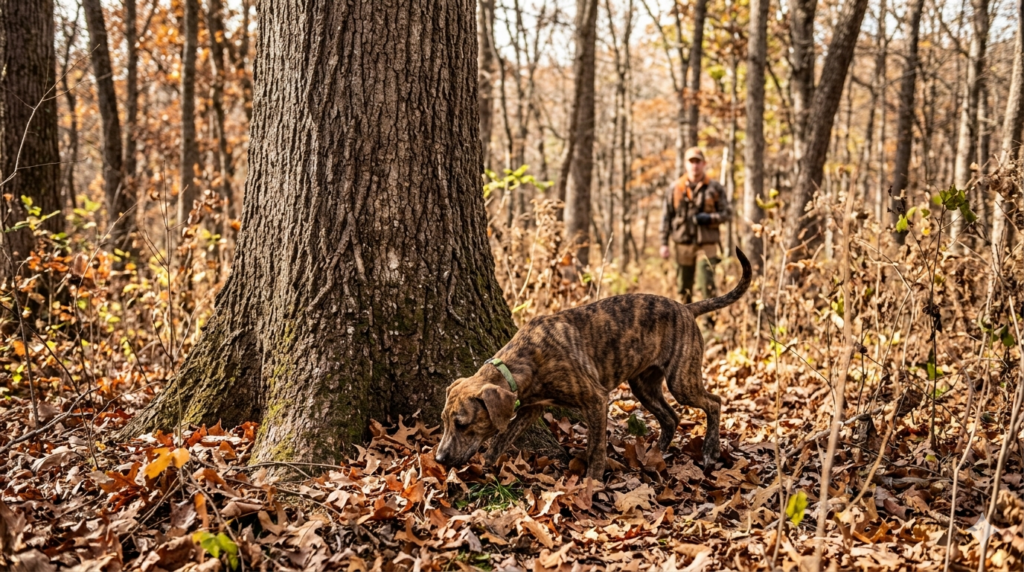
The dog moves a squirrel, runs it toward the timber, and then the track goes cold. And instead of working it out, the dog circles once, pops its head up, drifts off, or starts back toward you.
That is a loss track problem. It is one of the most common issues handlers run into with young squirrel dogs, and it gets misread more than almost anything else in this game.
Most handlers either panic and wade in too fast, or they decide the dog does not have enough ability to figure it out. Neither one is usually right.
Before you start changing things, you need to understand what is actually happening and why. If you want a broader foundation for what good early training looks like, the full breakdown on how to train a tree dog covers the core principles that apply here.
What’s Actually Happening
A loss track is the moment the dog is following a squirrel and the scent disappears. The squirrel left the ground. It changed direction sharply. Wind shifted. Leaves dried out overnight. Whatever the reason, the dog suddenly has nothing to move on.
Working out a loss means the dog slows down, uses its head, checks back and around, circles the area, and picks the track up again on its own. That is what a finished dog does. It does not look for you. It does not hunt something new. It works the problem.
Here is what a lot of young dogs do instead:
They overrun the last good scent and keep blowing forward on nothing. They pop their head up and immediately start hunting fresh air somewhere else. They look back at the handler like there is an answer waiting there. They mill around without any real method. Or they just come in.
There is also a less obvious thing happening with some young dogs. They are not really losing the squirrel. They are losing their nerve once the track gets hard. A dog that looks steady on hot, easy tracks can come completely apart when the squirrel pulls a trick. If you are trying to figure out whether your dog is actually working or just moving on guesses, read the piece on whether your dog is guessing or actually tracking a squirrel. It covers that line in detail.
The distinction matters. A dog that is honestly trying but confused is fixable with time and exposure. A dog that has learned to quit is a different problem, and one that usually started with handler interference.
Why It Happens
Not enough real track experience. Young dogs cannot solve a problem they have not seen enough times. A pup can look sharp on short, hot, cooperative tracks and then fall completely apart when the squirrel does something smart. Ability is there. Experience is not.
Moving too fast for the nose. Hard-charging young dogs are exciting to watch, but a lot of them are outrunning their scent. They blow past the last good ground check and never gear down long enough to find where the track went. Speed is not tracking. Accurate is tracking.
Handler pressure at the wrong moment. Calling out, walking toward the dog, recasting too soon, talking too much when things get quiet. Every one of those moves teaches the dog that help is coming. Once a young dog learns to expect a handler to fix the hard part, it stops trying to fix it on its own.
Poor scenting conditions. Dry leaves, a hard freeze overnight, wind coming through the wrong way, thin squirrel movement first thing in the morning. Any of those can make a young dog look worse than it is. Some days are just bad days to judge a pup, and pushing through bad conditions all the time builds nothing.
Too much easy hunting. A dog that only ever sees short, cooperative, fast-treed squirrels does not build the patience to stay with a tough track. Easy squirrels can hide a real weakness for a while. Then the first time the hunting gets hard, the dog has no answer for it.
Confidence is not fully built yet. Some young dogs shut down mentally when they cannot move the track right away. They try for a few seconds, nothing comes, and they give up. That is not always a talent problem. Sometimes it is just maturity, and maturity takes time on real game.
The handler has been doing too much. If the dog has been hunted behind older dogs constantly, or if the handler keeps solving the hard moments, the dog may simply never have had to figure anything out alone. Those dogs often look great until the pressure is on them to think.
How to Fix It
The approach here is straightforward. Most of it comes back to patience, structure, and keeping your hands off at the right moment. For the specific work of slowing a young dog down and teaching it to stay with a problem, the article on how to build track patience in a young squirrel dog goes deeper on the mechanics.
Step 1: Make sure the dog is old enough and far enough along.
A six-month-old dog struggling with a tough loss track is not a training failure. It may just be a young dog. Trying to drill or correct immaturity like it is a character flaw is one of the fastest ways to create a dog that quits permanently.
Step 2: Hunt the dog where it can succeed but still learn.
Find places with enough squirrel to give repeated chances. Avoid the worst scenting days when you are trying to build track confidence. Real hunting situations beat gimmicks every time. The dog needs genuine problems to solve, not manufactured ones.
Step 3: Let the dog work.
When the track breaks down, go quiet. Do not move toward the dog. Give it room to circle, check, and think. Most handlers close the distance too fast and never give the dog a real chance to solve anything.
Step 4: Watch for effort, not just results.
A young dog that stays engaged, keeps checking, and keeps trying even without finishing a squirrel is making progress. Improvement shows up first in attitude before it shows up in treeing. Notice that.
Step 5: Slow the dog down if it keeps blowing past the loss.
Some young dogs need solo hunting to break the habit of feeding off another dog’s speed. When it is running with an older dog, it may never slow down enough to actually work the scent. Solo time forces it to own the pace.
Step 6: Hunt it alone enough to build independence.
A dog that always has another dog to follow may never learn to make decisions on a hard track. Solo sessions teach responsibility. The dog cannot look sideways when there is nobody beside it.
Step 7: Do not overhandle at the point of failure.
No calling, no leading around, no turning the track into something you are solving together. Let the dog own the mistake and the fix. That ownership is what builds a dog that can work alone under pressure.
Step 8: End on productive sessions when possible.
Short hunts that end on honest effort beat long frustrating ones that end on confusion. Confidence grows from repetition of real problem-solving, not from grinding through bad days until the dog shuts down.
Devil’s Advocate
Some dogs just do not have it. That is the honest counterpoint to everything above. Patience and good structure and proper exposure are real, but they only develop what is already there. A dog with no track brain is not going to acquire one through solo hunting and quiet handlers.
If the dog is eighteen months old, has had real woods time, has been hunted in fair conditions, and still does not show any instinct to work a loss, that is useful information. Not every dog that looks promising at eight weeks becomes a squirrel dog. Bloodlines matter, and ability is largely bred in.
The other counterpoint is time. A handler who is still green themselves may be judging a young dog off a few bad hunts rather than an honest pattern. One rough patch on tough scenting conditions is not a trend. Three or four hunts across different conditions with consistent loss-track quitting is something worth paying attention to.
Neither rushing to fix it nor giving up on it is usually right. Diagnose the pattern first.
What Most Handlers Get Wrong
Expecting a pup to handle a cold, tricky loss like a finished four-year-old dog. Those are two entirely different animals, and comparing them is unfair to the young dog.
Mistaking speed and excitement for real tracking ability. A fast, fired-up young dog can mask a very shallow nose. That usually shows up on the first genuinely hard track.
Talking too much when the dog gets in trouble. The moment you start calling or clapping when the track breaks down, you are teaching the dog to look for you instead of look for the squirrel.
Walking straight to the dog every time it checks up. That move builds handler dependence faster than almost anything else. The dog learns to wait, and eventually to expect rescue.
Hunting only in bad conditions, then deciding the dog has no nose. A young dog in dry, frozen, windy timber does not have a fair shot at developing track confidence. Pick your days.
Pulling the dog off too quickly before it has time to sort the loss. Fifteen seconds of uncertainty does not mean the dog is done trying. Give it time.
Correcting quitting before you have made sure the dog understands the job. Pressure without understanding creates a dog that is both confused and anxious. That combination is harder to fix than either problem alone.
Hunting the dog behind older dogs so much that it never has to figure anything out on its own. Then wondering why it falls apart when it is running solo on a tough track.
Judging a young dog off one rough patch instead of looking for patterns across several honest hunts in fair conditions.
Quick Fix Checklist
- Is the dog old enough to be expected to handle a tough loss?
- Are scenting conditions fair enough to actually judge the dog?
- Are you staying quiet long enough when the track breaks down?
- Is the dog getting solo time, or always following another dog?
- Are you walking toward the dog when it checks up?
- Are you ending sessions on productive notes when possible?
- Has the dog had enough real squirrel contact to start building pattern recognition?
- Are you watching for effort and attitude improvement, not just finished squirrels?
- Are you hunting enough varied terrain to expose the dog to different track problems?
- Have you ruled out that the dog is simply blowing through the scent rather than losing it?
Closing
Most young squirrel dogs that will not work out a loss are not ruined. They are green, overhandled, or short on experience with hard tracks.
Track patience and problem-solving are not skills you install in a young dog. They develop through exposure, maturity, and having enough space to fail and recover without the handler rushing in. A young dog that learns to stay with a loss track and work it out on its own becomes something worth hunting for a long time.
Give the dog chances. Stay out of the way at the hard moments. Watch for honest effort before you judge the results.