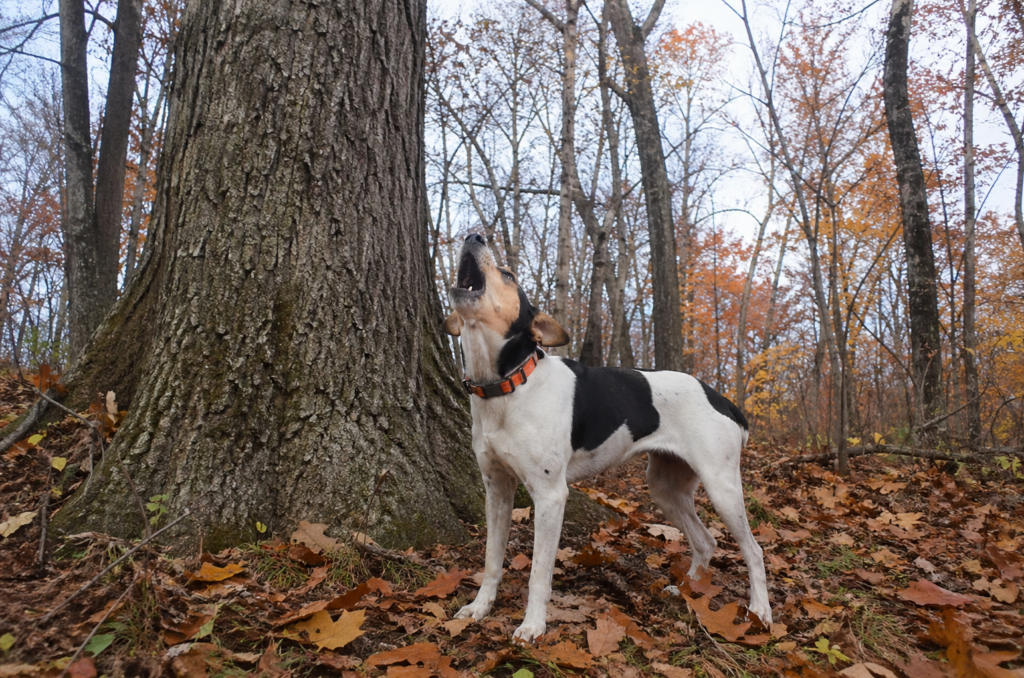
Squirrel dog hunting is exactly what it sounds like. A hunter walks timber with a trained dog. The dog ranges out, uses its nose and eyes to locate squirrels, pushes them into a tree, and barks until the hunter arrives. That core sequence, search, tree, bark, is what the whole sport is built around.
If you have never seen it, it can look deceptively simple. A small dog disappears into the hardwoods, and a few minutes later you hear it sounding off at the base of a tall oak. You walk in, look up into the canopy, find the squirrel, and decide whether to shoot. What you are not seeing is the dog working scent, tracking ground sign, and making constant decisions about which direction the squirrel went and where it ended up.
This is a tree dog sport. The game lives above the ground. The dog finds it. That distinction matters a lot when you are trying to understand what kind of dog and what kind of hunting you are actually getting into.
What Actually Happens on a Hunt
The typical squirrel dog hunt runs during daylight. Most hunters prefer mornings in the fall and early winter, when squirrels are active and the leaves are off the trees. You park at the edge of a woodlot, cut the dog loose, and follow along as it works.
A good squirrel dog ranges ahead of you, moving through the timber and checking likely trees, brush piles, and feeding areas. When it picks up scent or spots a squirrel moving, it follows until the squirrel goes up. Once the squirrel is in a tree, the dog parks at the base and barks. That bark is called a tree bark, and it sounds different from the dog’s trailing bark. Experienced handlers learn to recognize both.
You walk in quietly, spot the squirrel in the canopy, and take the shot or leave it. After the shot, the dog may retrieve or simply stay on the tree while you pick up the squirrel. Then the dog hunts again.
A finished dog on a good day might tree a dozen squirrels in a few hours. A young dog learning the job might tree two and miss several. The gap between those two dogs is what training is for. If you want to understand what drives that difference, The Squirrel Dog Will Show You What It Is takes a close look at how a dog’s natural tendencies reveal themselves in the field.
The Breeds Built for This Job
The two breeds that dominate squirrel dog hunting in North America are the mountain feist and the mountain cur. Both were developed in the American South and Appalachia by working hunters who needed a dog that could locate and tree small game in dense timber. Neither breed has much to do with the kennel club world. They were built by function, not by form.
The mountain feist is compact, typically under 30 pounds, and known for hunting close to the handler. It works well on smaller properties where you do not want a dog ranging hundreds of yards away. It tends to hunt with a combination of nose and eye, tracking scent on the ground and visually locating squirrels moving through the canopy.
The mountain cur is larger, often 30 to 50 pounds depending on the line, and tends to range wider. It has a reputation for a stronger nose and is often preferred by hunters who work big timber or who want a dog that can pull double duty chasing squirrels by day and raccoons at night. Many coonhound hunters have come into squirrel dogging through the mountain cur for exactly that reason.
Other breeds show up in squirrel dog circles. Treeing Tennessee brindles, Norwegian elkhounds, and various mixed-line dogs have all produced capable squirrel hunters over the years. But feists and curs remain the standard because they were bred specifically for this job. The United Kennel Club recognizes both and sanctions competitive squirrel hunts year-round. You can find more about the cur and feist breeds used in this sport at UKC Cur and Feists.
What the Dog Is Actually Doing
The job sounds simple, but the mechanics are not. Squirrels spend a lot of time on the ground, especially in the fall when they are moving acorns. A squirrel dog picks up that ground scent and follows it. When the squirrel goes up a tree, the dog has to recognize the switch from ground-running to treed game and then work the base to confirm the squirrel is still in that tree.
Squirrels are not cooperative. They will sit perfectly still in a fork 40 feet up. They will move from tree to tree through the canopy without touching the ground, a behavior hunters call timbering. A good squirrel dog follows that movement and re-trees the squirrel after every jump. A young or unfocused dog loses the squirrel when it timbered and gives up.
The dog is also managing distractions. Deer scent crosses every trail in the woods. Rabbits and other small game are present. A trained squirrel dog ignores all of it and stays on squirrels. That focus is partly genetics and partly the result of deliberate, patient training over months and years.
Understanding how your dog’s instincts are already working before you start formal training is one of the most useful things a new handler can learn. What Your Squirrel Dog Already Knows Before You Start Training covers that ground in detail for handlers who are getting ready to start a new dog. Those same fundamentals apply across squirrel dogs and coonhounds. If you’re starting from scratch, our guide on training a tree dog explains how to build confidence, independence, and honest treeing without rushing the process.
What Squirrel Dog Hunting Is Not
It is worth being clear about what this sport does not look like, because first-time observers sometimes walk away with the wrong picture.
It is not passive. You are walking timber for hours, often on uneven ground, following a dog that does not slow down for you. Physical conditioning matters. Comfortable boots matter.
It is not low-maintenance dog ownership. A squirrel dog is a working animal with high energy and a strong prey drive. It needs regular time in the woods, year-round conditioning, and a handler willing to put in the miles. A dog that sits in a pen all summer and gets pulled out in October for hunting season will not perform.
It is also not a short-term project. Most experienced handlers will tell you that a squirrel dog does not fully come into its own until its second or third season. Some dogs develop faster. Most need time. If you are expecting a finished dog in a few months, you are likely to be frustrated and potentially to misread a normal developing dog as a problem dog.
The reward is proportional to the investment. A hunter behind a finished squirrel dog in good timber, with squirrels moving, is having one of the best mornings available in the American hunting tradition.
Where and When the Sport Is Practiced
Squirrel dog hunting is practiced from late summer through early winter across most of the eastern and central United States. Peak season follows the squirrel’s most active feeding periods, typically September through January depending on region. Late season, after most of the leaves have dropped, offers the clearest visibility for both dog and hunter.
The sport is concentrated in the South and Appalachia, where the tradition runs deep and the timber supports good squirrel populations. States like Kentucky, Tennessee, West Virginia, Virginia, Arkansas, Mississippi, Alabama, and Ohio have active squirrel dog communities and a full calendar of competitive hunts. But the sport is practiced wherever hardwood timber and gray or fox squirrels are present, which covers a broad swath of the country.
Access to hunting land is the practical limiting factor for most new participants. Public land allows dogs in many states, but rules vary by property and season. Always confirm local regulations before hunting a new piece of ground.
The Competitive Side of the Sport
Squirrel dog hunting has a robust competitive circuit that runs through the fall and winter months. The United Kennel Club and the National Kennel Club both sanction squirrel dog hunts, where dogs are judged on their ability to tree the most game accurately during a timed cast. Events run from local club hunts to regional championships to the Feist and Cur World Championships.
Competition is not required to enjoy the sport. Most squirrel dog hunters never enter a competitive event. But the organized hunt structure has done a great deal to preserve and advance the breeding programs that produce quality dogs. A dog out of a competitive line comes with a measurable track record of what that bloodline produces in the field.
Getting Started
The practical entry point for most new hunters is finding an experienced squirrel dog person who will take you out before you commit to getting a dog. Watching a finished dog work for a few mornings will tell you more about the sport than any amount of reading. It will also help you decide what kind of dog, what range, what working style, fits the land you hunt and the way you like to move through the woods.
From there, the usual advice is to start with a pup from a proven hunting line. Bloodlines matter in this sport. A pup out of parents that hunt well inherits the instincts the whole training process depends on. A pup out of unknown background may have those instincts or may not. The difference in outcome can be significant.
Equipment needs are modest compared to many other hunting pursuits. A GPS collar helps you track a ranging dog, especially on larger timber. Garmin and Dogtra both make reliable systems used widely in the squirrel dog community. A quality hunting vest protects the dog from briars and brush. A basic rimfire or .410 shotgun handles the shooting side. The dog is the primary investment, and most quality feist or cur pups from hunting lines run in the range of a few hundred dollars up through the low thousands for a started or finished dog.
For a deeper look at what it takes to develop a squirrel dog from the ground up, the squirrel dog training section of this site covers every stage of that process in detail.
The Short Version
Squirrel dog hunting is a daytime tree dog sport. The dog locates and trees squirrels in hardwood timber. The hunter follows, spots the game, and decides whether to shoot. The breeds most commonly used are mountain feists and mountain curs, both developed specifically for this job. The sport demands a fit, experienced dog, a committed handler, and consistent time in the woods. It is practiced widely across the eastern and central United States, with a competitive circuit running through the fall and winter months.
If you have never been out with a finished squirrel dog, find one before you buy a pup. One morning in the timber behind a dog that knows its job will give you a clearer picture of what this sport is than anything else.