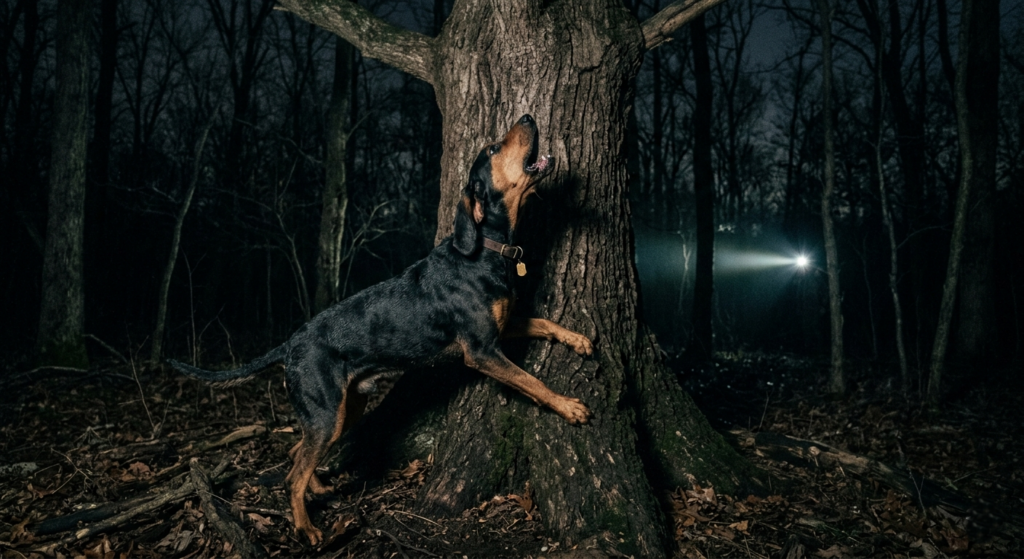
You’re standing in the dark at the edge of a creek bottom. Your coonhound cut loose twenty minutes ago, and you’ve been listening ever since. For a while, the dog was bawling every few seconds. Then it shifted. The barks got shorter, faster. Then it went quiet. Now nothing.
Most new coon hunters don’t know what to do in that moment. They call out. They blow the horn. They start walking toward the last place they heard the dog. Some just stand there, hoping the noise comes back.
The dog isn’t lost. It isn’t stuck. It isn’t done. It’s probably standing at the base of a tree trying to keep a coon pinned, and every step you’ve taken toward it has made it quieter and less confident.
This is what happens when a beginner steps into the woods without understanding what the dog is trying to say. A coonhound has a vocabulary. It isn’t complicated, but it is specific, and learning to read it changes everything about how you hunt.
You can find a solid foundation for all of this at coonhound training, but this guide focuses on one skill that trips up nearly every new hunter: understanding what your dog is telling you out there in the dark.
The Four Sounds That Matter
A coonhound doesn’t just bark. It communicates in distinct stages, and each stage tells you something specific about what is happening in the woods.
The Locate
When you first turn a dog loose, it’s looking for a starting point. Some dogs give a few exploratory barks while moving, almost like they’re talking to themselves. Others are quiet until they hit something worth opening on. Either way, what you’re hearing at this stage is search behavior. The dog is covering ground, nose down, working for a track.
Don’t read too much into these early sounds. A dog making noise while it searches isn’t necessarily on game. It’s working the area.
The Strike
The strike is the moment the dog commits to a track. When you hear a coonhound go from scattered searching to steady, rhythmic bawling, that’s the strike. The voice opens up. It gets consistent. The dog found something real, and it’s following it.
Some dogs open hot. Some are slower to commit. Both are normal, and breed plays a big role here. A Treeing Walker or English tends to open fast on a hot track. A Bluetick or Black and Tan will often be more deliberate, working the track carefully before really singing. If you’re still figuring out which dog fits how you like to hunt,
A Treeing Walker or English tends to open fast on a hot track. A Bluetick or Black and Tan will often be more deliberate, working the track carefully before really singing. If you’re still figuring out which dog fits how you like to hunt, what actually matters when buying a coonhound covers the differences in detail.
The key thing to understand about the strike: the tempo tells you something about the track. A fast, steady bawl usually means a hot track, meaning the coon passed through recently. Slow, choppy, inconsistent barking usually means a cold track, meaning the coon was there a while ago, and the scent has thinned out. Hot or cold, both are the dog working honestly. Neither is wrong.
The Trailing Bark
Once the dog commits and settles in, the trailing bark takes over. This is the sound that carries across a hollow on a clear night. Long, drawn-out bawls with a rhythm to them. The dog is covering ground behind the coon, pushing it toward wherever it’s going to tree.
This can go for minutes or for an hour, depending on how far the coon travels. Your job during this phase is to listen, stay patient, and pay attention to direction. If the voice gets louder, the race is coming toward you. If it fades, the dog is pushing the coon away.
What most beginners do wrong here: they move. They hear the dog going somewhere, and they follow it. Stay put. Let the dog work. The coon will tree on its own timeline, and if you’ve been chasing every sound, you’ll end up in the wrong part of the woods when the dog finally locks down.
The Changeover
This is the moment everything changes. When the coon goes up a tree, the dog’s bark shifts. The long bawls stop. What replaces them is faster, shorter, and more urgent. Some dogs chop. Some switch to a rapid series of sharp barks. Some bawl hard and fast at the base. Every dog has its own version of a tree bark, and you’ll learn your specific dog’s changeover as you hunt together.
But even without knowing your dog’s individual tree sound yet, you’ll know when it happens. The rhythm changes completely. The trailing voice has a forward momentum to it. The tree bark is stationary. The dog isn’t going anywhere.
That’s your signal to walk in.
What the Dog’s Behavior Tells You
The voice is the most obvious signal, but it isn’t everything. A coonhound communicates with its whole body, and understanding the behavioral cues helps you read situations the voice alone doesn’t explain.
When the Dog Goes Quiet
Silence is the most confusing thing for new hunters. The dog was going strong, then nothing. Here’s what’s usually happening: the dog has treed but isn’t comfortable yet. Maybe it heard you moving. Maybe it’s checking the tree, walking the base, trying to confirm the coon is actually up there. Some dogs go quiet for thirty seconds to two minutes at a tree before they really commit and open hard.
Give it time. If silence stretches past five minutes, you can start moving toward the last direction you heard the dog. Move quietly. Move slow. Don’t call out.
The Dog Is Circling
If you hear the bark moving in a wide loop without ever settling, one of a few things is happening. The coon bailed out of a tree. The coon reversed course. Or the track ended at the water, and the dog is working the bank looking for where the coon came out.
This isn’t a failure. This is the dog doing its job in a difficult situation. Stay patient. A dog that keeps working until it sorts out a hard track is building something real. Let it.
The Slick Tree
You walk in, the dog is barking hard, and the coon isn’t there. This happens to every dog. The coon either bailed to another tree before the dog arrived, or it was already down and gone.
The best dogs handle this by self-correcting. They’ll check the tree, figure out the coon isn’t there, and go back to work. Let the dog do this on its own. If the tree is consistently empty and the dog never self-corrects, that’s a training issue. But don’t assume it’s a problem after one or two slick trees.
A good GPS tracking collar, whether Garmin or Dogtra, makes these situations easier to navigate because you always know where your dog is, even when you can’t hear it. For more on what gear makes a real difference in the dark, essential coon hunting gear breaks it down without the marketing noise.
What Beginners Get Wrong
Walking In Too Fast
New hunters hear the changeover and head straight for the dog at a normal walk or faster. When you do this, you break the dog’s focus, disturb the coon, and teach the dog that your arrival means something changes. Some dogs will stop barking when they hear you coming because they associate your arrival with the hunt ending.
Walk in slow. Move quietly. Get close enough to see the tree, put a light on it, and let the dog keep working. The dog earned that moment. Don’t take it from it.
Calling the Dog Off a Cold Track
A dog working a cold track sounds unimpressive. It’s slow, inconsistent, and new hunters often call it off, assuming nothing productive is happening. What you’re watching is a dog developing nose work, patience, and the ability to stay committed when scenting conditions are difficult.
Cold tracks produce some of the best education for a young hound. Let the dog work them out. The nights that look unproductive on paper are often where the most learning happens.
Misreading Trash for Coon
Deer, possum, and fox all leave tracks. A young dog that runs trash sounds exactly like a dog that just struck a coon, at least at first. As you hunt together and learn your dog’s voice, you’ll start to notice patterns: how long it stays on a track, whether it ever trees, how it moves through the woods on different game.
You can’t rush this. Get out as many nights as you can, pay close attention, and let the dog make mistakes. Take mental notes on what their behavior looks like when something doesn’t pan out.
Do This / Don’t Do This
Do this: Stay in one spot during the trailing phase and let the race develop.
Don’t do this: Follow the dog through the woods, trying to keep up with the sound.
Do this: Learn your specific dog’s changeover bark before you ever hunt with another dog.
Don’t do this: Assume every dog’s tree sound is the same.
Do this: Give a quiet dog at least two to three minutes before making any move.
Don’t do this: Call out or blow a horn the moment the sound stops.
Do this: Walk in slow and quiet when the dog trees.
Don’t do this: Crash through the woods at normal pace toward the tree bark.
Do this: Let the dog self-correct a slick tree.
Don’t do this: Correct or scold the dog at the tree before it has a chance to work it out for itself.
Devil’s Advocate
Here’s a thought that goes against most beginner advice: learning the vocabulary of your specific dog matters more than knowing the general rules.
Every book, every website, every experienced hunter will tell you about the strike bark, the trailing bark, the changeover. All of that is real. But a Bluetick sounds nothing like a Walker, and both of them sound different from a Plott. Within those breeds, individual dogs vary even more. One dog’s changeover is another dog’s mid-track voice.
You don’t really learn to read a coonhound in general. You learn to read your coonhound specifically. General knowledge gets you started. Time with your dog is what actually builds the skill.
The hunters who know exactly what their dog is doing every moment of a hunt have usually been running that specific dog for two or three seasons. They didn’t get there by reading about it. They got there by paying attention, night after night, until the dog’s voice stopped being noise and started being information.
Quick Fix Checklist
Before your next hunt, take five minutes and listen to recordings of a coonhound voice on YouTube or hunting forums. Listen specifically for the difference between trailing and treeing. Train your ear before you’re standing in the dark trying to figure it out in real time.
Pick one thing to focus on per hunt. Don’t try to read everything at once. One night, concentrate on learning what your dog’s strike sounds like. The next night, focus on the changeover. Build the vocabulary piece by piece.
After every hunt, spend a few minutes reviewing what the dog did and how you responded. You’ll start to notice patterns faster than you’d expect.
If you hunt with a GPS collar, pull up the track after the hunt and match it to what you heard. Seeing the dog’s movement mapped against the sounds you remember is one of the fastest ways to connect behavior to voice.
What the Research Says
What experienced hound men have known for generations has been confirmed in the research: a hunting dog’s bark changes depending on what kind of animal it has found. A 2021 study published in Scientific Reports found that hunting dogs produce acoustically distinct vocalizations when encountering different species. The finding supports what any serious coon hunter will tell you: a dog on a coon sounds different from a dog on a deer, even to a human ear with minimal training. Full study: ncbi.nlm.nih.gov/pmc/articles/PMC8460642
The Long Game
The coonhound’s voice is the whole point of the sport. It’s why people drive an hour to put a dog down in the dark on a cold November night. Not for the coon. Not for the pelt. For the sound of a dog working, the shift from searching to striking, from trailing to treeing, building toward that final bark that tells you something real just happened out there.
You can’t rush learning to read it. But you don’t have to stay confused either. Get out often, keep your mouth shut while the dog is working, and pay close attention to what you hear. The dog is telling you something on every single hunt.
The sooner you learn to listen, the better those nights get.