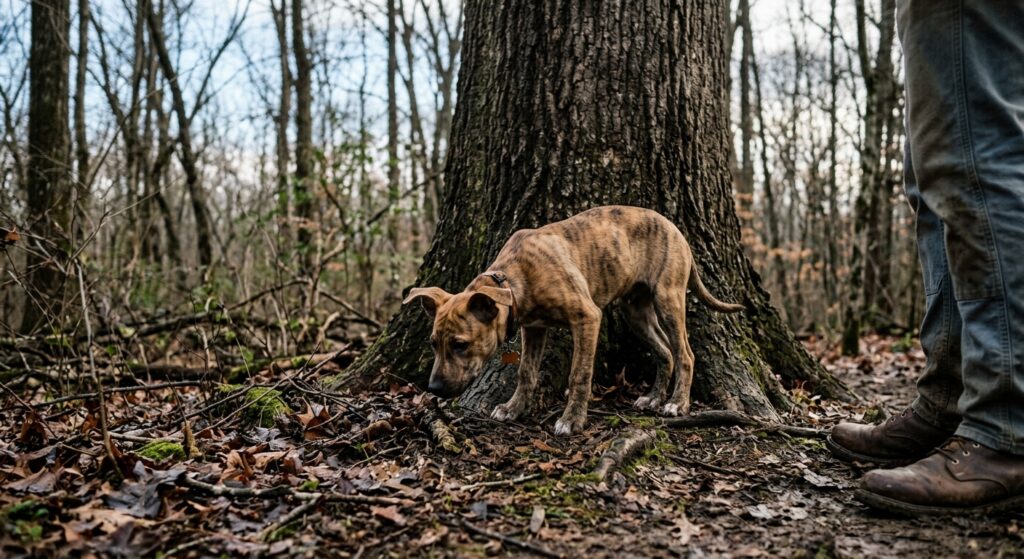
By the third week of the season you already know which dog gets the good ground. Frost is still on the tailgate at five in the morning, and while you’re loading the box, your hand goes straight for the leash on the dog that trees quick and clean. The slow one, the dog that stood at the base of three different trees last week and never opened its mouth, stays in the truck one more morning. Nobody said this out loud. It just started happening, one hunt at a time, until it was the pattern.
That is the moment most handlers lose a squirrel dog that never actually had a fair chance to lose itself. Not through a bad correction anybody would spot on video. Not through one bad training decision. Through simple, quiet redirection of effort, hunt after hunt, toward the dog that already looks like something, and away from the one that still needs the reps to become something.
By the time a handler admits what happened, the slow dog has two or three months less exposure than its littermate, and the comparison that started the whole thing looks like it was right all along. It wasn’t right. It just became true, because the dog never got tested fairly in the first place.
What’s Actually Causing the Problem
The real cause here isn’t the dog’s pace. It’s a math problem the handler doesn’t realize he’s running every single hunt. Somebody has to get the best cast, the best ground, the first turn while there’s still daylight scent to work, the one open box seat on a short weekday morning when there’s only time to run one dog hard. That decision almost always goes to whichever dog already looks good, because a strong-looking run feels like the better use of a short window in the woods.
The dog that hasn’t shown out yet gets the leftover ground, the tired legs at the back half of the hunt, the last twenty minutes before the morning heat shuts the woods down. That isn’t punishment. It’s triage, and on any single hunt it’s a reasonable call. But triage repeated for eight or ten weeks straight is exactly how a slow-starting dog turns into a genuinely underdeveloped one, and how a handler ends up with results that confirm precisely what he expected to see from the start.
This is where handler psychology takes over from actual dog development. Once a handler forms an early opinion about which dog “has it,” every ambiguous sign afterward gets read to fit that opinion. A missed track from the promising dog gets written off as a bad scent morning, cold front, wrong wind. The identical miss from the slow dog gets filed as proof. The Virginia-Maryland College of Veterinary Medicine’s guidance on training notes that dogs learn at genuinely different rates depending on age, motivation, and individual temperament, and that judging ability off a narrow early window of exposure ignores how much of that early variation is completely normal. A handler running that unconscious math isn’t seeing the dog clearly anymore. He’s watching a self-fulfilling prophecy build itself, one shorted hunt at a time.
Cold, wet timber makes this worse. On a rough scenting morning, a slow dog that’s already behind on reps has less banked experience to draw on, so it looks even further behind than it actually is. The handler reads that as more proof instead of recognizing it as the predictable result of an uneven rotation.
What to Do Differently
Fix the rotation before you try to fix the dog. If you’re running more than one dog, track ground time and cast order on paper or in a phone note, not from memory. Memory favors whichever dog already impressed you last time out. A written log doesn’t care whose turn it “feels like” this morning. Give the slower dog first cast on the next three hunts straight, even when it costs you a clean, easy tree from the dog you already trust. That isn’t reverse favoritism. That’s correcting a bias that’s already been running the other direction for weeks without you tracking it.
Second, separate “slow to show” from “not capable.” A dog that’s had genuinely equal exposure, equal ground, equal easy mornings and rough ones, and still isn’t picking up scent work the way its littermate did, is telling you something real about pace or ability. A dog that’s been getting the tired-legs, last-twenty-minutes slot for two straight months hasn’t been tested at all. You cannot evaluate a dog on unequal data and trust the conclusion. This is the foundation any honest squirrel dog training approach has to start from: build the picture with equal reps first, draw the conclusion second, never the other way around.
Third, hunt the slow dog alone at least once a week if your schedule allows it. Comparison is the engine behind this whole problem, and comparison only exists when both dogs are riding in the truck together. A solo hunt strips that away entirely. You watch the dog work a track through oak flats or a creek bottom without a faster partner setting the pace and pulling your attention, and you get an honest read on what the dog actually does when nothing else is competing for your eyes. Handlers who try this are usually surprised. The dog that looked lost next to a confident littermate often looks like an entirely different animal working alone.
Fourth, pay attention to timing, not just volume. A slow dog doesn’t need more hunts crammed into the same lopsided rotation. It needs the same quality windows, the same fresh-legs starts, and the same first-look-at-good-scent chances the faster dog has been getting. Ten equal hunts will tell you more than thirty unequal ones.
Common Mistakes Handlers Make
The biggest one is treating hunts like auditions instead of development. Every outing gets scored in the handler’s head, and once a dog scores low enough times in a row, the handler stops expecting anything from it and starts hunting around it instead of with it. That shift in attitude isn’t invisible to the dog. Dogs read tension, hesitation, and where a handler’s attention lands. A handler who’s already mentally checked out on a young dog handles it differently in the field. He corrects it harder for the same mistake he’d shrug off in the other dog, and he gives it less benefit of the doubt on a borderline tree. None of that gets logged anywhere as a training decision. It just quietly shapes the dog into the thing the handler already expects.
The second mistake is confusing a slow start with a permanent ceiling. What watching a young squirrel dog struggle actually costs a handler is patience, and patience is exactly what gets spent first when a dog looks rough compared to a faster littermate early in the season. The instinct to step in and rescue a struggling dog is well documented as a mistake that kills independence. The instinct to quietly stop investing in a dog is the same impulse wearing a different jacket. Both come from the same place: discomfort watching a dog struggle, and an urge to do something about it that ends up hurting the dog more than helping.
The third mistake is talking about the dog differently in front of other hunters before you’ve given it a fair shake. Say “this one might not have it” enough times standing around the tailgate and you start hunting to confirm that line instead of actually testing it. Words said out loud in front of other people harden decisions that were still soft in your own head a week earlier. Once you’ve said it to somebody else, backing off the label feels like admitting you were wrong, and that’s a harder thing for most handlers to do than just quietly writing off a dog.
None of this means every slow starter is getting cheated by a bad rotation. Some dogs really do lack the interest or the nose to make a serious squirrel dog, and pouring a full season of equal reps into a dog that’s genuinely behind on ability costs you development time you needed for a pup that’s actually showing promise. Equal opportunity isn’t the same thing as infinite patience. Refusing to ever admit a dog isn’t cutting it is its own expensive mistake, just running the other direction.
The difference is what you’re actually measuring. A dog that’s had honest, equal exposure and still isn’t tracking, still isn’t interested in scent work, and still isn’t building independence after a genuinely fair look, that’s real information you can act on. What handlers learn from watching a young squirrel dog looking worse after early promise applies here in reverse: normal developmental dips get mistaken for ceilings all the time, and the same confusion cuts the other way with a slow starter. A dog that’s been shorted on reps for two months and still isn’t showing much hasn’t been given the chance to prove anything either way.
Do This / Don’t Do This
Do this: Log actual ground time and cast order for each dog across a season, not from memory. | Don’t do this: Trust your gut about which dog “needs” the better ground this morning. |
Do this: Give the slower dog first cast and best ground for a real stretch, minimum three hunts, before drawing any conclusion. | Don’t do this: Save the good ground for the dog that already impressed you and call it efficiency. |
Do this: Hunt the slow dog solo at least once a week to get a clean, uncomplicated read on it. | Don’t do this: Only ever evaluate it running next to a faster dog it can’t help but be compared against. |
Do this: Separate what the dog is actually doing in the woods from what you’re saying about the dog at the truck. | Don’t do this: Let tailgate talk turn a slow start into a permanent label before the dog’s had a real season. |
Do this: Judge a young dog’s scent work in light of what it’s actually been given. | Don’t do this: Compare raw results between two dogs that haven’t had equal opportunity to produce them. |
Quick Fix Checklist
- Write down which dog got first cast on your last five hunts. If it’s the same dog every time, that’s your answer.
- Give the slower dog first cast and best ground for the next three hunts straight, no exceptions.
- Hunt the slow dog solo at least once this week, with no faster dog along to set the pace.
- Catch yourself before you say “this one might not have it” out loud at the truck.
- Track tree counts, cast order, and ground time in a notebook or phone note instead of relying on memory.
- Consider running a GPS tracking collar if you’re working more than one dog. Objective tree counts and track times settle arguments your memory can’t.
- After three fair hunts, ask honestly whether the gap closed, held steady, or is genuinely still there.
Closing
A dog that starts slow isn’t finished. Most of the time it’s unequal data wearing the shape of an excuse. Most squirrel dogs that get quietly written off in the first two months weren’t tested fairly, they were tested less, and the results looked exactly like what the handler already believed going in. Fix the rotation before you fix the dog. Give it the reps it hasn’t had yet, watch it work alone where comparison can’t creep in, and let the actual work in the timber tell you what the dog is, instead of your memory of last week’s hunt.
Some dogs really do turn out slower, or less capable, than the one riding next to them in the box, and that’s a real outcome you’ll need to accept eventually. But you only get to trust that once you’ve given the dog an honest look first, equal ground and equal casts for a full season, not a shorted one. Most handlers never do. That’s not the dog’s failure. It’s the rotation’s.