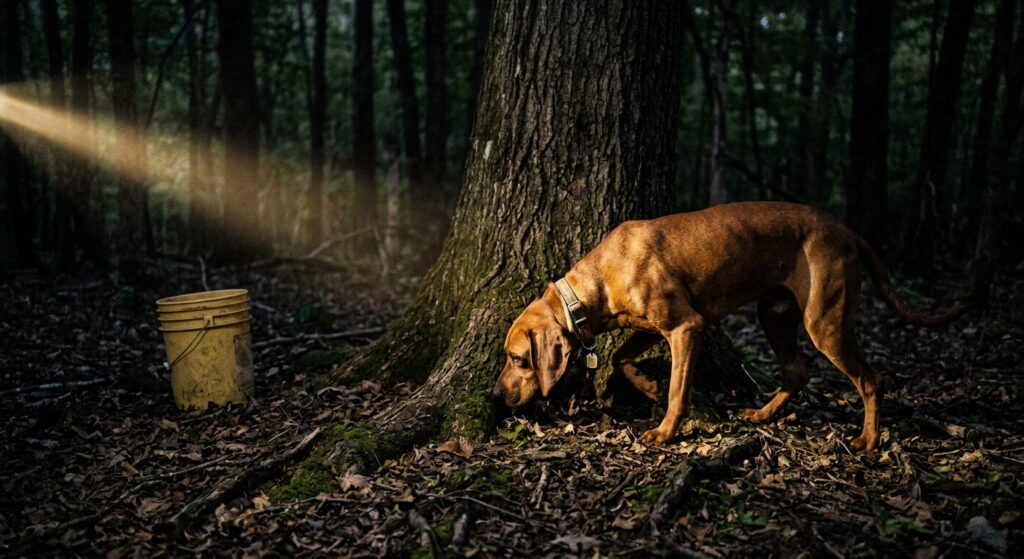
You already know the coons are there. You baited a bucket a few nights back just to check the dog’s work, and when you finally walked in, there they sat, right above it. The dog had the scent the whole time. It just would not close.
This isn’t the first time either. The last few trips out, same pattern: the dog works a circle, sometimes fifty yards wide, and stays in it. No bark change, no commitment, nothing that tells you the tree’s been found until you’re standing next to the dog. The second you walk in, it pushes on and trees clean. It’s not that the dog can’t find the tree. It won’t finish the job without you there.
That’s a different problem than a dog that’s lost, and a different problem than a dog that’s guessing. A guessing dog slams the first tree it runs into and barks confident on nothing. Your dog is doing the opposite. It’s accurate and unsure at the same time, and that combination almost always traces back to two things: what a baited site actually does to a scent picture, and what the dog has learned about when it’s safe to commit.
What a Feeder Actually Does to the Scent Picture
A natural find usually gives a dog one track to work, laid down within the last few hours, getting fainter the further it sits from the tree. A feeder is a different animal entirely. If that bait has been down more than a night or two, the dog isn’t working one raccoon’s scent, it’s working every raccoon that’s found a reliable meal there and kept coming back. Iowa State University Extension notes that steady food sources like this keep raccoons returning to the same spot repeatedly, night after night, which means the ground around that bucket is carrying layers of old scent stacked under fresh scent, not one clean trail.
That ground scent spreads out and pools around the base of the tree in a wide, even halo, and a halo like that is easy to follow and hard to leave. Circling it is actually the correct, honest read of what’s on the ground. The problem is the coon scent that needs pinning isn’t on the ground anymore, it’s twenty feet up a trunk, and following an easy circle is a lot less committing than trusting a thinner scent line straight up into the dark.
Add in the bucket itself, plastic and feed smell sitting where it doesn’t belong in a natural setup, plus your own scent from the trip you made to set it, and the dog is sorting through more variables at that tree than it would on a natural find. None of that means anything is wrong with its nose. It means this is a harder puzzle than the ones it’s used to solving clean.
There’s a second piece worth being honest about, and it’s not about scent at all. The fact that the dog pushes on the moment you arrive means the finish, not the find, is where it’s stuck. Some of that is just age and reps. A young dog, or one still building trust in its own reads, will often wait for the same signal that’s worked before. If you’ve been the one closing that last stretch every time, the dog has learned that’s part of how the job gets done, the same way it might learn any other routine you’ve unintentionally built into the hunt.
It’s worth addressing the two coons directly, since that detail usually raises a fair question. Two animals in the same tree ought to mean more scent at height, not less, so why would the circling still happen? Because volume at the source doesn’t beat volume on the ground. Two coons feeding at that bucket over multiple visits adds even more to the ground halo than a single coon would, on top of whatever scent they’re throwing off from the tree itself. More coons at a reliable food source doesn’t simplify the picture, it thickens the exact part of the scent picture the dog is already leaning on instead of the part it needs to commit to.
Weather plays a role too, just not the way it might seem. Calm, humid air is generally good scenting air, it holds scent well instead of scattering it, which is exactly why it also holds that ground halo together instead of breaking it up. A soft, moist night doesn’t shrink the circle on its own, it can just as easily make the whole scent picture, halo included, easier to read and easier to stay in. What actually works against the dog is harsh weather, a hard wind, bone-dry air, or frozen ground, all of which make scent harder to sort out for every dog, not just a hesitant one. Save the confidence-building work below for calm, favorable nights, not because the weather fixes the circling, but because a hesitant dog deserves its best shot at a clean, encouraging finish while it’s relearning to trust its own nose.
Teaching the Dog to Close the Last Twenty Yards Alone
The fix isn’t more pressure at the tree. It’s giving the dog more chances to finish the job without you standing next to it when it happens.
Start by not walking in the instant the circling starts. Give the dog real time, longer than feels comfortable, before you close the distance. If you move in at the same point in the circle every time, that’s the exact moment the dog is learning to wait for. Some nights that means standing back and letting the circle run its course a few extra minutes before you step in to help.
When the dog finally commits, whether that’s on its own or after you’ve walked in, the praise needs to land on the moment the bark changes over, not on the tree itself. If you praise the whole sequence as one event, the dog can’t tell the difference between finding the circle and finishing the job. Time it tight to the change in voice, not to your own arrival.
Pull bait sites out of the regular training rotation for a while. Let the dog cut its teeth on natural finds, a single fresh track with a cleaner scent picture, so it’s building confidence on straightforward reads instead of the layered, confusing kind a well-used bucket produces. Bring the harder, baited puzzles back into rotation once the dog is finishing clean on the easy ones consistently.
Build in more solo work generally, not just at this one tree. A dog that leans on the handler to make the final call needs reps making that call alone, in low-pressure situations where a hesitant finish costs nothing. That’s the same independence a coonhound that trees hard in company but not alone is missing, just triggered by your feet showing up instead of another dog’s.
Structure a few hunts this month around known, easy ground before going back to that bucket. A creek bottom or fencerow where you’ve had clean, quick finds before gives the dog a string of straightforward wins to build on. Save the harder, baited puzzle for after that streak, not before it, so the dog is walking into the tough scent picture with some recent confidence behind it instead of another round of the same hesitation.
Give it time across more than one outing before you judge whether any of this is working. One clean solo finish on an easy track doesn’t undo months of a learned pattern, and one more circling night doesn’t mean the fix failed. Look for the circle getting narrower and the wait getting shorter over several hunts, not a single overnight change.
Where Handlers Make This Habit Worse
The biggest mistake is becoming the missing ingredient without meaning to. Walking in fast every time the dog circles feels like helping, but it’s practice at waiting, not practice at deciding.
Right behind it is muddy praise. Petting the dog up and calling it good the moment you arrive, before it’s actually changed over on the tree, teaches it that your presence is the reward, not the commitment itself.
Don’t mistake this for a guessing problem and start correcting the dog at the tree. Guessing dogs slam trees fast with no real work behind it. This dog is doing real work, methodically, and getting it right. Correcting a dog for being accurate but hesitant teaches it to distrust a read that was already correct, which makes the problem worse, not better.
Leaning on bait sites as the main training ground is another one. They’re useful for confirming what’s in an area, but they’re a harder scent puzzle than most natural hunts, and a dog that only ever practices on hard puzzles doesn’t get the reps it needs on easy ones to build the confidence this problem actually depends on.
Last, don’t measure this dog against an older, more settled dog in the truck and assume something’s off. A dog still building trust in its own nose is not the same as a dog with a training flaw. Some dogs take a full season or two of clean finishes before they’ll close that gap without a handler standing there, and that’s normal, not a red flag worth worrying over.
Do This / Don’t Do This
Do: Give the dog extra time in the circle before closing the distance.
Don’t: Walk in at the same point every time it starts working scent.
Do: Time praise to the exact moment the bark changes over.
Don’t: Praise the whole approach, tree included, as one lump reward.
Do: Run natural finds for a while to rebuild confidence.
Don’t: Lean on baited sites as the regular training ground.
Do: Build in low-pressure solo reps away from this specific tree.
Don’t: Correct circling when the dog is actually reading it right.
Do: Factor age and experience into how fast this should close.
Don’t: Compare finish speed to an older dog’s and assume a flaw.
What to Try on Your Next Hunt
- Let the dog run a full circle without you closing in, time it, and see how long it actually takes before you help
- Praise only the moment the bark changes over, not the walk-in or the tree itself
- Pick one or two natural finds this week instead of hunting back over the bait bucket
- Give the dog a short solo push on an easy, low-pressure track away from that tree
- Save the solo confidence-building reps for calm, favorable nights, not harsh wind or bone-dry conditions
- Track the circle’s size and the wait time across several hunts instead of judging off one night
A dog that’s accurate but hesitant isn’t broken, and it isn’t guessing. It’s telling you exactly where the coon is and asking you to trust that the hard part is already done. Back off the last twenty yards, time the praise to the real moment it happens, and give the dog the reps to finish it alone. This is the same patient work behind any solid coonhound training program, just aimed at the last twenty yards instead of the first. The dog already found the tree. Teach it that it doesn’t need you to know it.