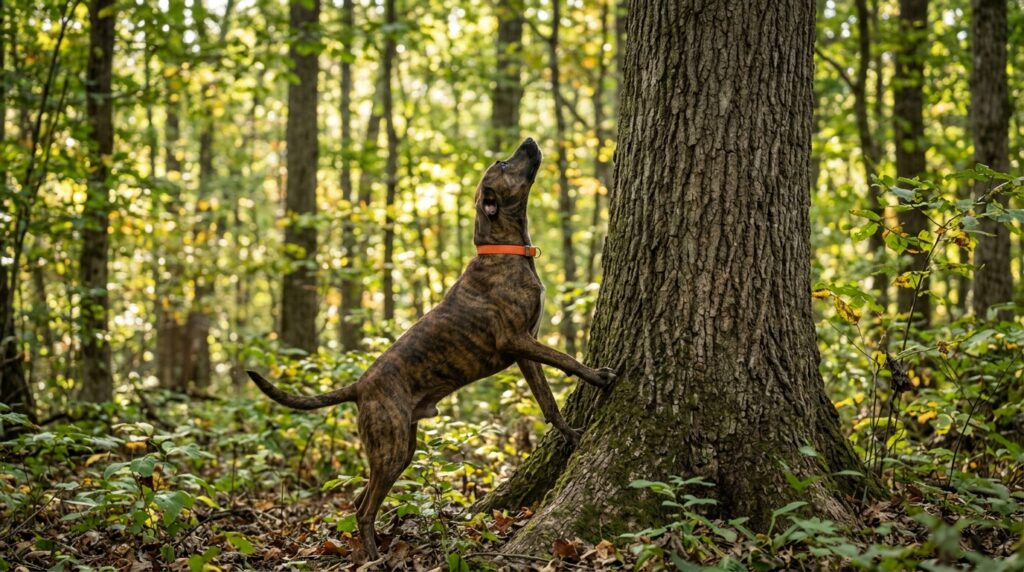
You picked the dog up on a Saturday morning and paid what the seller asked. He called it a started dog, and you believed him, because that’s the word everybody uses. Two cuts later, before the dew’s even burned off the ground, that dog’s made three trees and only one of them had a squirrel in it. You start doing math in your head. Is that a bad dog? Did you get taken? Should this dog already be treeing better than this?
Here’s the part nobody tells you when money’s already changed hands: the word “started” doesn’t mean what you think it means, and it never has. One seller’s started dog chased a yard squirrel one good time. Another seller’s started dog is treeing three or four squirrels a week and getting it right about a third of the time. Both dogs get called the same word. That gap between the two is exactly why so many handlers get frustrated early in squirrel dog training, not because the dog is bad, but because nobody handed them an actual definition to judge it against.
If you bought a dog that’s actively hunting and treeing some, missing more than it hits, that’s not a red flag. That’s what started actually looks like. The problem isn’t the dog. It’s that you were sold a label instead of a definition, and now you’re trying to judge a young dog against a standard nobody ever gave you.
What the Word “Started” Is Actually Selling You
“Started” isn’t a certification. There’s no test a dog passes, no association that signs off on it, no minimum number of trees a dog has to get right before somebody’s allowed to use the word. It’s a snapshot, and every seller takes it from a different angle.
For a squirrel dog specifically, a fair working definition looks like this: the dog is actively hunting, ranging out, using its nose and eyes, and treeing squirrels with some regularity, not just barking at leaves and running the fence line. Somewhere around thirty percent accuracy, meaning it’s right about one time in three when it commits to a tree, is a normal place for a started dog to sit. That’s not a finished dog’s number. It’s a young dog’s number, and it should tell you the dog has genuine ability and genuine interest, not that anything’s broken.
What that thirty percent actually represents is a dog still learning to sort real, fresh scent from everything else moving through the woods that morning. Squirrels double back. They cross into another tree before the dog gets there. A dog with plenty of nose but limited miles under it hasn’t built the pattern recognition yet to tell the difference between a squirrel that’s still up there and one that left ten minutes ago. That skill comes from reps, not from age and not from a single good outing.
This is also where the misjudging usually starts. Bad habits, not a slow accuracy climb, are what actually ruin a young dog’s development. A dog hunted too hard, too early, or pushed to look better than it is, learns the wrong lessons fast. That’s the real danger zone for a started dog, not the missed trees. For the fuller picture on how those early mistakes get baked in before a handler even notices, see The Mistake That Ruins More Young Squirrel Dogs Than Anything Else.
Judging the Dog You’ve Got, Not the Label You Paid For
The fastest way to misjudge a started dog is to draw a conclusion off one hunt. A slow morning after a hard rain or a hot, dry midday isn’t a fair test. Give the dog a real sample, five or six hunts minimum, across different mornings and conditions, before you decide anything about what you actually own.
Hunt it alone for at least part of most trips. A started dog run constantly alongside an older, finished dog will look better than it is, because it’s reading that dog instead of doing its own work. You want to know what your dog can find and commit to on its own nose, not what it can follow another dog to.
There’s real science behind why the reps matter so much. Research on detection dogs found that dogs given rigorous, repeated training exposure showed measurably higher accuracy than dogs without that volume of trials, and the improvement tracked with the number of reps more than with time on the calendar (PMC, Rigorous Training of Dogs Leads to High Accuracy in Human Scent Matching-To-Sample Performance). A squirrel dog treeing in the timber isn’t doing lab work, but the underlying mechanism holds: repetition builds discrimination. The dog needs enough trees, right and wrong, before it can reliably tell the difference.
Watch how the dog handles a miss, too. A started dog that shakes off a bad tree and keeps hunting is building the right pattern. One that shuts down after a miss needs a different kind of handling, not a different definition of started.
Pay attention to what the dog does before it commits, not just whether the tree turns out right. A dog that works a scent line, circles a trunk, and settles on the correct tree after real effort is doing exactly what a started dog should be doing, even on the mornings it gets the wrong tree. A dog that guesses fast off a cold trail and barks up the first thing it passes is a different situation, and it usually means the dog is being rewarded for noise instead of accuracy somewhere along the way. Slow that down before it turns into a habit, and the accuracy numbers tend to follow.
Where Handlers Misread a Started Dog
Most of the frustration with a started dog traces back to a handler error, not a dog problem. Expecting instant reliability because a seller used the word loosely. Judging the dog off a single bad morning. Comparing its tree work directly to an older, finished dog’s without accounting for the difference in miles. Correcting hard for a miss before the dog’s had enough reps to know better, which teaches hesitation instead of accuracy.
If the dog isn’t checking trees at all, rather than checking them and missing, that’s a different problem with a different fix, and it’s worth separating from a straightforward accuracy issue. That gets covered in Why Your Squirrel Dog Won’t Check Trees, And How to Fix It.
Most of the time, a started dog’s low accuracy is right where the dog is supposed to be at this stage. But it’s worth saying plainly: not every dog closes that gap. Some dogs put in the reps, get the daylight hours, get handled right, and still don’t tighten up past a certain point. That’s not always a training failure. Sometimes the nose and the desire are there but the finishing ability just isn’t, and a handler pushing harder on a dog that’s already getting what it needs isn’t going to manufacture accuracy that isn’t in the breeding. That’s a hard thing to sit with after the money’s already spent, but it’s the truth, and pretending otherwise does the dog and the handler both a disservice.
In the Field
Do This
- Track results across five or six hunts before drawing any conclusion
- Hunt the dog solo for at least part of most trips
- Give credit for genuine interest and independent range, not just confirmed trees
- Keep evaluation hunts in daylight hours, morning through midday, when scent conditions are workable
Don’t Do This
- Don’t judge the dog off one hunt, good or bad
- Don’t run it constantly behind an older dog and call that progress
- Don’t correct hard for a miss on a dog that hasn’t had enough reps yet
- Don’t compare its treeing percentage directly to a finished dog’s
Try This on Your Next Few Mornings
- Keep a simple tally: trees run versus trees with a squirrel actually in them
- Plan at least one hunt this week without another dog along
- Note the time of day and conditions that produced the better tree work
- Praise genuine effort on a miss the same way you’d praise a hit, early on
- Give it a full six to eight hunt sample before deciding anything about the dog
A started dog is exactly what the name says. Started. Not proven, not finished, not done learning. Thirty percent accuracy on a young dog that’s genuinely hunting and genuinely trying is a dog worth keeping and worth building on, not a dog worth doubting. What separates the ones that turn into real squirrel dogs from the ones that stall out usually isn’t talent. It’s whether the handler judged the dog fairly along the way, gave it the reps it needed, and let the accuracy come in on its own schedule instead of forcing it. Put the work in on your next few mornings in the timber, keep track honestly, and let the dog tell you what it’s actually got. The best practice and the most important advice I can give is, GO HUNTING WITH THE DOG BEFORE YOU AGREE TO BUY IT. That is the only way to get an idea of what your getting into. It’s still not bullet proof. The dog can still have good days and bad, but at least you can see what the dog is in the woods.